
Updated / Tuesday, 4 Aug 2026 13:08

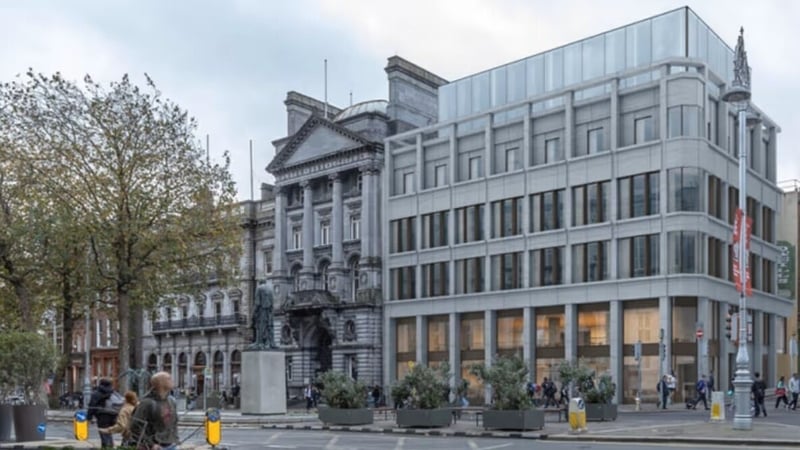
Plans for a new five-star luxury hotel on College Green in Dublin have been put on hold over objections that the development will be the equivalent of “dropping a glass-fronted portacabin” on the roof of a historical listed building.
An appeal has been lodged with An Coimisiún Pleanála over the decision of Dublin City Council to grant planning permission for the change of use of the Ulster Bank building at 30-33 College Green with the development of a 97-bedroom hotel which also fronts onto Church Lane and Suffolk Street.
The proposed new six-storey hotel, which will have a bar, café and restaurant at ground and mezzanine levels, is being developed by Figs Properties – a company owned by businessman and entrepreneur, Deepak Sharma.
The plans also provide for a spa and gym as well the demolition of the existing 5th floor slab and its replacement with a glazed domed roof structure that will function as a rooftop bar.
The appellant, Phillip O’Reilly, questioned if the development was “the best that can be done for this prominent and important site in the city surrounded by so many important, significant and historical buildings”.
Mr O’Reilly, who is a resident of Harold’s Cross, claimed the proposed upward extension of the building totally disregarded the built environment of the area.
“As proposed this development is tantamount to plonking a portacabin on top of the existing building and this is not acceptable,” he observed.
Mr O’Reilly claimed a condition imposed as part of the grant of planning permission requiring the developer to submit revised drawings to further set back the 5th floor level of the building was “not adequate”.

He said the proposed roof extension was not going to “resolve the overwhelming negative impact that this proposal will have on this architecturally important area.”
Mr O’Reilly said the elevations of the building were already “visually incongruous and visually abhorrent” while the situation would be “seriously exacerbated” by “plonking a glass fronted cage” on top of it.
“There is a serious need for a rethink here,” he added.
He claimed the development needed to be reduced by one storey as well as having a complete redesign of the roof components.
Mr O’Reilly pointed out that Dublin City Council’s decision to grant planning permission for the roof extensions was totally inconsistent with a ruling two years earlier when it comprehensively rejected an application for a similar hotel development on Dame Street.
Consultants for Figs Properties said the plans responded sensitively to the context of the location by incorporating both the 1800s protected structure and preserving the 1975 addition which has a “modernist” appearance which would establish a coherent relationship with adjacent buildings.
They claimed the proposed development would bring unused vacant offices back into active usage on a prime street in Dublin city centre.
Addressing any issue about an overconcentration of hotels in Dublin city centre, they pointed out that less than 12% of the entire stock of hotel bedrooms in the capital is located within a 1km catchment area of College Green.
They claimed the area would benefit from a high-end hotel with ample food and beverage as well as leisure facilities.
A report by Dublin City Council planners noted the current state of the building as vacant office space in a prominent city centre location was “regrettable” and had resulted in an increase in anti-social behaviour due to the lack of passive surveillance.
In an earlier submission to Dublin City Council, An Taisce said the proposed refurbishment of the protected structure was “welcome in principle”.
However, the heritage body observed that the visual impact of the development on Andrew Street was “considerable” and recommended that the plans should be reduced by one floor or stepping the proposed two-floor extension.
A ruling on the appeal is expected towards the end of 2026.