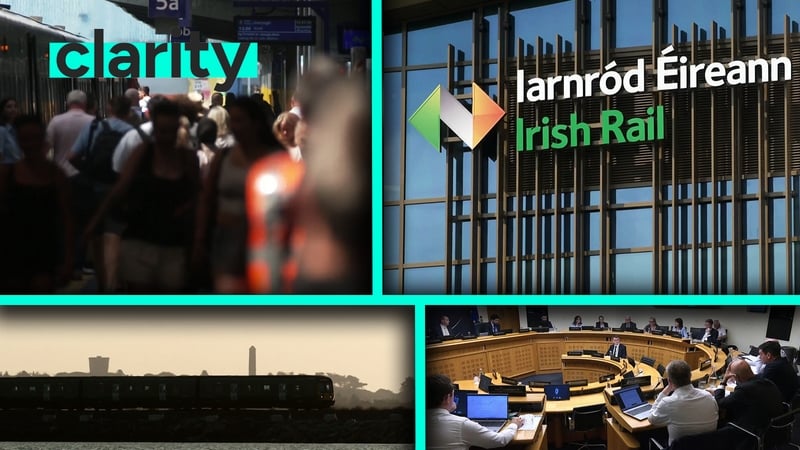
Officials from Iarnród Éireann and the National Transport Authority were questioned this week at the Oireachtas Public Accounts Committee over how €50m was wasted on a contract for a new train traffic management system.
Members said the €50m represented one of the biggest write-downs in public money ever to come before the Committee. So, how did it happen and what is the impact?
Regular commuters into Dublin’s Connolly Station will know the view from the railway bridge over North Strand Road. It’s where trains regularly have to come to a halt, waiting to enter the station.
The congestion isn’t helped, Mark Gleeson of Rail Users Ireland says, by a train traffic management system that is increasingly out of date.
“At the moment the control system doesn’t result in consistent behaviour or timings. Some days it works great, some days it works dreadfully,” he told Prime Time.
The current control system is decades old and there are large parts of the rail network that it does not cover directly. There is also, as people in Cork or Sligo will attest to, no real-time train information in parts of the country.
“It frustrates passengers that they’re told one thing but go to the station and find out that the train is either cancelled or delayed,” Mr Gleeson said.

Improving efficiency and providing better information were among the reasons Iarnród Éireann launched a project to develop a train Traffic Management System (TMS). It’s also essential for the network’s planned expansion, including the Dart+ extensions to the Dart line.
In 2019, the Government approved the plans for a new National Control Centre (NTCC) at Heuston Station, an updated signalling system, and new TMS software. The contract for the software which would act as the ‘brain’ of the railway network – integrating all the systems together – was awarded to Spanish technology company, Indra.
But while the control centre building was completed in 2022 with computers and hardware installed, there is still no new software to operate the system. A protracted project delivery process has now culminated in Iarnród Éireann seeking to write off €50 million.
How did it get to this?
The rail company said it was led to believe it was purchasing an off-the-shelf product, Indra’s DaVinci software, which would be tailored to the Irish network. But the contractor based the Irish product on a new version of DaVinci which was yet to be fully developed.
The system was to be in place by June 2024, but the timeline became increasingly delayed.
Despite two resets of the project, “upon completion of the comprehensive testing process, it was concluded that the software was demonstrably not suitable for training or commissioning,” CEO Mary Considine told the Public Accounts Committee on Thursday.
“Regrettably, six years on and two years after the original commissioning date, Indra still does not have a developed product fit for safe deployment on our rail network,” she said.
Members of the committee asked why the contract with Indra wasn’t ended much earlier if there were considerable changes to the original plans.
“We weren’t able to identify a clear breach such that we would be able to lawfully stop the contract,” Paul Hendrick, Director of Capital Investments responded.
The multi-million euro write down was described as a “monumental waste of public money” by Fianna Fáil’s Seamus McGrath. On a scale of modern spending controversies, it equates to more than one hundred Leinster House bike sheds, or more than 25 ‘Toy Show The Musicals’.

Indra maintains it has fulfilled its contractual obligations and in a statement this week noted it signed a “contractually binding restart agreement in December 2024 replacing the terms and project plan previously in force.”
Ireland’s rail infrastructure “presents highly complex legacy components,” it added.
“This has made it challenging for both parties to reach agreement on system requirements and integrations, as well as to align documented requirements with the actual network behaviour.”
The company, which said it had more than 20 years experience in Ireland, rejected suggestions of shortcomings in the safety or integrity of its systems.
“The current public narrative does not accurately reflect the reality of the project or the shared nature of the challenges involved.”
It said it was committed to working with Irish Rail to achieve a “successful implementation of the system that meets the expectations of both parties.”
Additional complication
The money wasted on the TMS system is a source of huge frustration, Mr Gleeson said.
“€50m is a lot of money. Two million a year would return catering to the entire rail network. We could have invested in new stations, new platforms, extra car parks. There’s a multitude of things we could have done.”
Brian Caulfield, Professor in Transportation in the School of Engineering in Trinity College Dublin, said Iarnród Éireann’s original plan to complete the system across the country at once, rather than in phases may have been too ambitious.
“Typically when we see transport projects do a big bang, there tends to be mistakes and errors,” he said.
We don’t have to look far for a more successful TMS rollout, he added.

“In 2024 the Northern Ireland National Rail Control Centre was opened. They took an off-the-shelf piece of software and now it’s operating in and around Belfast. The next phase is the rest of the rail network across Northern Ireland.”
Prof Caulfield suggested that the problems with Iarnród Éireann’s TMS project were linked to years of under investment in public transport.
“It’s like the movie ‘Everything Everywhere All at Once’, that’s what we’re doing right now when it comes to transport. We’re trying to deliver Cork Commuter Rail, Metro, Luas projects, BusConnects. The NTA is only so big and there’s only so many projects that they can deliver.”
In its draft accounts, Iarnród Éireann has proposed writing off the €50m in total. The breakdown includes €28m of design and software costs and €17m in project management costs directly connected to the Indra TMS system.
There are elements of expenditure such as the NTCC building which will not be written off as they can be used regardless of whether the Indra software project is continued.
‘Serious red flag’
Yet Iarnród Éireann conceded at PAC that there was further expenditure required including a quarter of a million euro for a review by consultants, EY.
In other words, the full scale of write down isn’t yet finalised.
“There will be additional costs, unfortunately, but we need a train control system and we need to move forward,” Mary Considine told PAC.
Fine Gael’s Grace Boland said it appeared almost as much money was spent on “project support” as was paid to Indra. “That is a serious red flag.”
Raising a new signalling system which is being installed in Cork, Committee chair, Sinn Féin’s John Brady asked how Iarnród Éireann officials planned to avoid “contractor delay claims and internal and external project management costs” of up to €800,000 per month if a TMS was not ready for the Cork system.
Ms Considine said the rail company would be putting forward a case to secure funding to avoid the additional costs which could potentially arise in August 2027.
“We’re 12 months away. There are options and we need to make sure that those options are put in place, that we avoid that cost,” she responded.
And there may be knock-on impacts elsewhere too.
The NTA was quizzed by TDs on whether future transport projects might be delayed because of a gap in funding from the TMS write-down.
“We will have to look across the whole portfolio, across the rail network as well, to understand what is safety critical, what is capacity and work out the things that we would need to change in terms of delivery timescales,” CEO Anne Shaw responded.

The fallout will add to passengers’ frustration at the “inertia of transport projects,” according to Professor Brian Caulfield.
“A 4km Luas line to Finglas is going to take over a decade and it goes through a field, for example. We’re not seeing solutions being delivered quickly enough.”
It will be 2030 before the train management system is complete, Iarnród Éireann has confirmed.
“It’s incredibly frustrating,” Mr Gleeson reflected.
“Passengers want reliable passenger information, and they want more trains. None of those things are available because we’re stuck in this quagmire of contractual delays and unfinished software.”