
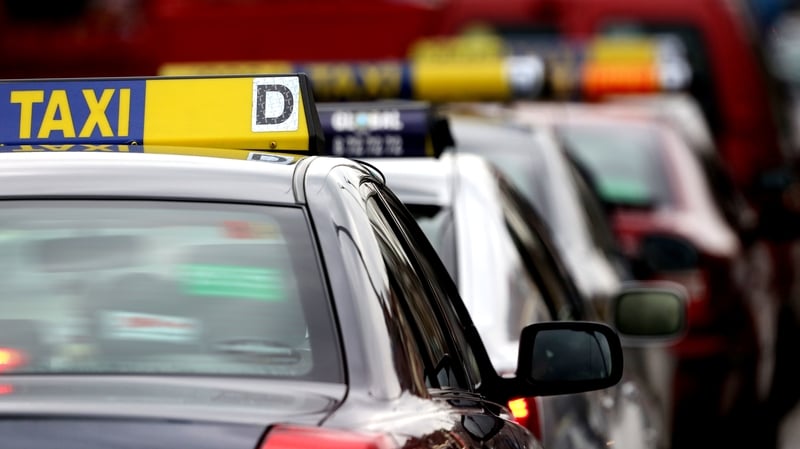
The taxi sector is attracting more new drivers with the highest number on record in 10 years.
A total of 1,893 licences were issued last year, bringing the total number to 27,891.
The National Transport Authority (NTA) said the figures, along with its latest research, shows that there is a “strong interest” in joining the sector.
“We see that business is there and people want to chase that business,” said Director of Transport Regulation Kevin O’Brien.
However, personal safety and antisocial behaviour remain a key reason not to work late nights or at weekends.
Mr O’Brien said there have been changes to the driver entry test to modernise it.
The authority that oversees public transport published a “snapshot” of the sector, based on its latest Small Public Service Vehicle Bulletin and recent taxi driver and consumer research.
There has been a sharp increase in wheelchair accessible vehicles and in the number of electric cars operating as taxis nationwide.
It said that overall availability is improving.
We need your consent to load this rte-player contentWe use rte-player to manage extra content that can set cookies on your device and collect data about your activity. Please review their details and accept them to load the content.Manage Preferences
“Seventy six percent of consumers said it was easy to get a taxi on their most recent journey, while the number of respondents who described the experience as ‘very easy’ increased to 34%.”
For wheelchair users that figure stands at 56%.
There are 4,781 wheelchair accessible vehicles in operation, which comprises of 23% of the total Small Public Service Vehicle (SPSV) fleet and 26% of the taxi and hackney fleet.
The NTA Wheelchair Accessible Vehicle (WAV) Grant Scheme continues to support the growth of an accessible fleet with 519 grants issued last year.
Mr O’Brien said it is encouraging to see improving availability and the high levels of passenger confidence, adding that the NTA is focused on increasing the numbers available to passengers requiring a wheelchair accessible taxi.
Over 1,000 passenger complaints were made last year, with over 50% focused on overcharging.
He said that many drivers offered refunds, adding that everyone taking a taxi should be aware that there is a maximum amount that can be charged.
The advice for passengers is “to keep a receipt”.
The latest research also highlights significant progress in the transition to a more sustainable fleet.
At the end of 2025, there were 3,306 fully electric SPSVs in operation, a 25% increase on the previous year. Drivers reported average savings of €95 per week in running costs when using an electric vehicle.

Passengers also continue to report high levels of safety when using taxi services.
A total of 97% of passengers feel safe while waiting at a rank while 89% feel safe hailing a taxi on the street.
The NTA said the findings will help inform the implementation of the SPSV Regulation Action Plan 2026-2028.
As part of the plan, the NTA will launch a series of public consultations later this year, including on fleet decarbonisation.
It also said it is continuing to make it simpler for people to provide a taxi service in rural areas.
‘I was attacked a few times late at night’, says Dublin taxi driver
Taxi drivers in Dublin gave their reaction to the research showing that there has been a further decrease in the number who are choosing to work late nights at the weekends.
Personal safety and anti-social behaviour were listed as some of the reasons.
One driver waiting at the taxi rank at St Stephen’s Green said he has regularly encountered physical and verbal attacks.
“I was attacked a few times late at night and it is still happening,” he said.
Another taxi driver in Dublin city said he is less inclined to work at weekends because “there are too many taxi drivers”.
He said he is reluctant to join long queues at the ranks unless big events are happening in the city like concerts.
He also said the surge in passengers using apps leave fewer people waiting at a taxi rank or hailing a taxi on the street.
The Taxis for Ireland Coalition has said while it welcomes the increase in licensed drivers, it warns of “significant shortages” and availability challenges, particularly in rural Ireland and at peak times.
A spokesperson said large parts of rural Ireland have seen taxi services decline dramatically or disappear altogether and that it is having a severe impact on the night time economy.