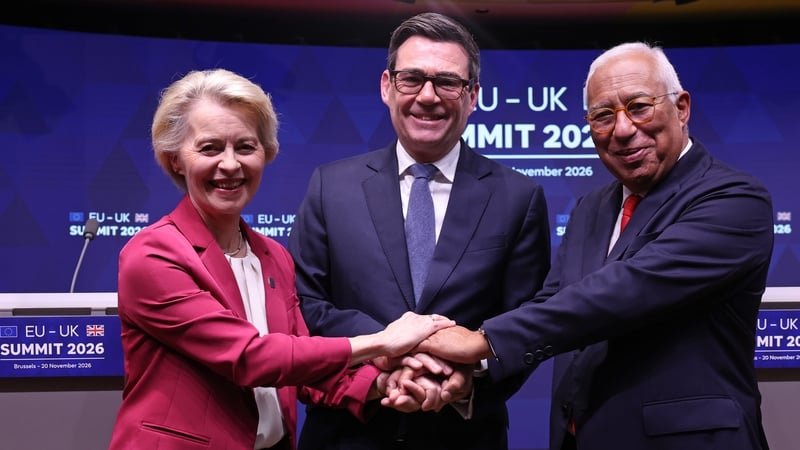
Britain and the European Union sealed deals on easing food trade and boosting youth mobility to reset ties at a summit today, but pushed back an agreement on university tuition fees and left open broader discussions about their long-term relationship.
A decade after Britain voted to leave the now 27-nation bloc, rancour has faded and both sides have recognised the need for a closer alliance as the world order is reshaped by Russia’s full-scale invasion of Ukraine, US tariffs, China’s dominance of critical minerals supply chains, and war in Iran.
“I think we can all confidently say this is a good day for Britain and this is a good day for Europe,” British Prime Minister Andy Burnham told a press conference after the summit. “The agreement that we’ve reached together is a win-win.”
The two sides concluded the summit with agreements on food checks, youth mobility and an emissions trading scheme, but put off for six months a deal on reducing university tuition fees, which the EU wants but Britain has resisted.
Mr Burnham, who was greeted on arrival by a string quintet, has said Britain should consider options for its future relationship including rejoining the EU. On Monday, he said it was an “obvious truth” that Britain had lost more than it had gained from Brexit.
“What we are announcing today is probably the limit of what we can achieve in this parliament, given what needs to be done to implement it,” Mr Burnham said, referring to the time remaining before the next UK election due by mid-2029.
Watch: Burnham hails deal as ‘a good day for Britain and Europe’
Britain and the EU signed three agreements today that change the terms of the Brexit arrangements.
The core package of deals included the establishment of a common Sanitary and Phytosanitary Area (SPS).
This allows cross-border trade in animals, plants and related products, such as sausages or seeds, without the certificates and controls currently required. Britain has estimated this could add up to £5.1bn (€6bn) per year to its economy.
The removal of SPS checks could also ease political tensions in Northern Ireland, where a special regime to protect the open border with the Republic meant checks on food products coming into the North from Britain.
Formalised in the Windsor Framework, most of these checks will be abolished by the agreement, ending the most intrusive aspects of the ‘Irish Sea Border’. It will not end customs paperwork for firms involved in the import and export of food and drink products.
Watch: Europe needs unity, says Costa
A further agreement will link the emissions trading systems of Britain and the EU, which would exempt British and EU goods, such as steel, from each other’s border carbon levies.
Each side is also set to allow the other’s young people in to work or study for three years, but here divergences are clearer.
Britain, mindful that immigration was a factor in the Brexit vote, had proposed letting in only 50,000, but has agreed to 100,000, EU diplomats said.
At the moment EU students going to the UK have to pay full international student fees, which are multiples of the cost charged to UK nationals.
The EU wants a reciprocal arrangement, under which EU citizens pay the same as UK citizens, and vice-versa.
The arrangement does not affect Irish students, who can avail of UK education at the same cost as UK nationals under the Common Travel Area arrangement, which predates EU membership for both countries.
UK students benefit from the same arrangement when studying in Ireland.

The EU-UK deals are to apply from 2028, with the first young people able to benefit from youth mobility by 2030, a joint summit statement said.
The EU says it is aiming to begin implementing the three new agreements on 1 March 2028, but the EU has indicated the food imports, emissions trading and youth mobility deals will be on hold until a deal is done on university fees.
The two sides have agreed to try and settle the issue within six months.
Then there is the topic of Britain accepting EU rules, a sensitive issue for opponents of EU membership.
A key UK demand is that the EU grant it special status under the bloc’s ‘Made in Europe’ rules, notably for cars. The EU has indicated it is willing to grant this, but only on condition that Britain align with its policies, which restrict imports of Chinese electric vehicles.
The draft joint statement had featured conflicting lines from Britain and the EU about the extent of coordination.
The final agreed wording said that, in sectors where cooperation had been agreed, Britain would “ensure outcomes consistent with relevant EU measures” to protect sectors and guard against circumvention.
This seems to allude to a Franco-German proposal that EU public money could be spent on British cars, through public procurement or subsidies, if Britain agreed to dynamic alignment with EU trade protection measures.
That could mean Britain adopting measures the EU has taken to restrict imports of Chinese-built hybrid and battery-electric vehicles, which London has so far been reluctant to do.
Watch: Trading relationship with UK is our ‘most important’ one – McEntee
Deal ‘will deliver real benefits for our citizens’ – Taoiseach
Taoiseach Micheál Martin said the agreement underlines an ambition to deepen co-operation across a range of areas such as energy and economic security, as well as foreign, security and defence policy.
“The outcome of today’s summit is warmly welcomed and marks a significant step forward in ensuring a strong and close relationship between the EU and the UK,” he said.
“Once implemented, the package of agreements announced today will deliver real benefits for all of our citizens with easier trade, better environmental co-operation and opportunities for hundreds and thousands of young people to experience living and working in the EU and the UK,” said Mr Martin.
Minister for Trade Helen McEntee said the SPS deal will make a real difference for people in Northern Ireland.
“Today’s EU-UK summit marks a significant milestone in further strengthening EU-UK relations. Collectively, these will deliver real positive change for citizens and businesses across the UK and the EU,” she said.
“I am conscious that today’s summit also represents a positive moment for Northern Ireland citizens and businesses. I am pleased that the EU and UK, once again, have recognised the ongoing need to account for the unique circumstances on the island of Ireland.”
Read more: What the EU-UK deal on food means for Ireland
Meanwhile, a Sinn Féin spokesperson said: “Brexit has had severe economic consequences and created a burden for business in terms of checks and paperwork.
“After a decade it is a welcome step forward to ease both the trading implications, but also the political damage done by the Tories.
“We are in a new era in terms of all-Ireland trade which has really increased, and those benefits are quantifiable. This deal – if it reduces paperwork, checks, costs and delays – is good news.”
Additional reporting: Reuters


