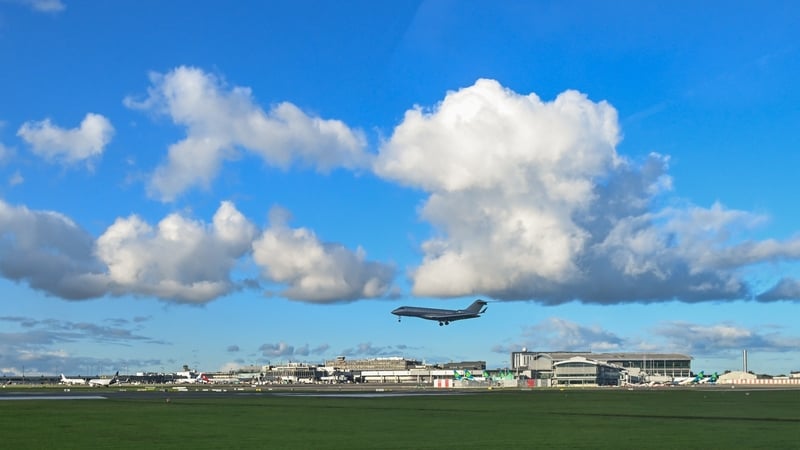
Analysis: Ireland controls 451,000 square kilometres of airspace and is a key gateway to the North Atlantic, so what does our air traffic control system look like?
Most of us never give air traffic control a thought. We board a plane, sit down and expect it to arrive safely and usually on time. Then on Friday 13 November, the US Federal Aviation Administration (FAA) ordered a nationwide ground stop which halted every US departure for more than four hours, the longest shutdown since 9/11. More than 9,000 flights were cancelled that day. Ireland controls 451,000 square kilometres of airspace and a key gateway to North America and the North Atlantic, so it’s fair to ask whether it could happen here.
What went wrong in the US?
The investigation is still going, but a picture is forming. The FAA stopped departures because it couldn’t trust the data in front of controllers, which was the safe call. Transportation Secretary Sean Duffy said a router fault may have occurred during contractor work on an FAA telecoms line, as older copper lines were being replaced with fibre. FAA sources told CBS the trouble was limited to Cisco 600 series routers built between 2001 and 2006, which began feeding out-of-sync data into the wider system. That meant static on voice lines and flickering screens for controllers, though every aircraft in the air landed safely.
We need your consent to load this rte-player contentWe use rte-player to manage extra content that can set cookies on your device and collect data about your activity. Please review their details and accept them to load the content.Manage Preferences
From RTÉ Radio 1’s The Business, what was behind the weekend’s US air travel chaos?
Investigators haven’t yet worked out whether it was human error, an installation mistake or faulty equipment. Officials said earlier that new security patches had overwhelmed the old routers, so the accounts don’t fully match. There is no evidence of a cyberattack, though nobody has ruled it out. The contractor, L3Harris, says it is supporting the investigation, and Duffy is using the episode to demand about $50bn to replace the whole system.
The likely culprit is probably a change made to an ageing, shared network, not a radar or a radio. It also fits a warning on record. That network is run by a contractor under an agreement dating back to 2002, and a 2023 FAA-commissioned review, reported by CBS, called it obsolete and warned that a failure could cut off a whole regional centre.
Were floppy disks to blame?
No, that’s a distraction. A week earlier, the FAA announced it would retire floppy disks used for weather and operational information at more than 400 facilities, with the new system due at 435 sites by the end of 2028. That is a separate system. The disks make a good headline, but the real lesson is how hard it is to modernise something while it keeps running.
From the Federal Aviation Administration a week ago, plans to retire old floppy disks to make way for a new system
What does Ireland’s system look like?
Different. AirNav Ireland provides air traffic management services in the airspace controlled by Ireland and it has nine radar sites with duplicated coverage, using eight Mode-S radars and three solid-state primary radars. Their data is merged at the Shannon and Dublin centres, which can cover for each other.
AirNav was the first provider to commission COOPANS, the system it shares with several European partners. There is an independent emergency display as a fallback. For voice, there is a fully independent radio backup at separate sites, a separate emergency voice switch, and as a last resort, handheld radios kept as a “fourth line of defence”.
So are Irish skies immune?
No, and the reason is worth understanding. AirNav says its core data network is designed for maximum redundancy and routing diversity, and I’ve found nothing suggesting otherwise. But the same network carries radar data, voice and flight data between its sites and centres. That is the kind of shared layer where America’s failure happened, which is a reason to ask how independent the backups are, not a claim that they’re weak.
We need your consent to load this rte-player contentWe use rte-player to manage extra content that can set cookies on your device and collect data about your activity. Please review their details and accept them to load the content.Manage Preferences
From RTÉ Radio 1’s Oliver Callan Show, what’s it like to work as an air traffic controller?
The record shows why. In 2023, a corrupted file that crashed the FAA’s alert system was also found in the backup. In September a software defect at the UK provider NATS, which an initial report said happened in “the space of a millisecond”, cancelled more than 2,000 flights, including dozens in and out of Dublin. As I wrote in an earlier piece, that was a failure at someone else’s centre and it still disrupted ours. Two weeks later, a separate NATS issue delayed 140 Ryanair flights.
Is there a safety net across Europe?
Partly. EUROCONTROL runs a crisis coordination cell that can be activated when major providers become unavailable. There is also a European air traffic management cyber response team that coordinates responses to cyber incidents, though on a voluntary basis. Both help with coordination, but neither can fix a failed system for anyone.
Friday wasn’t an argument against technology, but an argument for assuming it will fail and designing for that. Fair play to AirNav Ireland for publishing this much detail, but a published design is not the same as a proven one and we need a public independent assessment of how its backups work together under real pressure, which is better done on a quiet Tuesday than in the middle of a primetime failure. Passengers don’t need to understand ARTAS or COOPANS. but do need to know that someone is checking and testing.
Follow RTÉ Brainstorm on WhatsApp and Instagram for more stories and updates
The views expressed here are those of the author and do not represent or reflect the views of RTÉ