Updated / Monday, 9 Nov 2026 12:30

Getty
Analysis: One of the biggest challenges when it comes to wind and solar power is how to store this energy for later use
Energy storage is arguably the biggest challenge in green energy adoption. It is critical if we are to balance our national grid and reduce dependency on imported energy. Currently, we are wasting 15% of green energy produced in Ireland, which is enough to power 660,000 homes. This is primarily caused by high generation of wind farms at night when demand is low. This creates a problem that is simple in concept, but extremely challenging at a national grid level: how do we store this energy for later use?
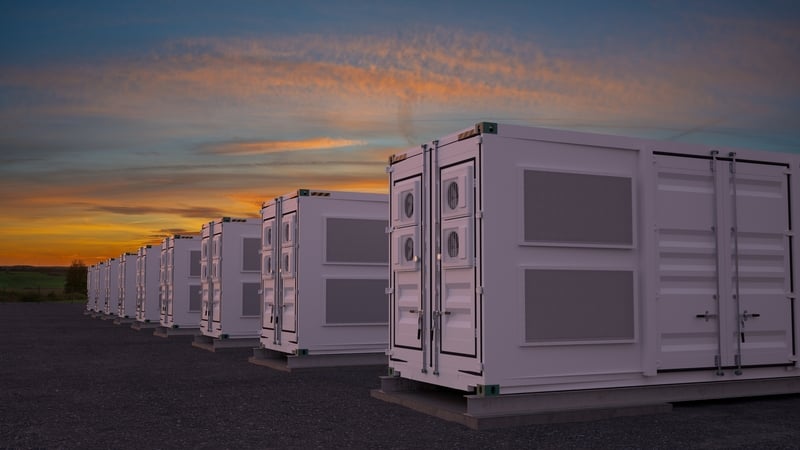
Ireland has some examples of success in this regard. We have created multiple large scale batteries including pumped hydro storage in the Wicklow mountains and one of the world’s largest fly wheel systems at Moneypoint in Clare. These types of storage differ from the lithium-ion batteries that power most of our devices. They essentially store energy by moving mass. Both have different strengths and weaknesses, but if we are to meet our emissions targets and secure our energy security more storage using different forms of technology is needed.
Rust battery
A recently launched project in partnership with US company Form Energy and Irish company FuturEnergy will use a new approach to storage in the form of the Ballynahone Energy Storage iron-air battery project. The battery system will be located southwest of Buncrana, near the Trillick substation in Co Donegal and will create 1,000 MWh which could power approximately 87,000 homes for 24 hours. While grid scale battery systems are not unusual, the technology used in Donegal is unique and very different to more common lithium ion systems. This battery technology, in the simplest terms, is able to draw electricity from iron as it rusts (oxidises). Recharging the battery reverses this chemical reaction.
We need your consent to load this rte-player contentWe use rte-player to manage extra content that can set cookies on your device and collect data about your activity. Please review their details and accept them to load the content.Manage Preferences
From RTÉ Radio 1’s Morning Ireland, why the move to renewable energy has been so slow?
Because the battery is mainly made of iron, air and water they are very cheap to manufacture and easy to recycle at end of life, which is approximately 20 to 30 years of use. The graph compares the cost of different energy storage technologies per kilowatt-hour, highlighting a wide range of expenses across various systems.
Iron-air batteries by Form Energy emerge as the most cost-effective option at an estimated €30 per kWh, while standard lithium-ion (LFP) and pumped hydro systems occupy the mid-range. In stark contrast, mechanical flywheels stand out as significantly more expensive than the rest, but are useful in specific grid balancing applications. The very low cost of storage makes this look like the ideal solution.

So what’s the catch?
As with all technological solutions, there are advantages and disadvantages. These need to be carefully considered, especially when technology has not yet been widely proven beyond manufacturer testing. One of the main draw backs for iron air batteries is the amount of energy lost during a charge and discharge cycle.
This is often referred to as round trip efficiency. Early reports suggest that iron air can achieve approximately 50% efficiency which means that half the electricity used to charge the battery is lost. By comparison, lithium ion can achieve 85-95% efficiency in grid scale use and pumped hydro can achieve approximately 75% efficiency. Iron air also has a lower discharge rate than lithium ion. It is designed to discharge over 50 to 100 hours.
You could consider iron air like a tractor that can draw a large load of electricity to the grid slowly, where lithium ion is the expensive sports car that can get there quickly, but with a much smaller load. These are two very different technologies used for different energy needs. Both of these battery types, in addition to a wide range of other energy storage devices, will be needed in order to create a reliable green energy system that can cope with intermittent generation.
We need your consent to load this rte-player contentWe use rte-player to manage extra content that can set cookies on your device and collect data about your activity. Please review their details and accept them to load the content.Manage Preferences
From RTÉ Radio 1’s Morning Ireland, what are the challenges facing transition to renewable energy?
We urgently need to develop more wind and solar, but without supporting storage systems like the project in Donegal we will not be in a position to reduce our dependence on fossil fuel generation that is currently the primary solution to intermittent energy generation.
While the round trip efficiency issue remains, it is important to remember that oil and gas electricity generation ranges from 40-60% efficient and results in considerable CO2 emissions. No energy generation or storage option is perfect, and we cannot afford to allow perfect to be the enemy of the good when it comes to securing Ireland’s energy independence.
Follow RTÉ Brainstorm on WhatsApp and Instagram for more stories and updates
The views expressed here are those of the author and do not represent or reflect the views of RTÉ
More stories on