Analysis: It’s vital that the infrastructure and organisational arrangements developed for yesterday’s challenges remain suitable for tomorrow’s risks
In The Lord of the Rings, Éowyn defeated the seemingly invincible Witch-king of Angmar. When a storm bearing her name swept across Ireland in January 2025, it proved equally formidable, although this time it was electricity poles, power lines and trees that bore the brunt of her force.
Some 768,000 electricity customers lost power. For many, the disruption lasted days; for others, considerably longer. The storm exposed the vulnerability of our electricity network and reminded us how dependent modern life has become on infrastructure we rarely notice until it fails.
We need your consent to load this rte-player contentWe use rte-player to manage extra content that can set cookies on your device and collect data about your activity. Please review their details and accept them to load the content.Manage Preferences
From RTÉ Radio 1’s News At One, Dr Indiana Olbert from the School of Engineering at the University of Galway on the extraordinary power and impact of Storm Eowyn
On 5 November 1946, the first pole in Ireland’s Rural Electrification Scheme was erected in Kilsallaghan, north County Dublin. 80 years later, the extraordinary achievement of connecting rural Ireland presents a different challenge in keeping it connected. This is not just about engineering, but also how organisations recognise changing conditions, mobilise resources and adapt. Management scholar David Teece describes these as dynamic capabilities: sensing emerging risks, seizing opportunities to respond, and transforming how organisations operate. Ireland’s experience of rural electrification, and its response to Storm Éowyn, demonstrates why all three matter.
Understanding the geography we inherited
Ireland’s electricity network was not built on a blank map. In 1841, before the Great Famine, the island supported more than eight million people, many living across an intricate landscape of farms, villages and rural communities. The Famine and generations of emigration transformed that population, but the geography shaped by centuries of settlement endured.
Take Co Monaghan, where I am from. In 1841, it was one of the most densely populated counties in Ireland, home to over 200,000 people. By 1946, when rural electrification began, that population had fallen to just 57,000, a decline of more than 70%. Yet its intricate territorial geography remained. Today, Monaghan has the highest recorded density of townlands on the island, almost twice the national average.

Across Ireland, more than 61,000 townlands reveal an extraordinarily fine-grained geographical landscape, shaped by centuries of settlement and agricultural activity. For the ESB, this presented an enormous logistical challenge. Bringing electricity to a relatively small and dispersed rural population required an extensive network of poles, wires and transformers, often to reach only a handful of households.
The Rural Electrification Scheme divided the State into 792 areas. Timber poles were imported from Finland, depots established and construction crews mobilised across the country. Local communities helped coordinate access, labour and accommodation. It was as much an achievement in logistics and organisation as in engineering.
But successful infrastructure also leaves a legacy. Ireland has approximately 70 metres of electricity distribution network per customer, compared with 36 metres in France and just 24 metres in Belgium. Of Ireland’s roughly 184,000 kilometres of distribution network, more than 155,000 kilometres run overhead, exposed to the elements across a dispersed rural landscape.
We need your consent to load this rte-player contentWe use rte-player to manage extra content that can set cookies on your device and collect data about your activity. Please review their details and accept them to load the content.Manage Preferences
From RTÉ Radio 1’s News at One, why is such wind energy going to waste?
Sensing today’s risks therefore requires understanding not just the next weather forecast, but the geographical and infrastructural inheritance that determines where disruption can occur and how difficult recovery may become.
How to turn knowledge into action
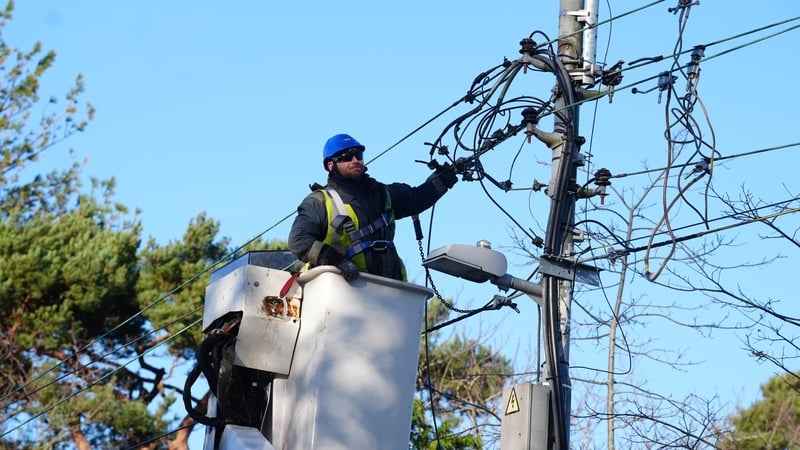
Storm Éowyn demonstrated how quickly one disruption can become several. A fallen tree damages an electricity line, but may also block the road needed by repair crews. Specialist forestry equipment is required before engineers can safely access the site. Meanwhile, households lose heating, water pumps stop working and communications become unreliable. These are not isolated problems. Forestry, transport, electricity and other essential services operate within the same interconnected landscape.
The restoration effort was extraordinary. More than 3,200 crew members, including technicians from seven European countries, were mobilised alongside 1,300 support staff responsible for coordinating logistics, damage assessments and network operations. It was an enormous exercise in emergency logistics, undertaken across a geographically dispersed network under exceptionally difficult conditions.
We need your consent to load this rte-player contentWe use rte-player to manage extra content that can set cookies on your device and collect data about your activity. Please review their details and accept them to load the content.Manage Preferences
From RTÉ Radio 1’s Morning Ireland, Lauren Boland from TheJournal.ie on the Government’s review of the response to Storm Éowyn
But responding effectively after a storm is not quite the same as reducing vulnerability before it arrives. Seizing opportunities for resilience means translating known risks into action. Electricity providers, forestry operators, transport authorities and planners must coordinate information, vegetation management, access arrangements and investment decisions. The challenge is not simply whether individual organisations perform well, but whether decisions made across different sectors improve the resilience of the wider infrastructure system.
How to prepare for future storms
Transformation means more than replacing damaged poles with new ones. It requires asking whether the infrastructure and organisational arrangements developed for yesterday’s challenges remain suitable for tomorrow’s risks.
For Ireland’s electricity network, this should include targeted reinforcement, improved vegetation management and better access for repairs. As wind energy becomes an increasingly important part of our electricity supply, investment in energy storage, grid flexibility and alternative supply arrangements will also be essential.
We need your consent to load this rte-player contentWe use rte-player to manage extra content that can set cookies on your device and collect data about your activity. Please review their details and accept them to load the content.Manage Preferences
From RTÉ Brainstorm, all you need to know about emergency planning (but were afraid to ask)
Yet technology is only part of the solution. As homes and businesses become increasingly dependent on electricity for heating, transport and communications, resilience must become central to how infrastructure is planned, managed and governed, ensuring critical services can continue operating even when the main grid fails.
This urgency is growing. The UN Environment Programme’s latest Emissions Gap Report 2026 concludes that exceeding the Paris Agreement’s 1.5°C warming threshold is now unavoidable, with the challenge shifting towards limiting the extent and duration of that overshoot. Climate resilience is therefore no longer simply about preparing for occasional extreme events, but developing the capabilities to adapt to changing environmental conditions.
Responding effectively after a storm is not quite the same as reducing vulnerability before it arrives
The challenge extends well beyond electricity. Flood management, water infrastructure, transport and telecommunications all depend on organisations capable of recognising emerging risks, coordinating resources and adapting before disruption becomes a crisis.
The achievement of 1946 was an extraordinary exercise in supply chain management, coordinating people, materials, transport and local communities around a shared national purpose. 80 years later, Ireland has the expertise, skilled workforce and organisational capabilities to meet a different challenge: building resilience across an increasingly interconnected and climate-exposed infrastructure system. The question is whether we can bring those strengths together before the next Witch-king-slaying storm arrives.
Follow RTÉ Brainstorm on WhatsApp and Instagram for more stories and updates
The views expressed here are those of the author and do not represent or reflect the views of RTÉ