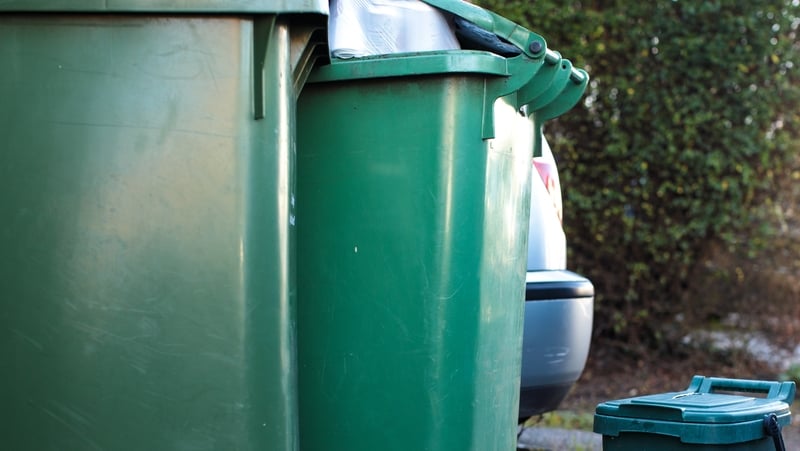
Consumers could face higher waste charges after a Government-commissioned report recommended increasing landfill and recovery levies.
The long-awaited report said the two levies should each “gradually increase” by €100 per tonne and acknowledged the costs would eventually be passed on to householders.
It recommended the introduction of incentivised charging to encourage separation of waste and recycling.
The report by consultancy Tetra Tech said there was a “persistent gap” between Ireland’s recycling rates and its targets.
It said Ireland was falling far short of its EU targets, recycling just 1.3 million tonnes of the 3.1 million tonnes of municipal waste generated in 2023.
This left the State exposed to infringement proceedings, possible fines, as well as other environmental and economic costs.
“Against this backdrop, Government must determine whether Ireland’s current municipal waste collection model is capable of delivering the required step-change in performance, or whether more fundamental reform is required to ensure targets are achieved,” the report said.
It acknowledged that increasing levies and introducing incentivised charging for separation of waste could have “high short term political sensitivity unless communication is exceptional.”
However, it said a “do nothing” approach while politically stable was environmentally untenable and that Ireland would fail to meet its targets.
It recommended following what was described as Scenario 2, which would include higher levies and enforced separate collection of recyclables and organic waste.
It said this could help Ireland meet a target of 65% recycling by 2035 and lead to a significant fall in greenhouse gas emissions.
The report said the increased levies would be “passed through to consumers over time.”
It said that this could hit certain groups harder – multi-unit dwellings with shared bins, rural households with “limited provider options” and households with “limited storage capacity for multiple bins.”
The report also outlined how the country’s bin collection market was becoming increasingly dominated by a small number of companies.
“Entry costs remain high and uncertain, particularly for new entrants needing to acquire customers and establish collection networks,” it explained.
The report said a single waste company held a market share of more than 50% in 16 counties.
In Co Longford, one waste firm served 96% of households while in Fingal in Dublin, one operator held 82% of the market.
The report said the number of rubbish collectors nationally had fallen from 73 in 2015 to just 47 by 2024.
“Rising compliance costs, investment requirements, and market pressures have contributed to this trend,” it added.
Reporting by Ken Foxe


