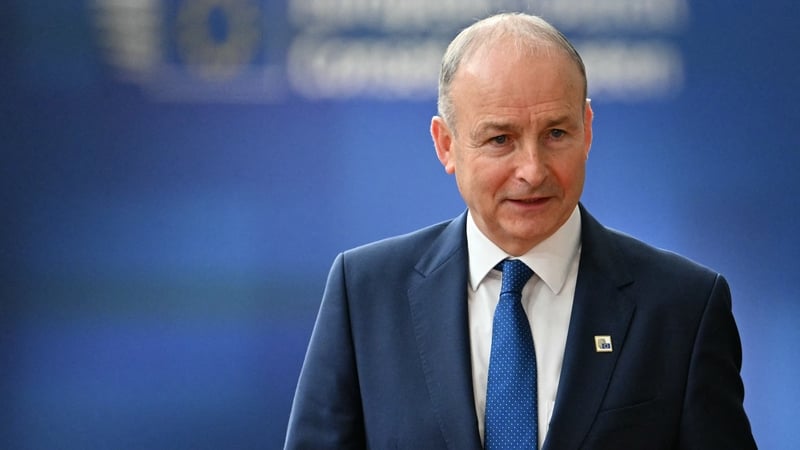
The Taoiseach has denied that the Irish draft seven-year EU budget will make it more difficult to secure the agreement of member states by the end of the Irish EU presidency.
The Government published its draft last Saturday but it has been roundly criticised by member states wanting deeper cuts to the original €1.72 trillion European Commission proposal, and by the commission, which has argued that the Irish draft has removed essential flexibilities and buffers within the seven-year budget.
EU diplomats from the so-called Frugal member states, who want a smaller budget, have cast doubt on the prospects for agreement by mid-December, and the final EU summit of the Irish presidency.
Agreement by then has been regarded as essential because of a swathe of elections next year which could return eurosceptic parties to power in large member states, and because of the timetable to approve the legislation that will allow the budget to take effect from 1 January 2028.
Speaking in Brussels, Mr Martin said he was not picking up the sense “behind the scenes” that agreement would not be reached by December.
He said: “To be frank with you, we were never going to please everybody on this one. In fact, the response you have might be positive in a way in terms of how these negotiations work.
“There is a journey to go. It’s challenging and it’s complex and there’s a wide divergence of opinion between, say, a number of countries which make up 46% of the [national] contributions [to the EU budget].
“Those countries are of the opinion that the [European] Commission budget was too high altogether. They wanted it to come down substantially. We’ve brought it down significantly.
“There are others who want cohesion and CAP protected at all costs. So it’s a very difficult balancing exercise. The function of the [Irish negotiating] box was to be a catalyst to get negotiations going in earnest. That will happen.”

The negotiating process will now be taken up by Antonio Costa, the President of the European Council – which represents 27 EU leaders – and the leaders themselves.
Despite that, the Taoiseach said Ireland would remain a neutral chair on the issue.
“We have the [EU] presidency, so we’re going to be constructive players in respect of getting an outcome to this.
“My view all along has been that a larger budget is required for Europe to retain its objectives. Even though we’re net contributors, we benefit from the single market.
“But that said, this budget, even after the work we’ve done, is still higher than the outgoing budget.
“It’s very clear to us from our consultations that people want to protect CAP and cohesion [funding], but there are other issues that will come onto the table as well that may give more latitude by the time this is all over. So there’s a lot to play for.”
Leaders will also discuss the growing trade tensions with China, the US-Israeli war on Iran and its impact on energy costs, as well as migration and the next seven-year budget.
Also on the agenda will be another spike in electricity prices due to the tightening of global gas and oil market due to the US-Israeli war on Iran, with the coming winter expected to push household bills even higher.
The leaders meet less than a week after the European Commission secured an agreement with the Chinese government to limit imports of hybrid cars from China.
It is a first step in what the EU hopes will be a broader plan to rein in the bloc’s goods trade deficit with China that hit €360 billion in 2025 and is on course to surpass that level this year.
The next EU-China meeting is planned for March.
Draft conclusions from the summit indicate leaders will ask the European Commission to continue its dialogue with China, while also making full use of EU trade defence measures and adding new trade instruments to protect the bloc further.
The summit comes as the bloc grapples with rising economic anxiety, which far-right parties are exploiting in elections.
EU leaders tasked the Commission in June to produce concrete results in trade talks with Beijing by October.
The hybrid cars deal was a first step, but the broader imbalance – spanning chemicals, steel and machinery – remains unresolved.
China has said that hyping up the issue of economic imbalances is an excuse to promote protectionism and exert pressure on and restrict China.
We need your consent to load this rte-player contentWe use rte-player to manage extra content that can set cookies on your device and collect data about your activity. Please review their details and accept them to load the content.Manage Preferences
German U-turn on Chinese imports
French and German proposals released last week are likely to be the focus of discussions.
The EU’s two largest economies said there was an urgent need for measures to deal with imports of chemicals and PET – the plastic widely used in packaging – and called for measures to retaliate quickly against countries that harm the bloc.
An investigation into PET is expected to begin soon.
The paper marks a sharp turn for Germany, which only two years ago was the most vocal critic of EU anti-subsidy tariffs on Chinese electric vehicles.
Several EU countries have also put high energy prices on the agenda, which the draft conclusions call an issue of “critical importance”.
The conclusions point to proposals already made by the European Commission, such as a one-year delay to the EU’s methane emissions rules for oil and gas imports and ask the EU executive to come up with further short-term measures.
Meanwhile, Ukraine’s President Volodymyr Zelensky, who will attend the summit tomorrow, is under increasing pressure from Russia and US President Donald Trump.
Mr Trump has been widely criticised for lifting sanctions on Russian diesel, effectively pouring $4 billion into Russia, then apparently withdrew intelligence support from Ukraine during a week of intensifying Russian air attacks in order.
That was to punish Ukraine for hitting Russian oil refineries.
EU leaders will discuss ways in which Ukraine can be given more moral, political and military support in the wake of the US president’s actions.
Additional reporting Reuters


