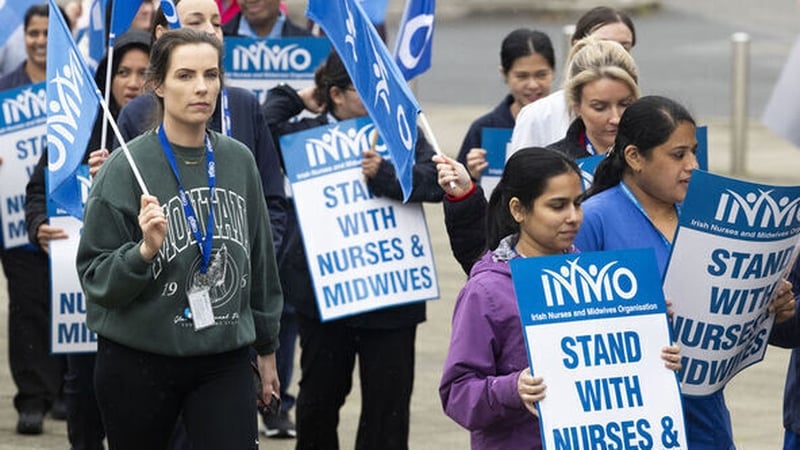
More than 300,000 public sector workers, including nurses, doctors, teachers and civil servants, are taking strike action today over delays in agreeing a new public sector pay deal.
The 24-hour work stoppage will cause widespread disruption, including the closure of schools and the cancellation of thousands of hospital appointments.
A further strike is planned for 21 October.
Public sector unions have accused the Government of failing to make meaningful commitments on pay following the expiration of the last public service agreement at the end of June.
They said they want pay to be discussed at the start of any negotiations, rather than at the end.
Unions also want a mechanism that would protect wages from inflation over the duration of a multi-annual deal.

The Government has said it is willing to discuss pay as a priority alongside other matters.
In Budget 2027, €1.2 billion was allocated for a pay deal.
Minister for Public Expenditure Jack Chambers has said it is deeply disappointing that the strike action is going ahead.
He said trade union leaders were being “completely unfair and unreasonable”.
“I’ve been very clear in repeated contact with trade unions that the only way all of the issues will get resolved is if they get around the table and have constructive and meaningful engagement with Government,” Mr Chambers said.
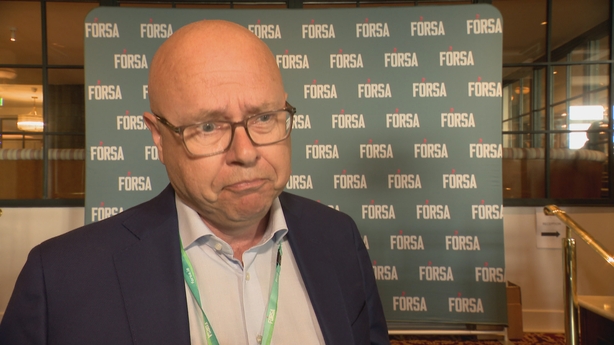
General Secretary of the Fórsa trade union Kevin Callinan said that instead of taking workers’ concerns seriously, the Government has stuck with the same dismissive attitude.
“People are struggling with the fundamentals necessary for a decent life,” Mr Callian said.
“Putting food on the table, heating their homes, trying to make ends meet,” he added.
He said that “by refusing to acknowledge the impact inflation is having on civil and public servants pay, Government is dismissing the very real struggles faced by its own workforce”.
Widespread disruption
The main teaching unions, including the INTO, ASTI, TUI and IFUT, are all taking part in the strike, which means that schools, colleges and universities will be closed for the day.
Special Needs Assistants, who are represented by the Fórsa trade union, will also be on strike.
Thousands of non-urgent medical appointments will be cancelled in hospitals across the country.
“Emergency departments, ambulance services operating at reduced capacity, and other critical and time-sensitive healthcare services, including urgent cancer treatment and dialysis, will continue to operate,” the HSE said.
Almost all court sittings will be cancelled because of the strike.
The only exceptions are emergency domestic violence and childcare applications, An Garda Síochána applications to remand an accused person in custody where station bail has not been granted, and High Court sittings to deal with injunctions to protect life, health, safety or welfare.
Sittings of the Dáil, Seanad and Oireachtas Committee hearings have all been suspended, and Leinster House will be closed.

Driving tests scheduled for today have been cancelled because staff from the Road Safety Authority will be taking part in the strike.
Local authorities across the country will see services severely disrupted, with many libraries expected to close.
Civil servants working across Government departments and State bodies will also be on strike.
All heritage sites and parks operated by the Office of Public Works are expected to close.
The only exception is the Phoenix Park, where roads will be open.
While members of An Garda Síochána and the Defence Forces are public sector workers, and are covered by public sector pay agreements, they will not be engaging in strike action as they are legally prohibited from doing so.
Public transport services are also expected to operate as normal.
The Communications Workers’ Union (CWU) and the National Bus and Rail Union (NBRU), although not directly involved in the strike, have instructed members not to pass the pickets.
NBRU members in Dublin Bus have been advised that they should not be expected to drive a vehicle through picket lines they encounter on their routes at locations such as colleges, hospitals or ports.