
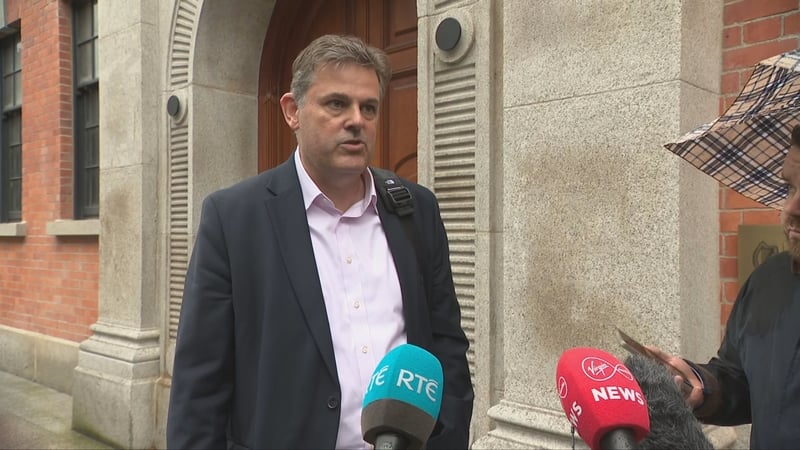
RTÉ Director General Kevin Bakhurst has described a meeting with Minister for Media Patrick O’Donovan this afternoon as “extremely constructive”.
The talks, which also involved RTÉ Chair Terence O’Rourke, took place at the Department of Culture, Communications and Sport in Dublin.
The meeting came a day after Mr O’Donovan said the broadcaster would receive €240m for 2027, which was €20m less than the €260m envisaged.
The minister said the cut was due to his dissatisfaction with the broadcaster’s progress in implementing promised reforms.
Speaking after the meeting, Mr Bakhurst said he had “an extremely constructive meeting with the minister”.
He explained how he had agreed to “carry on working with his officials to try to find a resolution to this but it was very positive, which was very welcome for our part”.
Mr Bakhurst said the situation was “delicate enough”, adding that “we want this process to be properly carried out, but the relationship is good”.
In a statement, the Department of Communications described the meeting as “positive”.
“The minister listened to the concerns of the RTÉ Chair and Director General in relation to Government funding and the support for the implementation of the strategy.
“The Chair and DG provided assurances on the delivery of reforms and their timing. The department and RTÉ will continue to engage constructively on all the issues discussed over the next few weeks,” added the statement.

Earlier, Minister for Enterprise Peter Burke insisted the Government was not expecting compulsory redundancies at RTÉ.
Speaking during Leaders’ Questions in the Dáil, Mr Burke said both sides would “try to work this out” after yesterday’s announcement.
However, Social Democrats Spokesperson on Media Sinéad Gibney claimed the developments raised “disturbing questions” about the “editorial independence” of RTÉ as she accused Mr O’Donovan of “Schrödinger cuts” and “blowing up RTÉ’s budget”.
She also raised questions over the sequence of events leading to yesterday’s announcement after it emerged Mr O’Donovan had flagged with the Department of Public Expenditure and Reform on Friday that he would not be able to fulfill the agreement with RTÉ unless his department received additional funding.
More money was subsequently released to the Department of Media, Ms Gibney told the Dáil, but RTÉ still received below what was agreed.
Speaking earlier, Mr Bakhurst said that he “completely rejects the assertion that the pace of reform and transformation” within the organisation has been slow, and claimed RTÉ had not received an explanation from the minister for the reduction in funding until his comments to the media.
Ministers call for ‘cool heads’ and ‘calm’
Minister of State Seán Canney said cool heads are needed to make sure RTÉ delivers on its commitments.
“When you have a written agreement, you also have more than just the funding. There’s also the performance of what you will do for that funding,” he said.
Speaking on RTÉ’s Morning Ireland, Mr Canney said: “Obviously, targets weren’t being met, so the funding had to be addressed and I do believe that what will happen here is that RTÉ and the minister will see how progress has gone over the next number of months and I’m sure further engagement will take place.”
Mr Canney said people “need to have cool heads” and to make sure that RTÉ delivers on its commitments.
“Funding has been made available and more funding will be made available as progress is made,” he said.
Speaking in the Dáil, Labour TD Duncan Smith said Minister Canney’s appeal for cool heads “was referring, in fact, to the minister, Patrick O’Donovan, himself”, as Mr Bakhurst “has shown a remarkably cool head”.
Deputy Smith accused Mr O’Donovan of “over-sensitivity and vindictiveness” and of holding “the public purse like a guillotine over RTÉ”.
‘Discussions to be had’ on RTÉ reducing headcount
Mr Bakhurst said yesterday that RTÉ had already achieved 90% of its reform agenda as agreed with the Government, but Mr Canney said the broadcaster’s commitments on voluntary redundancies have been “less than what was expected”.
RTÉ plans to reduce its headcount by up to 400 in the period up to 2029. It delivered 97 exits in 2025 – 67 Voluntary Exit Programme (VEP) exits and 30 additional role suppressions.
“I think there is work to be done here,” said Mr Canney.

However, Trevor Keegan, co-chair of the RTÉ Trade Union Group, said some of the slowness over redundancies “could be laid at the [Media] minister’s, and his department’s, door”.
He said “months and months went by” before staff heard that the first VEP had been accepted by the Government.
PAC Chair John Brady said members have requested a copy of the agreement on reforms made between the RTÉ and the Department of Culture, Communications and Sport.
The Sinn Féin TD said the €20m cut to RTÉ”s funding for 2027 “raises very serious questions”.
“We are also now witnessing an unedifying public back-and-forth between RTÉ and the minister, with serious questions being raised about the agreement that was reached and the basis on which it was subsequently revised,” he said.
National Union of Journalists General Secretary Laura Davison said there was an agreement in place, and as she understands from the Director General, “an agreement in writing for the three-year period,” which should be honoured.
TG4 requests meeting with O’Donovan
TG4 has requested a meeting with Minister O’Donovan, and is awaiting a response.
In a statement, the broadcaster said that its funding position is “entirely separate” from that of RTÉ, and that any funding arrangement that may arise for TG4 should be determined independently.
“TG4’s yearly funding requirements are determined through a rigorous statutory process undertaken by Coimisiún na Meán as part of the Annual Review of Performance and Public Funding under the Broadcasting Act 2009,” the statement read.
“Following this assessment, Coimisiún na Meán makes a recommendation to the Minister regarding TG4’s funding needs.
“Any funding arrangement that may now arise for TG4 should therefore be determined independently, based on TG4’s own remit, performance and funding needs.”
The statement also said that reliance on annual budgets limits TG4’s long-term planning and investment and creates uncertainty for the Irish independent production sector, much of which is made up of SMEs.
“The budget outcome is particularly disappointing given TG4’s very strong performance in 2025.
“The broadcaster recorded its fifth consecutive year of audience growth and its highest audience share since 2009, having generated €92.8 million in economic output and supported up to 1,460 jobs across Ireland,” the statement added.
Additional reporting Sandra Hurley, Róisín Cullen