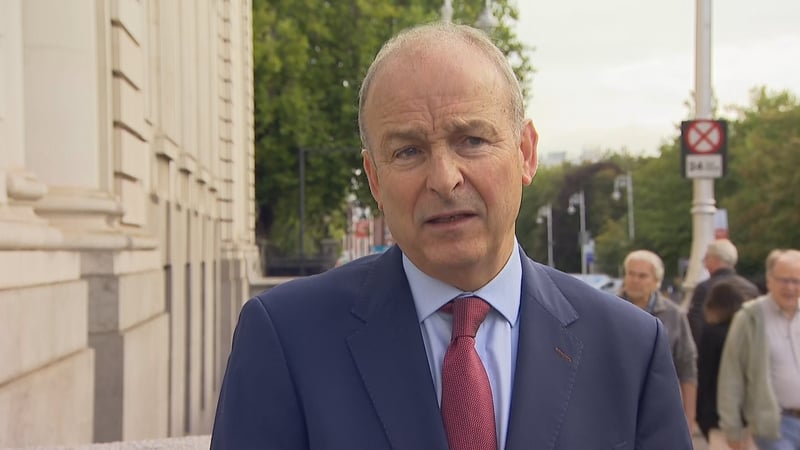
Taoiseach Micheál Martin has reiterated his opinion that upcoming public service strike action is unnecessary, despite the Irish Nurses and Midwives Organisation (INMO) head calling this “absolutely inflammatory” and a “little bit glib”.
Mr Martin had told Newstalk radio on Wednesday: “I just get the sense now that people want industrial action, irrespective of what happens.”
Responding to this, general secretary of INMO, Phil Ní Sheaghdha said: “To say that public servants are just taking strike action for the fun of it is a little bit glib.
“If we are serious about trying to find a resolution, I would avoid using that commentary as it’s absolutely inflammatory,” she told RTÉ’s Morning Ireland yesterday morning.
Speaking after turning the sod on a housing development in Dún Brí, Dundrum, the Taoiseach defended his comments.
“Look, I’ve met Phil Ní Sheaghdha on numerous occasions. Phil knows me well. She knows I’m not an inflammatory type of person,” he said, before reaffirming his opinion.
“Everyone needs to dial it down a bit, and I’ve asked Phil to look at and listen to the entirety of what I said in the interview,” he said.

“I do not believe the basis exists for industrial action. I don’t believe the public should have to endure that, because there have been significant tax cuts in the Budget, which will help workers.
“In addition to that, we have provided €1.2 billion for public service pay in the estimates. If that’s not a platform for negotiations, I don’t know what is,” he added.
Public sector unions have accused the Government of failing to make a meaningful offer on pay and are planning large-scale strike action on 14 October.
We need your consent to load this rte-player contentWe use rte-player to manage extra content that can set cookies on your device and collect data about your activity. Please review their details and accept them to load the content.Manage Preferences
More than 300,000 public sector workers are to take action on Wednesday, in the biggest day of national strike action since the aftermath of the 2008 economic crash.
Among the protests planned is a picket line at Leinster House, where the Dáil is scheduled to sit.
It is understood that the body that runs the Oireachtas has not received a derogation from unions that would facilitate sittings next Wednesday when public sector unions plan a strike.
This means that it is unclear whether the Dáil, Seanad and committee business will go ahead that day as opposition members have said they will not cross picket lines.

Earlier, SIPTU announced further strike action on all public sector workplaces for 21 October.
In a statement, SIPTU Deputy General Secretary Adrian Kane said: “Unions want to enter negotiations. However, we need a guarantee that the value of members’ wages that has already been lost in 2026 will be restored. The Government must also be serious about a pay offer which will adequately address the cost-of-living pressures for the years covered by any possible agreement
“Nearly 70,000 SIPTU members across the public service will strike on 14 and 21 October. They will have the full support of our more than 90,000 members in the private sector. Our members’ view is that the cost-of-living crisis is one struggle for all workers,” he said.
SIPTU’s National Executive Council will meet later this month to consider a further escalation of the dispute if progress is not made, the statement added.
Minister for Public Expenditure Jack Chambers described the move as “totally unwarranted”.
“We’ve been willing to talk for weeks and for months, and it’s unfortunate that the leadership in the trade union movement has decided to escalate matters rather than engaging in a substantive conversation,” Minister Chambers said.
On whether workers who strike next Wednesday would be docked a day’s pay, Minister Chambers added: “Well, there’s procedures around that, which they’re familiar with, and look, if they’re not attending work, and that obviously has an impact, there’s a standard process in any organisation.”


