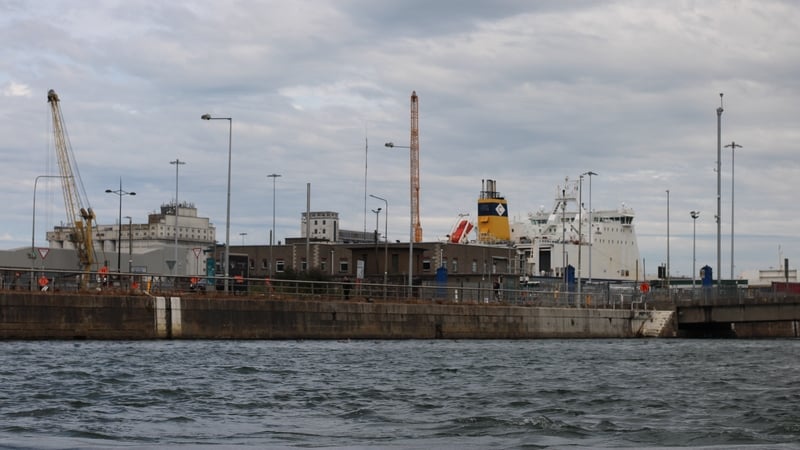
Representatives of port companies around the country have expressed frustration at the pace of progress when it comes to planning decisions about future developments.
Chief executives from facilities in Cork, Dublin, Waterford and Shannon Foynes were questioned about their long-term strategies at a meeting of the Joint Oireachtas Committee on Transport.
CEO at the Port of Cork Ann Doherty said there needed to be an integrated approach when it came to new initiatives.
“Strategic projects should not have to navigate disconnected planning, marine, environmental, road, utility and funding processes,” she said, calling on the Government to establish a single-delivery mechanism, across all relevant bodies, to oversee this.
Ms Doherty pointed out that the planned development of ports had knock-on consequences for the release of land for housing and other infrastructure.
The role of ports in accommodating offshore wind generation was raised by several contributors.
A National Designated Maritime Area Plan for Offshore Renewable Energy (ORE) is being formulated.
This aims to ensure 20 gigawatts of ORE can be delivered to the grid by 2040.
CEO at Shannon Foynes Port Company Pat Keating said there was “massive opportunity for the regions” arising from the rollout of new energy sources.
But he said that policy certainty was crucial in this regard, to unlock funding and associated investment opportunities.
His counterpart at Dublin Port, Barry O’Connell, said planning processes in relation to strategic developments should run in parallel to each other, to speed up the decision-making process.
This would allow for a streamlining of policy to allow applications for maritime area consents proceed in tandem with associated planing processes.
Mr O’Connell went on to detail one proposed project at the port, which was “five years in the making [involving] a 10,000 page submission”.
He said this has been under consideration by An Coimisiún Pleanála for 120 weeks, with no decision forthcoming.
Such adjudications should happen within a 48-week timeframe, Mr O’Connell suggested.
Other port representatives agreed with that contention.
They said it was imperative that port projects were designated as critical national infrastructure and that revised service standards for consenting bodies were needed.
CEO of Waterford Port David Sinnott said that State investment would be needed to assist with the provision of additional facilities.
He said there were a range of expectations on ports, to help with the delivery of freight capacity, offshore energy, supply chain security and national defence.
But he said all of these could not be funded solely by commercial ports.
Towards the end of the proceedings, Independent Ireland Deputy Ken O’Flynn left the meeting when questions he wanted to raise about governance of the Port of Cork were ruled inadmissible by committee chair, Fine Gael TD Michael Murphy.
Deputy Murphy said the committee was specifically focusing on the long-term strategy and plans for the future development of ports and the matters being raised by Mr O’Flynn were not in keeping with the agenda.
“If you don’t want me to ask questions to the Port of Cork, about the future of the Port of Cork, chairman, there’s no point in me being at this meeting,” said Deputy O’Flynn, before leaving the room.