
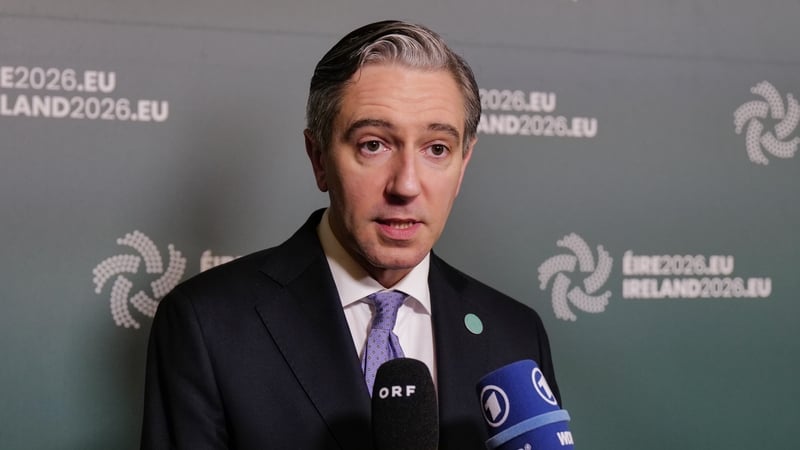
Tánaiste Simon Harris said the two-day informal meeting in Dublin of EU finance ministers, the finance ministers of Canada, UK, Ukraine and Switzerland, and the heads of the European Central Bank and the IMF is “focusing on a number of areas.”
He said these include banking competitiveness, innovation in financial services, and then tomorrow, on AI – “particularly AI in terms the economic opportunities and challenges for the European economy as well.”
Mr Harris said these were “major strategic issues” to be discussed.
But he said it was also “right and proper” that EU ministers meeting at Dublin Castle “consider” the “very pressing and real issues that every finance minister across the European Union is facing in terms of energy prices.”
He said at today’s working lunch he intends to hold an “initial discussion around the windfall energy tax as a potential policy lever.”
The Tánaiste said the European Commission will then “likely” be asked to “work on that and to revert back to the formal meeting of finance ministers in Luxembourg in October.”
Earlier, France’s Minister for Finance Roland Lescure said there should be fair taxation of digital services across the world.
Roland Lescure is in Dublin for talks with the rest of the EU finance ministers today and tomorrow as part of the Irish presidency of the Council of the European Union.

In an interview with the Irish Times, Mr Lescure said the large tax revenues from multinational technology companies should be ‘redistributed” more fairly among European countries.
He added that there was a need to “make sure that everyone gets their fair share of a cake that’s a European cake, not an Irish cake”.
But today he said he wished to clarify those comments.
“I’d like to clarify what I said because I understand that looking at the paper this morning, my words kind of came out out of proportion. It’s not about Ireland or France. The technological revolution is a global revolution,” he stated.
“I think Europe has a role to play in being one of the champions, but let’s face it, on some of those issues, we’re lagging behind the US, we’ve got an issue with China,” he said.
“Anything to do with that global phenomenon has to be dealt with in a global way,” he stated,
“As you know, there’s been work at the OECD level looking at the way we could have a fair taxation of digital service across the world,” he added.
We need your consent to load this rte-player contentWe use rte-player to manage extra content that can set cookies on your device and collect data about your activity. Please review their details and accept them to load the content.Manage Preferences
Mr Harris was asked for his response to reports that France wishes that corporate tax generated in Ireland to be redistributed in the EU.
“I very much welcome the clarification of the French finance minister here in Dublin today,” he said.
“Tax is obviously a national competency, it’s an absolute matter for every member state, the tax policies that a member state wishes to pursue,” whether France, Ireland or any other country.
Mr Harris described Roland Lescure as a “good friend of Ireland and a very good colleague” and he said Mr Lescure made the point that he was “talking about the need for a broader global conversation.
“That’s always been Ireland’s position that if there’s to be any conversations around broader tax reform, that should always happen at an international level because we should never put the European Union or the European economy at a disadvantage,” Mr Harris said.
The Tánaiste added that Ireland is “one of the largest contributors to the EU Budget per head of capita,” and “pleased” to be so because “it’s an investment that this country benefits from significantly in terms of access to the Single Market”.
“But the European economy, the European Union Budget benefits in a very real and tangible way from the success of the Irish economy,” Mr Harris added.
The Tánaiste also said there is a “genuine view from at least half-a-dozen EU member states” which he said have written to him formally saying windfall taxes on energy companies “merits consideration.”
“I’m very eager to facilitate that conversation,” Mr Harris said.
“I think there’s a dawning reality that there’s a small number of companies making extraordinarily large profits not on the basis of enterprise or innovation – I support enterprise and innovation – but simply on the fact that the Strait of Hormuz is closed,” he stated.
“And at the same time households and businesses are really, really, under pressure and there’s the inflationary impact of that as well,” he added.
He said it remains to be determined whether there is “consensus” across the EU for windfall taxes on energy companies, but his “job as president of ECOFIN is to act as an honest broker and facilitate discussion.”