
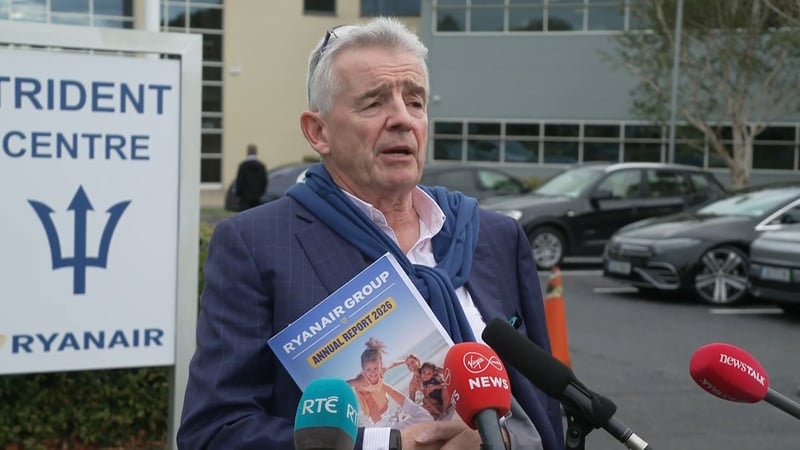
Ryanair group chief executive Michael O’Leary has said his airline is “better hedged than almost any other airline in Europe” with regard to oil prices.
Speaking at the company’s AGM in Dublin today, Mr O’Leary said Ryanair has hedged 80% of its oil costs at $67 a barrel until next March.
The airline has also hedged a further 15% of its oil at $85 a barrel for the 2028 financial year.
Mr O’Leary said Ryanair “stopped hedging as oil prices rose in recent weeks”.
“We think oil prices will continue to be bumpy between now and the end of the year, so there is plenty of time to extend our hedges between now and Christmas if needed,” he said.
“It is unlikely oil prices will stay up at such high prices through the winter, but if they do there will be more airline failures,” he added.
The Ryanair CEO also nudged his airline’s outlook for average fares higher, saying they may rise slightly this winter following a “mild upturn” since July, although the outlook depended heavily on oil prices.
The airline’s average fares fell month-on-month from February to July, contributing to a slump in profits in its last financial quarter, as high oil prices raised costs.
Mr O’Leary said today, however, that fares had since risen by a “very low-single digit” amount year-on-year.
“In the last month, there’s been a slight upturn,” Mr O’Leary told a news conference. It is impossible to say what was causing the increase or whether it would be sustained, he added.
Average fares for the current quarter from July to September as a whole are set to fall by a very low-single-digit percentage year-on-year, he said.
That is a slight upgrade from his July prediction that falls were moving closer to mid-single digits than low-single digits.
For the winter season from October to March, he in July said fares were set to fall by low to mid-single digits in percentage terms, but that pricing might move to flat or even slightly higher if rivals reacted to oil costs by reducing capacity.
He said today that the flat-to-slightly higher scenario appeared more likely.
“A lot depends on what happens to oil prices for the next five or six months but – I would be reasonably hopeful that pricing will be flat-ish, maybe even slightly positive in the second half of the year,” he said.
Oil prices have this week risen above $100 a barrel as attacks increased in the US-Israeli war on Iran.
Ryanair cut flights from its winter schedule earlier this month to reduce losses and its exposure to unhedged fuel, resulting in a reduction of its fiscal 2027 traffic target to 214 million passengers from 216 million.
If oil prices remain high into next year, there will be a “significant uplift” in airfares, Michael O’Leary said.
Ryanair CEO Michael O’Leary today also accused the head of Britain’s air traffic control operator of lying about the cause of an outage that led to thousands of flight cancellations earlier this week.
Mr O’Leary said Ryanair had been told by NATS that the outage was caused by a rogue flight plan, the same problem that caused a major disruption in 2023.

Speaking on BBC Radio on Wednesday, NATS CEO Martin Rolfe said he believed the latest outage had been caused by “something different” from previous incidents.
Michael O’Leary, who has repeatedly called for Rolfe to resign, rejected that explanation.
“NATS have told us it was another rogue flight plan. Now Martin Rolfe is out denying it yesterday,” Mr O’Leary said. “I believe he’s telling lies to save his own skin.”
A NATS investigation into the 2023 outage found it was caused by a “one in 15 million” event in which a flight plan contained two identically named but separate waypoints, forcing both the system and its back-up into a “fail-safe” mode.
Responding to a similar statement from Michael O’Leary yesterday, NATS said the latest outage had been caused by a different issue. It did not immediately respond to a request for comment on O’Leary’s latest remarks.
Ryanair is suing NATS in London’s High Court for more than £7m over the 2023 outage and has called on the operator to reinvest profits in performance improvements and staffing.
The UK government has given Rolfe a week to investigate the cause of the latest systems failure.
Transport minister Heidi Alexander, who summoned Rolfe for a meeting over the incident, said she believed the outage was avoidable and asked the Civil Aviation Authority to conduct an independent review.
Ryanair investors revolt over Michael O’Leary’s €150m pay deal
More than a third of Ryanair shareholders have voteed against pay plans for boss Michael O’Leary that could net him at least €150m.
The Dublin-based carrier revealed 39% of investors at its annual general meeting failed to give the plan their backing.
The pay deal looks set to get the green light after receiving a majority of 61% of votes in favour, despite the significant revolt, though Ryanair said it would discuss with shareholders.
“The company will continue to consult with shareholders in order to understand the reasons behind the result,” a Ryanair spokesperson said.
The wider remuneration report received 86% of investor votes in favour.
Ryanair announced in June it had agreed a new contract running up to April 2032, under which Mr O’Leary will be given an option to buy 10 million shares at €26.70 each if profits exceed €4 billion or if its share price goes above €42.
The group said at the time the shares option would be subject to Mr O’Leary staying with the group until April 2032, as well as “very ambitious” performance targets.
“Achievement of these very ambitious targets would create substantial additional value for all Ryanair shareholders,” Ryanair said in June.
Michael O’Leary has been chief executive of the airline since 1994 and has been on the group’s board since 1988.
Shares in Ryanair were lower in Dublin trade today.
Additional reporting by Reuters and PA