European farmers have been promised flexibility but no new money to help cope with the effects of record-breaking droughts and heatwaves this summer.
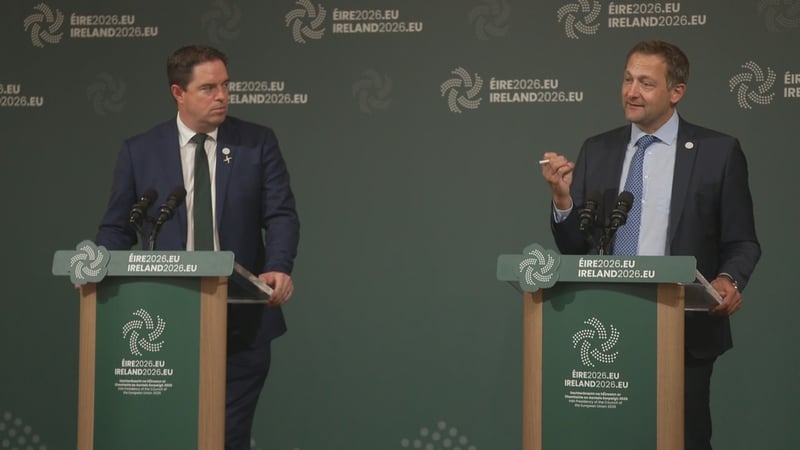
The EU Agriculture Commissioner briefed agriculture ministers gathered in Dublin Castle for an informal meeting, as part of Ireland’s Presidency of the EU Council, on the reports he had received from farmers in recent weeks.
Speaking to journalists after the meeting, Commissioner Christophe Hansen said one farmer had told of working in dangerous heat to save what he could of his crop.
“One farmer told me that in his greenhouse in France, he had to cope with 48C inside, and he had to work under these conditions in order to save what could be saved and doing five times more work than usually needed. And this puts, of course, a huge pressure, as well mentally and physically, on the people that work in agriculture,” explained Mr Hansen.
When asked what help the EU can deliver for the agriculture sector, he said he had written to member states reminding them of the tools at their disposal.
“Member states can make certain CAP (Common Agriculture Policy) payments in an earlier manner, helping as well to provide the much-needed liquidity to farmers because that is what, in this first phase, is most needed.
“And there are also possibilities to derogate from certain requirements when farmers are facing exceptional circumstances on natural disasters.
“And there are also flexibilities beyond the CAP too. For example, in the nitrates directive, the farming calendar to spread manure can be adapted in view of specific climatic conditions, and this is something we announced as well,” said Mr Hansen.
Ireland’s Minister for Agriculture Martin Heydon, who hosted his EU colleagues today, said the Government will keep under review the 1 October deadline for the spreading of organic fertilisers.
“The minister with direct responsibility for this is Minister (James) Browne, in terms of if there was to be any latitude movement on those dates, but I would obviously work really closely with him, and I think he would take a fair steer from my direction on it as well. And you wouldn’t make decisions around any flexibilities on this until you’re absolutely sure what the ground conditions and that would be like.”
Minister Heydon said he will be updating his cabinet colleagues on the effects of the summer droughts on farmers and there could be further supports if needed.
Speaking before the meeting, the Spanish Minister for Agriculture had called for a discussion on EU funding for farmers affected by drought.
Luis Planas said climate is one the big issues of the moment and could impact food security and food prices.
“The response has to be acts and action, and it has to be also investment of money. For example, (in) Spain… We have dedicated a lot of the national budget to address these issues. Is this being tackled also by the EU? This is something that we have to discuss.”
Both Minister Heydon and Commissioner Hansen spoke of the possibilities for reducing livestock emissions offered by research into breeding cattle and introducing new feedstuffs such as new types of grass sward and seaweed additives.
The Commissioner was asked on his view on the accounting of biogenic methane as part of climate action.
Ireland is treating methane from agriculture differently to that which is produced by fossil fuels but not all EU member states agree with this approach.
The Commissioner said this will be discussed at an EU level.
“We have a meeting on the 16th of September of the livestock strand in order to exactly discuss this point, because I think this is very important that we base this on the scientific evidence in close cooperation with the actors, and I would not prejudge what is coming out.”
While the next CAP budget was talked about by ministers during their two-day visit to Ireland, it is not expected that it can be agreed during Ireland’s presidency.
The size of the overall EU budget is to be determined by negotiations on the Multi Annual Financial Framework (MFF) and until that is decided, sectoral budgets agreements will be limited to partial general approaches which do not include numbers.
The Irish Presidency may get to that stage for CAP in October but the size of the CAP budget would not be agreed until next year, possibly during the Lithuanian Presidency.
There are concerns amongst farmers as current proposals would see CAP funding cut by 20%.
At Dublin Castle there was much discussion as to how other budgets such as the Competitiveness Fund and innovation budgets could be used to benefit farmers.
Commissioner Hansen gave the example of funding for water infrastructure to help farmers become more climate resilient.
“In the agriculture sector, but as well in other economic sectors, without water, you will not have the enabling conditions to be competitive. So this is, of course, what we are currently looking at.
“It’s too early to say one percentage or so on, but I think we need to find the the right synergies, which is then as well enabling and growing the budget that is available for these these kind of measures,” said Mr Hansen.
The Minister for Agriculture hinted that the Government may seek to secure additional funding for farmers through the EU competitiveness funds.
Mr Heydon said: “Member states will decide how money is divided up, but of course, you know, competitiveness and the competitiveness fund is an area and a source of funding for agriculture, and as we consider the importance of continuing to fund food security in that broader context of the security question, identifying all opportunities for funding is really, really important.”