“It’s not often I’m lost for words,” Eddie Hearn announced at the start of his nine-minute monologue at the Taylor-Pili fight press conference at Croke Park last June.
“The last person to fight at this incredible stadium? Mohammad Ali,” Hearn said, confirming that the many editions of the international rules series had passed him by.
When Ali fought Al ‘Blue’ Lewis in Croke Park in July 1972, he was treated beforehand like a visiting leader of a foreign superpower.
He was mobbed by admirers at Leinster House and had a private meeting with Jack Lynch. He had a lengthy televised sit-down interview with Cathal O’Shannon. Eddie Keher taught him the basics of hurling.
Ali himself was very anxious to meet Bernadette Devlin and she had lunch with him on the day of the fight, where they discussed politics, a subject on which they were perfectly aligned.
From Hearn’s perspective, the bout could have served as a cautionary tale.
Only 18,000 attended the fight, a good portion of whom got in for free and the event wound up losing money for its promoter – Killorglin-born publican Michael ‘Butty’ Sugrue, who in a previous life had been billed as ‘Ireland’s Strongest Man’ during his days with Duffy’s Circus.

GAA director general Seán Ó Siocháin criticised Sugrue for charging too much for tickets. Dave Hannigan, in his book ‘The Big Fight: When Ali Conquered Ireland’, contended that part of the problem was that Ali was far too visible and available in Dublin in the lead-up to the fight.
The Ali fight long predated the relaxing of Rule 42, which contrary to popular imagination, did not prohibit ‘foreign sports’ from being played in GAA venues. Officially, it only barred horse racing, greyhound racing and “field games other than those sanctioned by Central Council”.
In practice, this meant the GAA’s rival codes of British origin (readers may be familiar with them). Aside from that, there were four American football games played at Croke Park prior to the lifting of the rule and a couple of baseball games in the late 1940s.
The rule was eventually lifted – albeit only temporarily at the start – at 2005 Congress, just in time for the upcoming redevelopment of Lansdowne Road. There was enough ecumenical spirit among the delegates for them to be appalled at the prospect of Ireland home soccer matches being held at Anfield.
A previous attempt to ditch Rule 42 at the 2001 Congress had fallen just two votes short of the two-thirds majority, with the traditionalist-inclined President Sean McCague refusing all appeals for a recount.
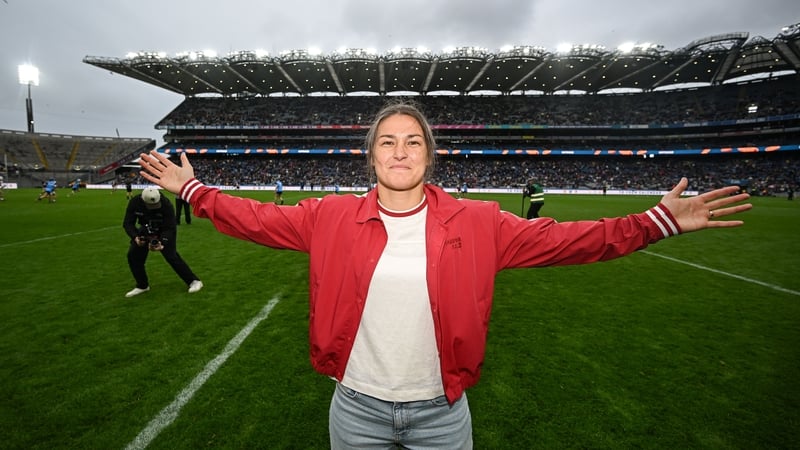
It all means that Katie Taylor will walk out to a very different Croker than Ali did 54 years ago and one that has flowered into a multi-purpose, entertainment venue.
This summer demonstrated how much times had changed. Croker had initially been opened as a stop-gap arrangement to stave off the ignominy of the Irish soccer and rugby teams playing competitive home games abroad.
And now this month, the stadium is playing host to pre-season friendlies between Manchester United and Leeds United – an encounter which now famously has the distinction of being the best attended soccer match in the history of the island.
President Jarlath Burns, whose highly consequential three-year term concludes at the beginning of next year, happily attended the game on behalf of the association, though admitted he had no affinity with either of these teams. As he’s made clear before, he’s an Arsenal fan.
It’s a far cry from his late-1980s predecessor John Downing, who told a Sunday newspaper he’d be unable to watch Ireland play England in Stuttgart as he was planning to mow the lawn that day.
In 2026, the Man United-Leeds United fixture seemed to provoke the ire of League of Ireland ultras more than it did GAA die-hards – though there was some dissent among the latter.
Pat Gilroy told the Irish Times this weekend that he’s taken to referring to Croke Park as “Ceasar’s Palace because it’s just a revenue generator. And that’s not Peter McKenna’s fault . He’s doing a great job but he’s doing it with the hand he’s dealt, which is ‘we need more money’.”

McKenna is already talking excitedly about the prospect of holding even more pre-season friendlies involving Premier League teams in the years to come. He’s even touted Croke Park as a Champions League final venue.
It’s no secret why McKenna is giddy about the possibilities. A perusal of the GAA’s recent annual financial reviews are instructive. The 2024 review reported a 19% jump in revenue largely on foot of a busy summer for Croke Park. The stadium saw a 60% increase in revenue in 2024 – despite a decline in match-day attendances from the previous summer.
The difference? Croke Park hosted seven concerts in 2024 – Bruce Springsteen, AC/DC (two nights) and Coldplay (four nights) – compared to none at all in 2023 (unless you count the Mary Wallopers performing as a warm-up for the hurling final).
Haters of the split season like to portray Croke Park’s lucrative concert season as the primary driver behind the current calendar. It provides an easier rhetorical target than the poor club player hankering after some certainty about when his championship might start.
And yet it was the GAA hierarchy – as opposed to the grassroots – who recently promoted a compromise motion whereby the All-Ireland finals would be nudged into August. By the eve of the vote, this motion was so obviously doomed that it was withdrawn before it could be rejected.
And so Croke Park (aka, Ceasar’s Palace) is free to host musical A-listers, Premier League behemoths and boxing extravaganzas throughout August and early September.
Taylor’s long-awaited bout at Croker falls on a very evocative weekend in the GAA calendar.
The first weekend of September had traditionally been earmarked as All-Ireland hurling final weekend – save for a spell between 1997 and 2005 and again in 2012-13 when it was played on the second Sunday.
From the traditionalist perspective, this Saturday should have been the day when Galway and Limerick hurling supporters were arriving in the capital, populating its watering holes on the eve of the decider. A night when Daithí and Jacquí interview Joe Connolly and Joe McKenna about the 1980 All-Ireland hurling final.
Whatever their misgivings, even the most dyed-in-the-wool GAA diehards would struggle to begrudge Katie Taylor her big day in Croker.
It’s testament to the stadium’s status in the Irish psyche that Taylor insisted back in June that a bout in the Aviva Stadium would never have satisfied her. If that was all that was on the table, she’d have retired instead.
It was “Croke Park or nothing.”
Watch Katie Taylor v Flora Pili in their undisputed World Super Lightweight title bout in Croke Park, live on RTÉ2 and RTÉ Player on Saturday 5 September from 8pm.