
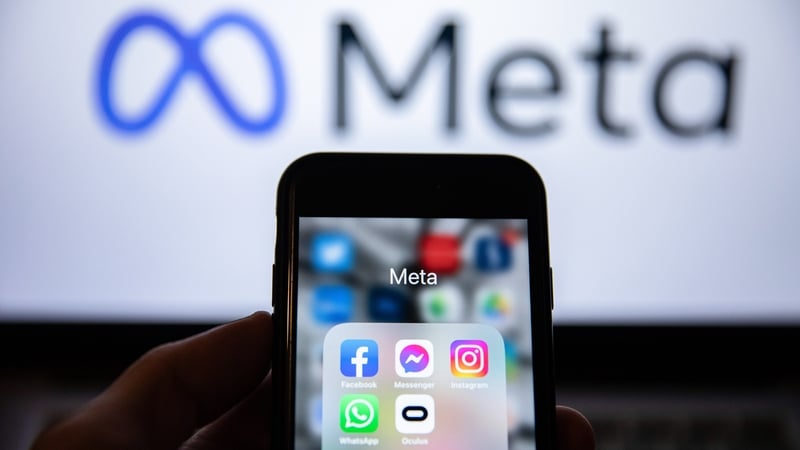
Social media giant Meta has agreed to pay $18 billion and make major changes to Facebook and Instagram to resolve claims by US states that it designed the platforms to be addictive, that it misled consumers about their safety, and that it improperly collected children’s personal data.
The company said it would impose daily usage limits, restrict nighttime access by children, and introduce new parental controls.
The changes will automatically apply to under-18s on Instagram and Facebook in participating US states and territories, but what will it mean for users in Ireland?
The court cases
Wednesday’s settlement brought an end to a trial in California which covered claims from California, Colorado, Kentucky and New Jersey that Meta violated their state laws protecting consumers.
It also covered claims from 29 states that Meta had violated online privacy laws by collecting the personal data of children.
In addition, the settlement resolved lawsuits by California, Illinois, New Mexico and Washington DC, over separate privacy claims.
Meta has denied any wrongdoing as part of the settlement.
The money
The payments to the US states from Meta will come to around $18bn, which the company said, “can be used to fund youth online safety initiatives, among other state priorities”.
The legal costs for Meta are expected to be around $10bn.
These are enormous sums, but the social media giant can easily afford to pay.
For the second quarter of this year, Meta reported revenue of $60.8bn, and income of $15.85bn.
The bill could have been a lot higher if Meta had lost the various cases.

Before the California trial began, Meta said the states were seeking up to $1.4 trillion in penalties. The states suggested the figure would be closer to $200bn.
Meta said the $18bn will be distributed in annual instalments over a 10-year period.
The states will receive 70% of the money over the decade. Meta said the remaining 30% will be released only after two specific conditions are met.
The first is that YouTube and TikTok implement a one-hour daily limit, night mode, and age assurance measures.
The second condition is that YouTube and TikTok each pay an amount matching the 30% figure, with half of the remaining funds tied to YouTube’s payment and half tied to TikTok’s.
The changes
As part of Wednesday’s announcement, Instagram and Facebook in the US will now have a default two-hour daily time limit that teenagers can only turn off with a parent’s permission.
There will be a default block on the apps between midnight and 6am.
A ‘school mode’ will see notifications muted by default between 8am and 3pm.
Teenagers will receive prompts after every 15 minutes of continuous screen time on Facebook or Instagram. They’ll also receive prompts when their total daily usage hits 60 minutes and 90 minutes.
Under 18s will be able to choose a non-algorithmic feed, one that doesn’t deliver content driven by a recommender system, as their default.

“We will periodically remind them of this option, and parents can choose to adjust their teen’s default experience to require this setting,” Meta said.
Teenagers will be able to turn off autoplay, so that content no longer automatically plays.
“Instead, they’ll need to take a deliberate action, like a tap or swipe, to see more. Parents can choose to adjust their teen’s default experience to require this setting,” Meta said.
The social media company said it would hide likes and reactions by default and disable cosmetic surgery and extreme makeup filters.
On age assurance, Meta said it will “work hard to find and remove underage accounts from our apps and, as part of our agreement, we’re investing in even stronger technology to proactively catch accounts that may belong to under-13s”.
A ‘breakthrough moment’
Tánaiste Simon Harris told RTÉ News that the Meta case in the US should compel all social media companies to immediately adopt new child protection measures across all platforms in all jurisdictions.
“Social responsibility should not have to be compelled in court but now that we have this settlement, it needs to be a breakthrough moment,” Mr Harris said.
He added: “We have long needed to see a shift from individual responsibility to social media companies being accountable for the harms their products are causing.
“We now need to see meaningful safeguards, not limited to those agreed in the settlement, but across the range of design features which intentionally, negatively impact young people.
“This does not need to wait for measures individual governments and the EU are planning to take.”
“Social media companies must see that change is now unavoidable.”

Noeline Blackwell, Online Safety Coordinator at the Children’s Rights Alliance, said the Meta settlement, and other US lawsuits against various social media companies, were significant for those campaigning in Ireland and across Europe for a safer online world for children and young people.
“While Meta stops short of admitting any wrongdoing, in settling, it concedes that it knows its products are fundamentally not safe enough,” Ms Blackwell said.
However, she believes that while the additional restrictions, time limits, filter bans and nighttime blocks are all welcome, the settlement should have gone further and ensured that recommendation algorithms are switched off by default.
“The very algorithms and addictive design patterns that pull children down rabbit holes and into the reach of predators,” Ms Blackwell said.
“So, the work to stop the relentless targeting and profiting off young people by these companies does not end with this case,” she added.
Will the Meta changes impact Ireland?
Meta has said that the new protections and controls will automatically apply to under-18s on Instagram and Facebook in participating US states and territories.
Asked what it will mean for Ireland and the rest of Europe, a company spokesperson said they had nothing to add beyond the original statement outlining the US settlement details.
It is worth noting that some safeguards and parental controls are already in place for users of Instagram and Facebook in the EU.
In the wake of Wednesday’s settlement, the European Commission was asked about tackling the addictive design elements of Meta’s platforms.
“We have been very clear … we expect proper screen time management, we expect proper parental control on these platforms. Meta knows … the ball is in Meta’s court,” a Commission spokesperson said.
Last month, the EU accused Meta of breaching its online safety rules claiming that Instagram and Facebook had features with addictive designs to keep users hooked.
The European Commission’s preliminary findings followed a two-year investigation under the Digital Services Act.

The Commission said Meta should disable features such as autoplay and infinite scroll by default, introduce effective screen-time breaks and make its recommendation system less focused on driving engagement.
Meta said it disagreed with the findings, and they did not “accurately take into account the significant steps we’ve taken to protect teens”.
It is somewhat ironic that while US President Donald Trump has repeatedly criticised Europe for being too strict on American tech companies, it is US courts and prosecutors that are taking the toughest stances against the social media giants and achieving the most significant results.
It is now clear that the legal shields that once protected platforms from prosecution have been breached.
It is also clear that tech companies can easily switch off harmful features and are willing to do so to avoid costly legal payouts and damaging trials.
The fines imposed by regulators in Ireland and across the EU go unpaid by social media companies and instead get lost in lengthy legal battles and appeals.
European governments have been focused on social media bans for children, but these are difficult to police and have been shown to have limited impact in other jurisdictions.
Perhaps regulators and governments on this side of the Atlantic should take inspiration from the US judicial system in order to bring about real change.