
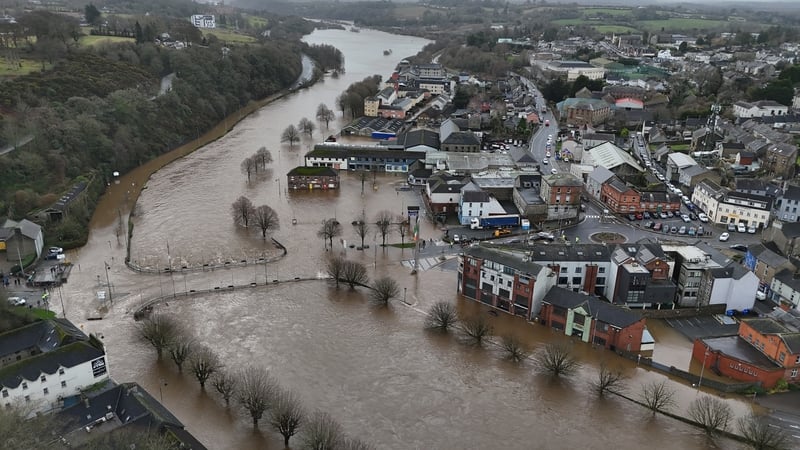
Insurance Ireland is proposing a new levy of €24 per household to be placed into a “sustainable flood insurance fund” to address what it calls “Ireland’s flood insurance protection gap”.
The levy is among a number of measures put forward in a report by the group representing insurers, which it said would allow homeowners to continue to access sustainable flood cover amid increased flooding risk due to climate change.
It said the fund should be designed to ensure households in higher-risk areas can access flood insurance, where cover would otherwise be unavailable.
Insurance Ireland said the Government could consider rebalancing existing insurance levies alongside the proposed new one that could allow its proposals to be introduced “with broadly no net additional cost to the average household”.
Research from the Central Bank indicates that around 5% of households struggle to obtain flood cover.
Beyond the difficulty in obtaining sufficient flood insurance, Insurance Ireland said affected homeowners can also struggle to get a mortgage or sell their property.
The group is also suggesting a scheme be established to make homes more resilient to flooding, which would be backed by grants and a new flood performance certificate, similar to the BER system.
Such measures could include flood doors and barriers, self-closing airbricks, non-return valves, raised electrical sockets and flood-resilient flooring.
Also proposed are more “responsible and resilient” housing developments, which include stronger requirements to prevent the creation of new avoidable flood risk through inappropriate development in high-risk areas.
In addition, the group is calling for continued investment in major flood defences as well as better coordination and sharing of flood-risk information.
Under its proposals, a dedicated flood agency would oversee the framework – including administration of the fund, flood-risk scoring, certification, and coordination between stakeholders.
Insurance Ireland said that based on modelling of approximately 1.9 million residential properties, just 8% of them account for almost half of all expected flood-related losses.
Its analysis also suggests that a severe flood event – of the kind expected to occur only once every 200 years on average – could result in damage costs of around €791m, which the group said is “beyond what the current market can absorb”.
According to the research, the expected yearly flood cost for residential properties is €56.2m (€8.4m coastal and €47.8m inland).
Commenting on the report, Insurance Ireland Chief Executive Moyagh Murdock said flooding is “no longer solely an insurance issue.
“It is a housing, climate resilience and financial stability challenge that requires a coordinated national response.
“For a homeowner, being unable to obtain flood insurance can have profound consequences.
“Not only does it mean carrying a significant financial loss if flooding occurs but it can also affect their ability to secure a mortgage or ultimately sell their home,” Ms Murdock said.
She added: “Our objective is to provide a sustainable pathway to flood cover for existing homeowners while, critically, reducing the underlying risk that Ireland will face in the years ahead.”
Ms Murdock said the industry wants to “work with Government, State agencies, lenders, and other stakeholders to turn that work into a national framework that protects homeowners and strengthens Ireland’s resilience to a changing climate”.
Robert Troy, Minister of State with responsibility for insurance, welcomed the proposals.
“As climate change continues to increase flood risk, ensuring the availability and affordability of flood insurance is a key priority for the Cabinet Sub-Group on Insurance Reform,” Mr Troy said.
He added: “The recently established Flood Insurance Protection Gap Working Group will give careful consideration to the Taskforce’s recommendations as it examines a range of policy options to find the most appropriate solution to address Ireland’s flood insurance protection gap.”