
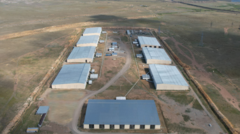
Like AI systems, Bitcoin relies on vast networks of powerful computers housed in data centres.
Because Bitcoin operates without a central authority, these computers verify transactions and are rewarded with newly-created digital coins.
But the rewards have reduced and the value of coins has dropped since last year.
One bitcoin was worth about $124,000 (£91,000) at its peak in October 2025, but has since fallen sharply.
More recently, it has rallied to around $80,000 – meaning it is up almost 30% so far in August.
But, for companies that have already made the change, even that may not be enough to get them to return to the crypto industry, because the switch of use – once made – is expensive to undo.
Industry analysts say Bitcoin mining companies have been pivoting to AI because they have years of experience in finding cheap electricity and efficiently running large data centres.
TerraWulf, Ionic Digital, Core Scientific, Iris Energy, Bitdeer, Riot Platforms and Hut 8 are just some of the companies increasingly diverting investment and infrastructure from bitcoin mining towards AI.
Riot Platforms signed a $9bn, 20-year compute deal with Anthropic earlier this month.
Wolfie Zhao from The Energy Mag – a publication that rebranded from The Miner Mag to reflect the trend – predicts the industry pivot will continue even as the price of Bitcoin has risen in recent days.
“We expect to see many public miners continue winding down their Bitcoin mining hardware in the coming quarters,” he said.
Asked if the shift away from Bitcoin mining might affect the security or stability of the cryptocurrency, Zhao said he hoped more miners will enter the market as conditions improve.
But he predicted many of the big players would not easily be able to switch back to Bitcoin.
“Once that multi-gigawatt power infrastructure has been retrofitted to AI or HPC colocation, there is no turning back,” he said.
“You can unplug from the Bitcoin network any time but signing a GPU colocation lease for 10 or 20 years means steady revenue and a commitment to keep the infrastructure up for the tenants.”
Bitdeer, which claims to be the largest Bitcoin miner in the world, just announced a 16-year deal to provide compute for Anthropic.
But the company’s chief strategy officer, Haris Basit, said Bitdeer will continue mining Bitcoin, believing many operators would ultimately pursue a dual-purpose model.
“Bitcoin mining is particularly well suited to that model because it is flexible and interruptible, while AI workloads can provide longer-duration contracted revenues,” he said.