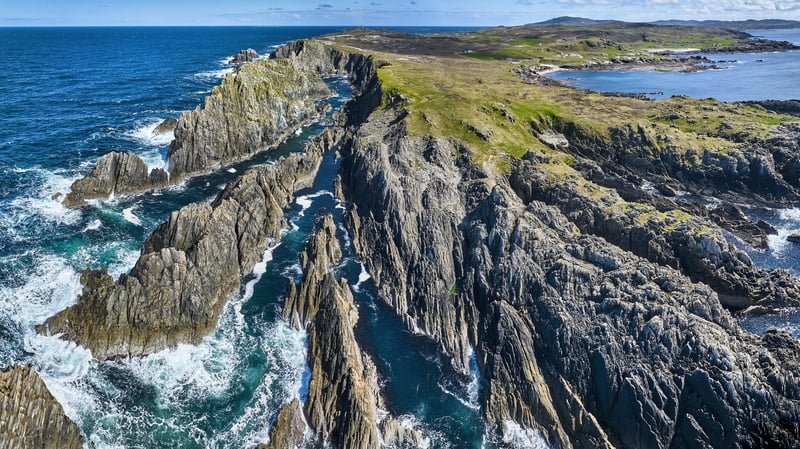
The day’s catch on Leenan Pier in Inishowen, Co Donegal, is sorted by hand – live crab for China and lobster for France and those landing it note margins are tightening.
For fisherman Robert Kearney, the catch reflects both sides of the inshore trade: high-quality seafood leaving a remote coastal community for international markets and a business model under severe pressure from fuel, bait and shellfish prices.
“This is a typical catch for August; there’s a lot of soft-shell crab on the ground [sea-bed]. We don’t have a big quantity of crab, but the quality is very high.
“This is destined for China. A van will take it away tomorrow and it will be flown live into Beijing within two to three days,” he said
The lobster is bound for France.
Mr Kearney said the value of the catch is hit by bills.
“This may look like a good catch; but it’s leaving it tight on the line for running costs. A boat of this size here today, for the diesel and the bait was €800.
“Four years ago, we could take this boat to sea and a full day’s bait was €200 and a full day’s diesel was €200.

“The price of the shellfish seems to be coming down. It’s balanced out now at half the price that it was five years ago.
“We’ve three men on deck and myself; four men to pay. We’ve bait. We’ve diesel. It’s so tight,” he said.
A family business under pressure
The boat is a family workplace. Mr Kearney’s brothers and his sons are part of the crew, but he said keeping a crew together has become increasingly difficult.
For families trying to maintain viable businesses in a remote coastal community, fishing vessels represent a significant investment.
In recent years, they’ve had to contend with the impact that Covid-19, Brexit and international wars on seafood exports and increases in fuel costs.
“If it goes any further, I would nearly call it Armageddon for the inshore fleet – that’s how tight it is. We’re on a tight line; bait, diesel and a crew,” Mr Kearney warned.

He notes Leenan and other small piers along north Donegal support a wider economy from shops and fuel suppliers to hauliers and processors.
“You’ve Glengad, Bunagee, Malin Head Pier, Fanad. They reckon for every one job on a boat, there’s three on shore. That’s a lot of work that this small area is keeping.”
He said some Government support had been helpful but argued that assistance with running costs and access to grant aid needed to be simpler and more effective.
“That fuel subsidy; there was so much red tape and paperwork… they put you through so many loopholes to get so little… It was like a week at school. They can simplify it.”
Department set to pay out €9.8m in fuel supports
The Department of Agriculture, Food and the Marine introduced a Fishing and Aquaculture Registered Vessel Fuel Support Scheme some months ago to offset increased fuel costs experienced as a result of the conflict in the Middle East.
The scheme, operated by Bord Iascaigh Mhara, was designed to support applicants for the five-month period from March to July 2026.

A spokesperson for the department said payments commenced in July and continued through August, with more than €8.5m paid to date on 397 applications.
They added final payments are expected to total approximately €9.8m, subject to completion of final checks.
The department spokesperson said there was also a separate Aquaculture Business Vessel Fuel Support Scheme for those not required to be on the Irish Sea Fishing Boat Register, in which payments are due to issue in due course.
That scheme launched on 24 June and closed for applications on 8 July. It is being implemented under the Temporary Crisis Framework set up by the EU Commission.
‘We want to pass it onto the next generation’
For Robert Kearney, the question is not only whether the industry can maintain viability, but whether young fishermen who are learning the trade will see a future in it.
“We’ve done it since we were 12 years of age. We’re at it a lifetime. We want to pass it onto the next generation.
“My two sons have been on the boat since they were 12 or 13 years old, learning the trade.
“My 13-year-old [son] got up at 5am. It was pouring rain for the first five hours. It was blowing four to five westerly. He had a tough morning, but he got through it.
“My older son is 18; he does a bit of boxing. He’s on a full-time payroll with us since he left school. I would love to think in a few years, if they wanted to fish that there’s something there.”

‘One of the best jobs in the world’
Martin Kearney, who fishes alongside his older brother Robert, describes it as “one of the best [jobs] in the world,” but added the challenges are stark.
“Our whole family is based off fishing. If it gets any worse, I’d say it will just be a matter of trying to look for different jobs; that’s how important it is – it’s running all our houses.
“It seems to be just whenever the price of fuel goes up, everybody else is able to put their prices up, except the fishermen.”
He said fishing has always been his main ambition, and will continue, if, at all possible.
“It’s one of the best jobs in the world. There are a lot of people and if it wasn’t for the love they had for it, this wouldn’t be worth it at this stage,” he said.
Mr Kearney owns a small boat, which he uses for lobster fishing. Although he would like to upgrade to a larger vessel, he feels it is now beyond his reach.
“About five or six years ago, I bought my own small boat for fishing lobsters; I always thought I’d be able to build it up and someday get a bigger boat, but that’s out the window at this stage, unless you put yourself into massive debt.”
‘Everything has gotten too dear’
Standing alongside Robert and Martin on Leenan Pier is Denis Kearney, who has been fishing crab for 48 years, and echoed their concerns.
“I’m fishing since ’78… I would say people are just struggling. They’re making no fortune.
“You couldn’t even go now to buy a new boat. Everything has gotten too dear; too expensive.
“It’s all family run boats around here and it’s very hard work; five o’clock in the morning until six or seven o’clock in the evening. I’’s very hard,” he remarked.
A task force chaired by former IFA chief executive Michael Berkery is considering the challenges facing catch fisheries, aquaculture and seafood processing.
The Food Vision Seafood Sector Group was set up by Minister for Agriculture, Food and the Marine Martin Heydon and Minister of State Timmy Dooley in the spring.
Mr Berkery’s report is due later in the autumn; those looking for assurance about the industry’s future, will be keeping a close eye.