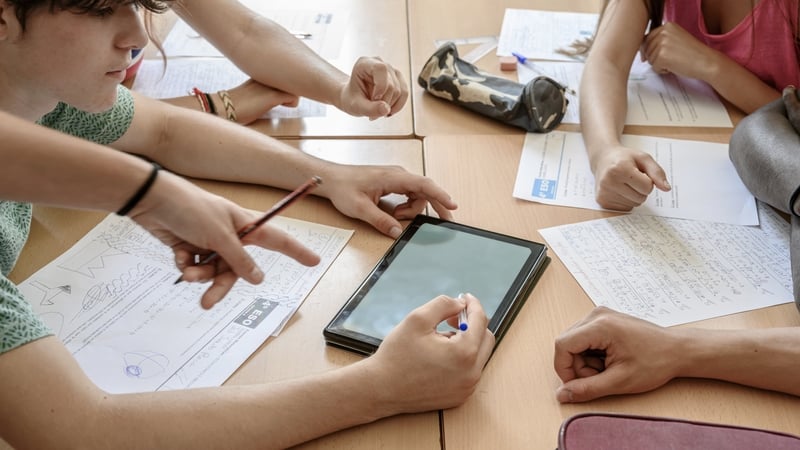
Analysis: The annual cost of sending a child to secondary school can exceed €2,800, once transport, clothing, lunches and activities are included
Ireland takes pride in offering free primary and post-primary education to all. In principle, no child should be denied access to schooling because of cost. Yet for many families, the reality feels very different. Beneath the surface of a “free” system lies a much more complex web of voluntary contributions, digital expectations, and everyday expenses that collectively place significant financial pressures on households at this time of year.
The myth of ‘free’ education
Schools in Ireland cannot legally charge mandatory fees for admission or attendance. Any additional payments requested by schools must be clearly identified as voluntary, and a child’s place in the school cannot depend on whether a contribution is made or not. However, the distinction between ‘voluntary’ and ‘expected’ is often blurred. Surveys show that 84% of parents in Ireland are asked to make financial contributions to their children’s schools.
The reality is these payments have become an essential part of how schools operate. Annual voluntary contributions average roughly €140 per child but varies drastically depending on the school. For families with multiple children, the cumulative effect is substantial.
We need your consent to load this rte-player contentWe use rte-player to manage extra content that can set cookies on your device and collect data about your activity. Please review their details and accept them to load the content.Manage Preferences
From RTÉ Radio 1’s Today with David McCullagh, the real cost to parents of a child’s education
Why schools rely on parents
School leaders argue that voluntary contributions are a necessity and not a luxury. While schools are provided with capitation grants, these can fall short of covering the basic running costs such as heating, electricity, insurance and classroom materials.
As a result, schools turn to parents to bridge the gap. Across the system, this reliance adds up to tens of millions of euro each year, effectively topping up what is meant to be a publicly funded service. In some cases, contributions go beyond core costs, going to support extracurricular activities, technology upgrades, and facility improvements – elements that enrich education but also deepen inequalities between schools.
How transparent are voluntary contributions?
One of the longstanding criticisms of voluntary contributions has been the lack of transparency surrounding how the money is used. In Ireland, that is now changing. Under planned reforms, schools will now be required to tell parents how much is collected through voluntary contributions and how those funds are spent.
We need your consent to load this rte-player contentWe use rte-player to manage extra content that can set cookies on your device and collect data about your activity. Please review their details and accept them to load the content.Manage Preferences
From RTÉ Radio 1’s Drivetime, should school voluntary contributions be scrapped?
This move towards transparency is significant and acknowledges public concern about accountability. It also highlights a deeper issue: if schools must publicly justify how they spend voluntary contributions, it raises questions about why such contributions are needed in the first place.
More tech in the classroom, more costs for parents
Alongside voluntary contributions, the growing role of technology in education has introduced a new layer of hidden costs. While initiatives, such as the free book scheme, have reduced some expenses, digital learning often requires students to have access to a device – items that are not always fully covered.
For some families, this represents a major upfront cost. For others, it creates a subtle but important disadvantage: students without reliable access to devices or broadband may struggle to keep the pace with their peers. What emerges is a form of digital inequalities, where access to education increasingly depends not just on attendance, but on access to technology.
We need your consent to load this rte-player contentWe use rte-player to manage extra content that can set cookies on your device and collect data about your activity. Please review their details and accept them to load the content.Manage Preferences
From RTÉ Radio 1’s Drivetime, how to manage back to school costs
The hidden costs of going to school
Voluntary contributions and digital devices are only part of a broader financial picture. Research shows that the annual cost of sending a child to secondary schools in 2026 can exceed €2,800, once expenses such as transport, clothing, lunches and activities are included.
Even where individual costs appear manageable, their cumulative impact can be significant – particularly during back-to-school periods or in households with more than one child. For some families, these pressures can lead to difficult choices: cutting back on essentials, taking on debt, or opting out of certain school activities altogether.
Perhaps the most troubling consequence of these hidden costs in how they reinforce inequality. Schools in more affluent areas are often better able to raise funds through contributions and fundraising, allowing them to offer enhanced facilities and opportunities. Meanwhile, schools serving disadvantaged communities may struggle to generate similar income, despite facing greater needs. At an individual level, students whose families cannot afford contributions or extras may feel excluded – whether from trips, resources or simply the social fabric of school life.
We need your consent to load this rte-player contentWe use rte-player to manage extra content that can set cookies on your device and collect data about your activity. Please review their details and accept them to load the content.Manage Preferences
From RTÉ Radio 1’s Drivetime, one in four families fall into debt over back-to-school costs
The Irish education system remains a success story in many respects, but the persistence of hidden costs challenges the idea that it is truly free. Greater transparency around voluntary contributions is a step forward yet transparency alone does not resolve the underlying issue: a funding model that leaves schools dependent on parental contributions to meet basic needs.
If free education is to mean equal access in practice as well as in principle, the question is not just how much parents are paying – but why they are paying it at all.
Follow RTÉ Brainstorm on WhatsApp and Instagram for more stories and updates
The views expressed here are those of the author and do not represent or reflect the views of RTÉ