
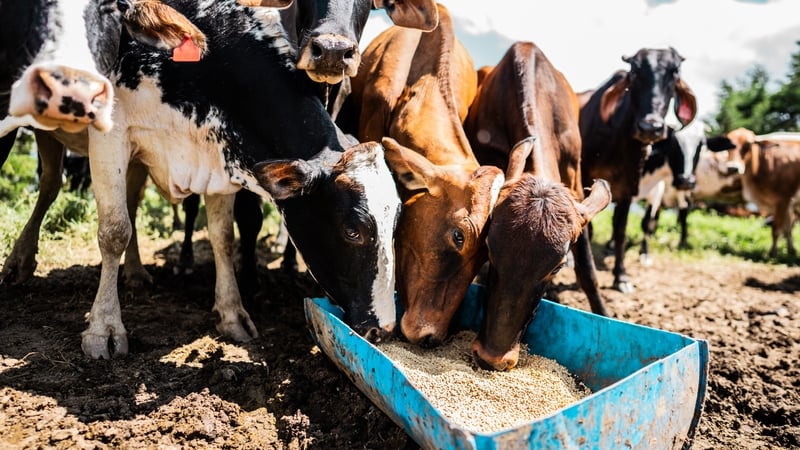
President of the Irish Farmers’ Association (IFA) Francie Gorman has called for the National Fodder and Food Security Committee (NFFSC) to reconvene for a meeting on the situation over animal feed in the country.
The IFA said the impact of this summer’s hot, dry weather and the lack of rain could force many farmers to use up their winter food stocks prematurely.
Speaking on RTÉ’s Morning Ireland, Mr Gorman said he agreed with the Department of Agriculture that there is no current shortage of food for animals, although he said the country has experienced an “unprecedented lack of rain” lately.
“We’ve had very little rain in some parts of the country for probably up to two months and there is an issue in certain parts of the country,” he said.
Mr Gorman said there is a major “cost issue” on dry stock farms, while tillage farms have experienced a “very tough harvest”.
“I think at a time too when farmers would normally be expecting the workload to maybe diminish, we’re now heading into full winter feed mode, so you’re looking at a huge burden been placed on farmers at a time when they would have been hoping to get away,” he said.
Mr Gorman said farmers are looking for the NFFSC to meet to assess the situation and to make sure “proactive” measures are being taken to address the issue.
“I do think the cost issue has to be addressed,” he said, adding he did not believe there was a fodder supply issue with the country as a whole, but that fodder may need to be “moved from A to B”.
“We do need a proper assessment done and we need that to be publicised,” he said.
“I think unquestionably we’re in an era of different climate patterns and how we provide for greater buffers of feed even during the summer and not just the winter months is something that needs to be looked at,” he added.
Fertiliser action plan must be backed, Gorman says
Mr Gorman said a recent European Commission’s fertiliser action plan, to combat soaring prices caused by the closure of the Strait of Hormuz and the Iran War, must be backed by the Government.
“That needs to be supported to the maximum co-funding level to give that buffer of cashflow on farms because some farmers are in a position where to be able to purchase and afford that fodder is an issue,” he said.
With more very hot weather predicted for this week, Mr Gorman said the farming industry “accepts” the role it plays in climate change emissions.
He said: “While we’re responsible for 40% of the emissions as a sector, we have very little heavy industry to offset that.
“We will probably go further than any other sector in meeting emission targets, but even still, that’s not something that we’re sitting back on our hands and hoping it will come right in the day.”
Mr Gorman said the industry will continue to address climate change through measures that have being recommended to adopt at farm level.
He said: “It comes back down to how we can be proactive?, how do we deal with this situation today?”
“If you were asking me three weeks ago what the situation was, I would say we’re not in a really dire situation yet, but today that has changed.”
Mr Gorman said farmers need to make sure they “don’t end up in a worse position in six or eight weeks time” when the autumn sets in and they “don’t have that grass growth”.
“Maybe we won’t be able to provide the fodder immediately that we need, so… if we can get the committee to meet, we need to assess the situation and let farmers know it’s fine if the department know what the situation is, but you communicate that to the National Fodder and Food Security Committee and that needs to be done straight away,” he added.