
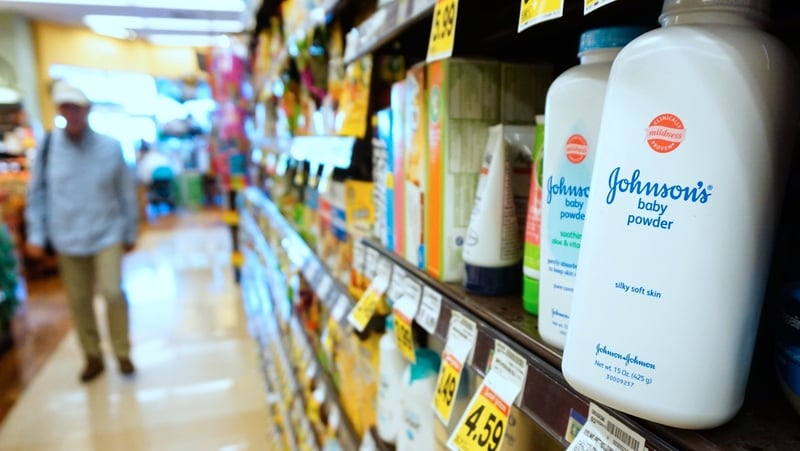
Allegations that some of Johnson & Johnson’s talc-based products – including their iconic baby powder – were to blame for customers developing cancer have been around for many years now.
The first cases date back to 2009, and despite multiple attempts by the company to shut the controversy down – and despite numerous adjudications and settlements – it has continued to rumble on.
Today there are still more than 70,000 cases outstanding.
The claims centre largely on allegations that the talc products caused either ovarian cancer or mesothelioma – a rare form of cancer that affects the membrane around internal organs.
That cancer has traditionally tended to afflict people who worked in mines, or in industries that used a lot of asbestos, before the risks of that material were known.
That’s an important factor in those claiming a cancer link, because deposits of the mineral talc tend to be found close to deposits of asbestos. Plaintiffs allege that the talc Johnson & Johnson’s was selling was contaminated with asbestos.
For its part Johnson & Johson has continually denied claims that the product is dangerous, and said the cases were “without merit” and based on “junk science”.
In the years after the allegations game to light the company did reformulate the likes of its baby powder – and more recently stopped using talc altogether, swapping it out for corn starch instead.
But even while doing that it has insisted that the use of talc was safe and there was no proven link between it and cancer. It said the reformulation was purely a response to a drop in sales of the product, which were based on online “misinformation”.
Courting costs

Johnson & Johnson says it has prevailed in the “overwhelming majority” of ovarian cancer cases tried to date – but that doesn’t give the full picture of its legal battles.
The company has already settled some cases – including most of the mesothelioma cases. That obviously means that those cases were never ruled on in court.
Meanwhile, there are more-than 70,000 pending cases, includes some class action suits. Others are tied up in what’s called multidistrict litigation, which is a way US courts can combine multiple, similar cases in order to speed up the process.
Meanwhile, even if it is the case that Johnson & Johnson has won most of the cases that have gone to trial, the value of the cases it’s lost has been significant.
Most notable of those is a $4.7 billion payout the company was ordered to make to 22 women in a St Louis case in 2018. That figure was later lowered to $2.1 billion on appeal; though it still represents a significant payout for a relatively small number of cases.
Crucially as part of that case, the company was forced to hand over thousands of internal documents – some of which revealed that it had detected traces of asbestos in its talc as far back as 1971. The documents also showed it had spent decades keeping that fact from authorities and the general public.
More recently, in October of last year the company was ordered to pay $966m to the family of a Los Angeles woman who died from mesothelioma. In December it was ordered to pay $1.5 billion to a woman in Baltimore who blamed the talc on her developing the same condition.
In both cases the company said it would appeal.
Deciding to settle

Those examples alone mean the company is currently facing a more-than $4.5 billion bill for just 24 customers. That would not include some smaller court rulings, as well as the money it has paid out in out-of-court settlements.
As a result – and even bearing Johnson & Johnson’s continual claim of innocence in mind – it is perhaps unsurprising to see it move to settle the majority of its outstanding cases for $5.5 billion.
But there have also been two recent developments that are significant to the timing of its offer.
Firstly, Johnson & Johnson has had a number of court victories in New Jersey, where it’s headquartered.
That has seen the company undermine some of the experts that plaintiffs were using in their cases. In a recent case a judge also cast doubt on a plaintiff’s ability to stand up an actual, causational link between the products and their cancers – meanwhile remaining plaintiffs in a multidistrict litigation have been asked to show why their case shouldn’t be dismissed.
While that doesn’t completely undermine those who are still taking cases, it does arguably give Johnson & Johnson a stronger hand than it’s had for some time.
At the same time, though, it also recently had the door firmly shut on a separate bit of legal manoeuvring it had been trying to pull off, which would have ended these cases entirely.
Choosing Texas

The so-called Texas Two-Step a legal strategy that a handful companies in the US have pulled off to escape existing and potential future lawsuits.
It works by a company splitting itself in two, with one entity left holding the assets. In other words, the products, buildings, equipment, workforce and so on.
The other company, meanwhile, is given charge of the liabilities.
Then the company that holds the liabilities declares bankruptcy, perhaps paying out a relatively small amount of compensation in the process. Then the company is liquidated – essentially ceasing to exist – which means there’s nothing left to sue.
That process then allows the ‘assets’ company to go about its business – and it cannot be held responsible for anything the legacy company might have done in the past.
The company first tried to pull off the Texas Two-Step in 2021, but the case was rejected as a bad faith one. Essentially the judge said that the bankruptcy process is for a company that is in financial distress, which isn’t the case for Johnson & Johnson.
Since then it’s made two further attempts at declaring bankruptcy for its liabilities business – including one attempt that linked the bankruptcy to a $10 billion settlement with litigants.
Part of the reason for that hefty offer was the fact that a bankruptcy-linked settlement would have shielded it from any attempts others might have made to sue in the future.
But both of those bankruptcy cases – including one late last year – were rejected. That means the company is unlikely going to be able to dump its liabilities as it might have hoped.
As a result, it’s now looking for another way of putting them to bed, and not have them potentially drag on for years more – at a far bigger cost.
The company says the resolution it’s offered allows it to “put this matter behind it and remain focused on its mission to develop medicines and devices that save lives.”
Some of the law firms involved in pending cases seem to be happy with the potential deal too – though it will require approval from 95% of plaintiffs in order for it to go through.
A class apart
Getting that agreement should be made easier by the fact that many of the outstanding plaintiffs are tied together through class actions.
A class action is essentially a case where a person or group of people sue on behalf of a larger group.
So in a case where a company has allegedly done something wrong – like sold faulty or dangerous goods, or mis-represented a product or service – a case can be taken on behalf of all those who were left out of pocket, harmed or deceived by that company.
It’s a way of making the process more efficient – but supporters of this kind of case also see it as a way of levelling the playing field.
After all, one customer going up against a business, especially a massive corporation, is going to struggle in the face of the resources it has to defend itself.
But if that customer go in with a lot of other people in the same boat, and potentially represent thousands or even millions of people, resources and risk can be pooled – and companies may take the case more seriously.
Perhaps more importantly in that regard, a class action could have a better chance of attracting a decent law firm to take the case in the first place.
When it’s one person suing a major company, a law firm will be aware of the David and Goliath nature of these kinds of cases. It will also be aware of the fact that, often, there’s a relatively small amount of compensation on offer to those that win.
In those circumstances many may decide it’s not worth their while to take the case at all.
But if the company is representing 100, or 1,000 or 10,000 people – each of whom is getting that relatively small settlement that they can share in – then it’s a different story.
Though this generally isn’t something Irish lawyers need to worry too much about – class action lawsuits tend to be a US phenomenon.
There isn’t as much of a history of them in Ireland – or indeed Europe.
Historically the closest Ireland has gotten to them are test cases – where one person pursues a case, the result of which might open the door to others to follow suit.
The EU’s Representative Actions Directive, which was passed in 2020, does allow for something resembling a class action case. It allows for citizens to collectively seek to have their consumer rights protected when it comes to the likes of faulty products, deceptive practices or data breaches.
However such cases can only be taken by approved bodies – and have to be done on a not-for-profit basis.
Costly dust up

It will be some time before the full cost to the company will be clear.
Even the $5.5 billion settlement offer is in some doubt – as some lawyers argue it could end up higher than that in the end.
Then there is the $4.5 billion in existing judgements against the company – presuming they don’t get reduced or overturned on appeal, that brings its bill comfortably above $10 billion.
But that doesn’t include multiple smaller verdicts, and multiple settlements, the details of which aren’t publicised. It also doesn’t count the amount the company has spent on lawyers, PR and marketing and product retooling. Not to mention the impact the controversy has had on sales.
With all that in mind, it’s probably the biggest single compensation bill that a health or pharmaceutical company has ever faced. And by any measure it’s a lot of money.
That being said, Johnson & Johnson had a net profit of $26.8 billion last year alone – so it’s probably not going to have a dire impact on its operations.
To put it into context against other cases – what Johnson & Johnson is set to pay is a lot more than the $7.2 billion pay-out agreed by Purdue Pharma last year, relating to the opioid crisis.
Unlike Johnson & Johnson, Purdue did end up successfully filing for bankruptcy as part of its settlement. As part of that arrangement the Purdue assets, including Oxycontin, were transferred to a new not-for-profit company, Knoa Pharma. Assurances have been given that the Sackler family have absolutely nothing to do with this new entity.
Johnson & Johson’s settlement does falls short, though, of the $15.3 billion that Volkswagen paid out to settle private and public cases relating to ‘Dieselgate’ – where it was found to have intentionally cheated emissions tests.
That ended up with it buying back affected cars and issuing the owners with compensation.
Johnson & Johnson’s settlement is probably roughly on a par with the settlement Enron shareholders secured in a 2008 class action – that was worth $7.2 billion, but adjusted for inflation is more than $11 billion today.
But all of those pale in comparison with the Tobacco Masters Settlement Agreement – which was struck in 1998, and was valued at at least $206 billion. As it included some indefinite payments, the total figure has likely gone higher than that, though.
This, of course, centres around smoking and cancer – and the fact that the companies selling the products knew about this link but kept it hidden, and actively denied it, for decades.
Technically, though, it wasn’t a class action – it was a settlement with the attorneys general of most US states. In fact the deal included a provision that the tobacco companies involved would be shielded from class actions by individuals.