
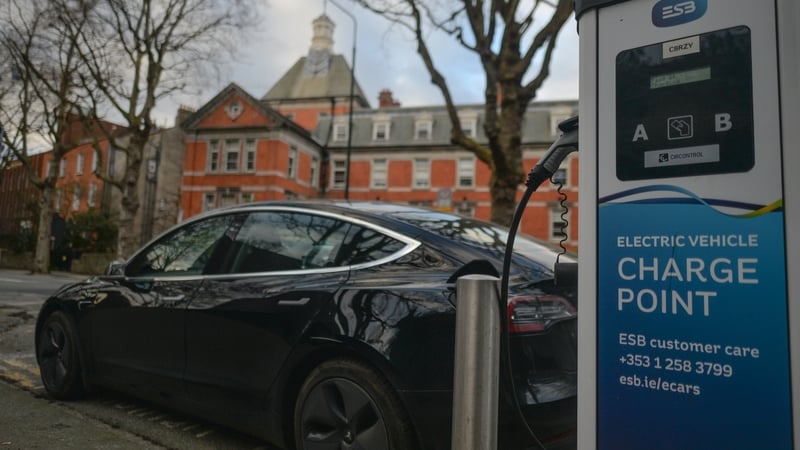
When faced with the big decision of buying a new car, more Irish consumers are choosing to go fully electric.
For the first time, battery electric cars have become the most popular new private vehicle, taking the title from hybrids.
“It’s the future coming,” said independent motoring expert at Carzone, Conor Faughnan.
The latest figures from the Society of the Irish Motor Industry (SIMI) show that among all new car registrations in July – a proxy for sales – battery electric vehicles (EVs) accounted for 26% of the market.
It is a major milestone for the country; the Government aims to make 30% of the entire national fleet electric by 2030.
Currently, only 4% of all cars on Irish roads are fully electric.
“The mainstream population is becoming much more familiar with EVs and much more comfortable with the idea of having one,” Mr Faughnan said.
He believes that “range anxiety” – which refers to the fear that a battery charge won’t be sufficient to complete a journey – and worries about resale value are now less of a concern for many buyers.
The turbulent start of the year likely contributed to EVs’ growing popularity, especially among previously undecided consumers.
The Iran war sent petrol and diesel prices to new highs after March, while EV charging costs remained largely the same (though tariffs were increased in July).
According to Switcher.ie, EVs are about 60% cheaper to run than petrol or diesel cars, with a typical home charge costing between €7 and €30.

“An average person driving, for example, 17,000 kilometres a year is going to pay about €800 to run their car compared to about €2,000-€2,200 for petrol or diesel just to fuel the car,” head of automotive content at DoneDeal Paddy Comyn said.
However, to get that saving, one must first buy an electric car, which is still a premium option for many.
EVs have become significantly cheaper in recent years but still typically start at around €20,000-€25,000.
Mr Faughnan argues that a brand new car was never “for everybody” and is “an expensive thing to buy”.
“Right across the market, there are about 2.5 second-hand car sales for every new car sale. Most people, when they buy a car, buy it second-hand, not new.”
The Government’s incentives were brought in to increase EV affordability.
Among them are the €5,000 grant, deducted at the point of sale, and the recent oversubscribed scrappage scheme, which offered €3,500 to owners of old petrol and diesel cars.
“I would still argue that the State should do more because we have electric vehicle targets, and we do want to increase the pace of fleet transition,” Mr Faughnan added.
Infrastructure delivery would also need to accelerate to match growing EV sales.
With 4,000 public charging stations, Ireland has below-average levels of public infrastructure, despite having average levels of car fleet electrification.
To match the pace of EV infrastructure development in other comparable European countries, Ireland would need closer to 13,000 stations.
Private home charging is generally more convenient and significantly cheaper, but roughly a third of Irish households don’t have driveways.

Servicing remains a key concern
While there’s excitement in the industry about Ireland’s EV ‘revolution’, many consumers remain concerned about long-term maintenance.
Electric cars are free from the traditional flaws of internal combustion engine vehicles, linked to oil or exhaust systems, and, in theory, should require less upkeep than traditional cars.
However, the complexity of software-centred vehicles poses new challenges.
“EVs are generally very reliable, but when they go wrong, they can go spectacularly wrong,” said Mr Comyn, adding that any engine can fail when not serviced properly.
EV warranties usually cover around seven to eight years of use, with manufacturer-recommended dealers providing servicing and repairs.
Battery faults, issues with electric motors, as well as air-conditioning failures are the most common repairs carried out by Service Stop in north Dublin.
The garage services up to five EVs a week, and a similar number come in for repair each month.
“The big problem with the manufacturers now is that everything is moving so quickly that the new technology isn’t getting enough time to be tested before the next new technology comes,” said business owner David Corbally, who adds that issues are usually related to vehicles with more than 100,000km on the clock.

One driver shared her concern about EV battery performance with RTÉ News.
Jackie Manning, the owner of a five-year-old electric car from a popular Japanese brand, said that despite showing full capacity, the battery’s state of charge can “drop rapidly and unpredictably while driving”.
“As a result, the vehicle can no longer be relied upon for predictable range” said Ms Manning, who lives in rural Cork.
The motorist is now facing the prospect of costly, self-funded diagnostics for her vehicle, as the warranty won’t apply unless the battery’s health is reflected on screen.
Mr Corbally points out that battery issues like these – not reflected on the dashboard but felt by the consumer – are relatively frequent and might require a stress test to identify the problem.
Software performance is key to an EV’s health, with engineers like Mr Corbally concerned about how it could impact long-term use and whether it could make repairs financially unviable, pushing consumers towards buying a new car every few years.
“EVs are software-controlled and manufacturer support is needed for a long period of time. Is it going to be a case like with your mobile phone, where at some point they stop supporting your old operating system?”
Denmark’s EV success: high taxation
Ireland’s scale of EV adoption is on par with many comparable European nations, according to a comparison by DoneDeal.
As in Ireland, roughly a quarter of British consumers choose EVs when buying a new car.
In Spain, Italy and Poland, the share of EVs among all new cars purchased is no higher than 10%.
Elsewhere, the electric future has already become the present.
Almost all new private cars purchased in Denmark are electric, Professor Jeppe Rich, from the Department of Technology at the Technical University of Denmark, said.
The pathway to this was steep: painfully high taxes.
Denmark has “among the highest registration taxations in the world,” said Prof Rich.

Buying a new petrol or diesel car is an extremely pricey affair in Denmark.
For any vehicle costing more than €10,000, the customer must pay a one-off registration tax of at least 85%. A car costing more than €32,000 will be taxed at 150%, bringing the total cost to €80,000.
Registration tax for EVs is much lower, however that is due to change in the coming years as the Danish government will try to replace “the hole in the budget” created by lower vehicle tax revenues.
Similarly to Ireland, many Danish households choose to hold on to their old petrol and diesel cars – for longer trips, Prof Rich explained – while using the electric car for daily needs due to lower running costs.
It remains to be seen how long this transition period will take in Ireland.
Sixteen years after the first EV was sold in Ireland, electric vehicles account for only 4% of the national fleet.
“We see, just from web searches, surveys, and web traffic that people expect the next car that they buy to be an EV. So, it’s clearly coming,” Mr Faughnan said.
“The adoption curve for EVs will be a steep one.”