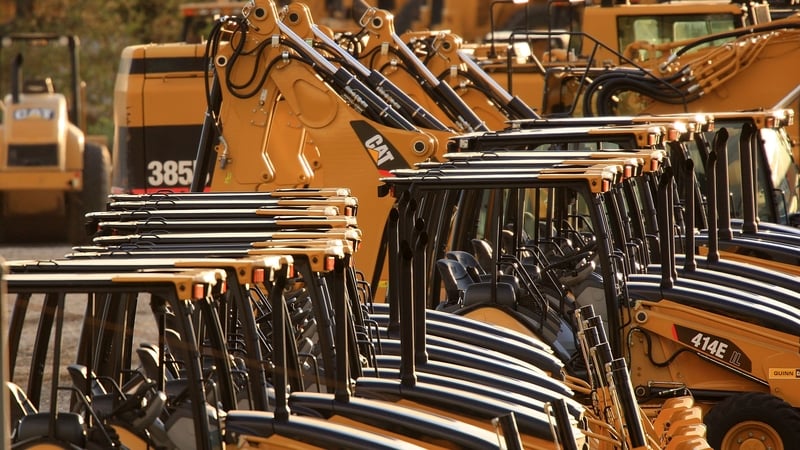
Caterpillar has raised its annual revenue growth forecast after beating second-quarter profit estimates, benefiting from a buildout of AI data centres that has spurred demand for its power-generation and construction equipment.
Shares of the company jumped 11% in premarket trading, after it cut its full-year tariff costs forecast to around $2.2 billion from the previously expected $2.2 billion to $2.6 billion.
Over the last few quarters, the equipment giant has seen a surge in orders for construction equipment amid a nationwide buildout of data centres as well as the backup power equipment needed for such buildings.
“Construction leading growth in the quarter was a standout,” Oppenheimer analyst Kristen Owen said. The stock’s reaction “reflects the importance of the durability of core Caterpillar businesses in sustaining the stock’s momentum.”
Caterpillar’s results are often seen as a bellwether for the industrial economy. Its quarterly earnings beat and raised forecast signal that the AI-led demand boom for ancillary equipment is sustainable.
In the April-to-June quarter, Caterpillar said it booked orders worth $9.4 billion, taking its order backlog to a record $72.1 billion.
Its overall revenue grew 24% to an all-time high of $20.54 billion in the quarter ending June 30.
Core construction segment revenue grew 35% in that period on strong retail sales, particularly in top market North America, where it recorded a 50% jump.
The power and energy arm, meanwhile, posted 17% growth in revenue. The two segments accounted for a combined 81% of Caterpillar’s total revenue.
The company builds power generators and backup power equipment under its power & energy segment, while its construction industries segment manufactures excavators and bulldozers.
Caterpillar also said it recorded an expected tariff recovery of $392m in the second quarter.
It reported adjusted per-share profit of $8.17, compared with $4.72 per share a year earlier, well above analysts’ expectation of $6.20 per share, according to data compiled by LSEG.