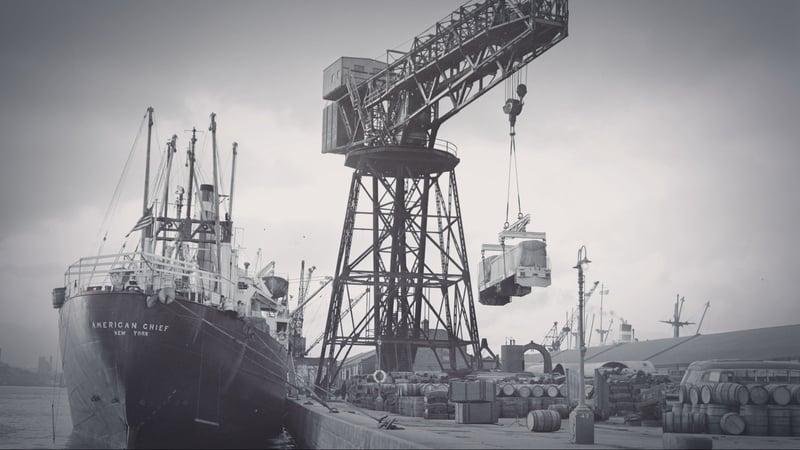
“When we got near the place, the other lad said ‘Oh Jesus! Couldn’t stick the noise down here’.
“It was the hammering and banging in the shipyard.
“I went in. The other lad wouldn’t go in.
“He said it was too noisy and that’s how I got started in Liffey Dockyard.”
Joseph Jones, who began working in the docks of Dublin in 1939, reminiscing and recounting tales from another era, is just one of the Dublin Port workers from down the years who have shared their stories for an oral history project.

Ron Carthy, another former worker, recalls the humour and intelligence of the colleagues he worked alongside in the 1960s
Mr Carthy said: “James Byrne, he was known as Mutt, was a typical Dublin wit.
“He was late one morning and the foreman said ‘Mutt, what do you call this?’
“He pointed at his watch and Mutt says ‘a watch?'”
He added another humorous tale: “The same foreman said to him one day ‘you should have been here at eight o’clock’.
“Mutt said ‘why? What happened?'”
Mr Carthy said Mutt had left school “like most people did then, at 14”.
“Another two lads, Big Dunser, Billy Donaghue and Billy MacDonald, would get the morning paper, and would have the crossword finished before you even lit a cigarette.
“These were well-read people. Every day they’d be changing books and reading.
“They may have left school early, but they had a fantastic command of the English language.
“They were anything but stupid.”

Since the Dublin Port Memory and Story project began in 2019, Dublin Port has gathered around 40 stories, mainly from dockers.
Lar Joye, Port Heritage Director at Dublin Port, said the company wants to gather more stories from dockers but also wants to hear from others who worked behind the scenes at the port and from those with connections to the general docklands area.
“We have over 400 pensioners, so we’d love to talk to some of our own pensioners,” he said.
Mr Joye said the project is not just looking for people who worked on the water or worked on the docks.
“We’re looking for the administration staff, the people who worked in HR, the people working in marketing – all aspects of people who worked in the port,” he said.

He said the project also “want to talk to the local community, people who have learned from the port, experienced the port from the outside”.
“The Docklands area that we now associate with all the American companies, that was port land right up into the 1980s.
He said capturing these stories helps bring the history of the port to life
Mr Joye said archives “can be very, very dry”.
“The stories that we get are the administration, the official stories that are handed down in the paperwork, in the photographs and the maps, and so on.”
However, he said what is secured through oral history “is bringing that to life and allowing people to fill in the gaps that you might not pick up in the files”.
“It kind of brings an archive alive.
“Today we try to capture the economic history, the personal history, the social history.”

Anthony Finnegan worked at Dublin Port for almost 30 years, initially as a fitter turner, but he is now a tour guide at the port.
He is among those who have put their recollections on the record.
Mr Finnegan said: “In November 1979, I came down, met with the chief engineer and he walked me across what was the Crossberth.
“It was like walking back in time. You went behind those Victorian walls, but the workshops were Victorian.
“You had all that ancient steam converted into electricity.
“The first memory of walking into the place was a big cast-iron steel fire that was red-glowing in the workshop.
“That’s what kept the workshops warm.”
He said the “lads themselves were amazing”.
“You went in. The first things you were asked were: ‘Who are ya? Who owns ya?’
Those from East Wall or Ringsend, he said, were “generally the population in the port”.
“But I was from Finglas,” he said, adding “I says ‘nobody, I don’t know anybody’ and that was it”.
“So from there, they really made me feel at home.”

Tara Brady, Oral Historian with Mac Conmara Heritage Consulting, said the accounts of people who worked in the port are an important part of the story of Dublin city.
She said such accounts provide “the human side of Dublin Port, and it gives us the real side and the raw side of working here”.
Ms Brady said: “What they talk about and what they remember the most is the community and the craic and the camaraderie they had coming into work every day.
“The other thing that stands out the most is the pride that people had in working in Dublin Port, and being from a port community in the surrounding area. People were so proud to work here.”
Those who think they have a tale to tell can contact dublinportarchive.com or phone the Port on 01 8876000 to arrange to speak with their historians.