Analysis: Social bots already shape online discussions around major issues with people struggling to recognise their use and influence
By Ana Jovančević, Elaine Smith and Mike Quayle, University of LImerick
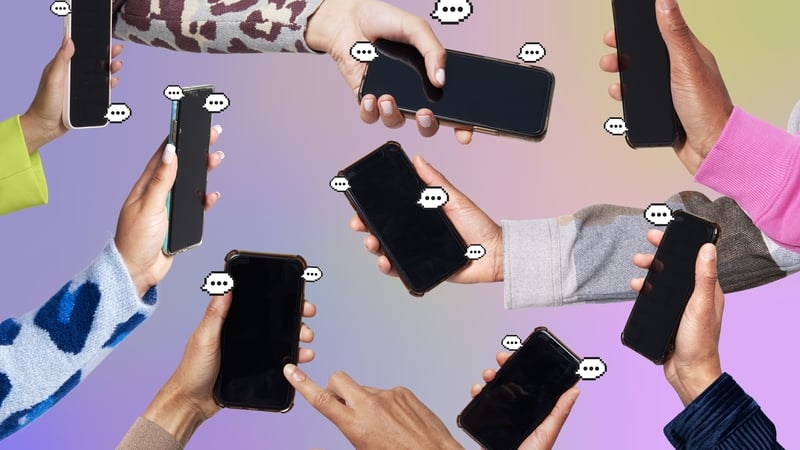
A growing share of our communication has moved to online spaces, but these communications are not always with other humans. Many interactions on social media now involve bots, automated accounts that are designed to appear human. Some bots are supposed to be helpful, like customer-service chatbots (benign bots). But others are designed to manipulate discussions, spread misinformation, amplify particular political viewpoints, or promote harmful content (malicious bots).
So how common are they? No-one knows for sure, though estimates say social media activity in 2024 consisted of approximately 37% malicious bots, 14% benign bots, and 49% human users. Studies of X (formerly Twitter) have reported figures ranging from 25% to 68%, depending on the topic being discussed. Various other sources suggest different estimates, but one thing remains clear – bots are present on social media in substantial numbers.
We need your consent to load this rte-player contentWe use rte-player to manage extra content that can set cookies on your device and collect data about your activity. Please review their details and accept them to load the content.Manage Preferences
From RTÉ Radio 1’s Oliver Callan Show, interview with journalists Carole Cadwalladr about online privacy, and the influence of social media and big tech
How do bots influence your opinions?
Given their growing presence and potential influence, an important question emerges: how exactly do bots persuade people? One of the most important factors in persuasion is group identity: people define themselves partly by their own group memberships and are influenced by the social groups they identify with. Attitudes, when expressed, are social signals that help people recognise “us” and “them”. When we express our attitude, others mentally categorise us as belonging to a particular group(s). Is it possible that this feature of our psychology can be hacked by bots to seem more convincing?
To test this, we ran two studies with human participants expressing opinions in a group containing a strategic bot (study 1) or one-on-one with a strategic bot (study 2). Some participants (study 1) were told that one in their group was a bot and others were unaware.
Both studies also included a control condition in which participants received responses only from real humans. The interactions focused on whether environmental problems should be addressed through taxation measures or educational approaches. Participants completed attitude measures before and after the interaction, allowing us to track changes in their opinions.
We need your consent to load this rte-player contentWe use rte-player to manage extra content that can set cookies on your device and collect data about your activity. Please review their details and accept them to load the content.Manage Preferences
From RTÉ Brainstorm, how social media has impacted on young people’s mental health
Four bot strategies
We tested four different bot influence strategies:
The Extreme Bot consistently expressed the strongest possible support for environmental taxation policies. This is repetitive, not human-like, and we expected influence to be minimal.
The Escalating Bot began with a neutral position and gradually became more supportive of environmental taxation. This strategy was designed to create a sense of momentum, encouraging participants to move in the same direction.
The Scaffolding Bot always responded from a position that was just slightly more supportive of taxation than the participant’s own response. The idea was to build rapport and gently guide attitudes without appearing obviously persuasive.
The Mimicking Bot copied participants’ responses during the early stages of the interaction before later switching to a strongly pro-taxation position. This strategy drew on evidence suggesting that sharing the same attitudes can build trust and a sense of shared identity.
We need your consent to load this rte-player contentWe use rte-player to manage extra content that can set cookies on your device and collect data about your activity. Please review their details and accept them to load the content.Manage Preferences
From RTÉ Radio 1’s Brendan O’Connor, can a chatbot be a good friend?
Could people easily identify bots?
People found it very difficult to identify bots during these interactions. Admittedly, they had very little to go on, but were only able to reliably identify the extreme bot – and only when explicitly told that there was a bot in the group. This fits the existing evidence well: even researchers with advanced detection tools struggle to tell humans from bots.
Could bots change people’s minds?
Being told that a bot was present changed how people reacted to it. Simply knowing that a bot was trying to influence them sometimes made participants push back and modify their opinion in the opposite direction. This psychological reactance is a common response to attempts at persuasion or control.
While this may initially seem like a good thing, savvy bot-operators might use this to their advantage, intentionally injecting extreme opinions into a debate to push moderate users in the opposite direction. This shows that bots can influence the direction of attitudes even when their behaviour is somewhat artificial or obviously strategic.
We need your consent to load this rte-player contentWe use rte-player to manage extra content that can set cookies on your device and collect data about your activity. Please review their details and accept them to load the content.Manage Preferences
From RTÉ Six One News, social media companies appearing at Oireachtas committee deny platforms are addictive
When participants were unaware that a bot might be present, the scaffolding and escalating strategies were most influential, with the escalating bot stringing the participants along to produce stronger shifts in attitudes. These findings align with social identity theory, which argues that attitudes develop through social interaction and can change both in groups and in one-to-one relationships.
Why does this matter?
Social bots are already used to shape online discussions around major issues. Whether spreading misinformation, reinforcing existing beliefs, creating echo chambers, or influencing public debates, they have the potential to affect attitudes on topics ranging from elections to climate change and public health.
Our studies have many limitations, but suggest some important conclusions. First, we will usually struggle to recognise bots during online discussions, especially when those bots appear to share our views. Second, the way a bot behaves matters: some strategies are more effective than others.
From New York Times, how Russian bots invade Western elections
Thirdly, even when we can obviously recognise a bot, we may be influenced by our impulse to distance ourselves from its extreme opinion. As AI-generated communication becomes increasingly realistic, understanding how bots shape opinions may become just as important as understanding the messages they deliver.
This leaves ordinary users, and our societies, in a difficult position. What is to be done? While this is not something that can be solved by individuals, we can insulate ourselves from the worst effects by getting news from a variety of sources, including from traditional media. More importantly, we need better regulations on social media companies to provide users with tools to understand their online social world; and this would be greatly helped if researchers had better access to social media data.
This research project was jointly funded by Taighde Éireann – Research Ireland and the European Union’s Marie Sklodowska-Curie Actions
Follow RTÉ Brainstorm on WhatsApp and Instagram for more stories and updates
Dr. Ana Jovančević is a Rosetta-Marie Skłodowska-Curie Postdoctoral Research Fellow at Lero, and in the Department of Psychology at the University of Limerick. Dr. Elaine Smith is a Marie Skłodowska-Curie Postdoctoral Research Fellow in the Department of Psychology at the University of Limerick. Prof Mike Quayle is a Professor in the Department of Psychology at the University of Limerick and a member of the Centre for Social Issues Research and Lero.
The views expressed here are those of the author and do not represent or reflect the views of RTÉ