
Updated / Wednesday, 22 Jul 2026 12:24

Getty
Analysis: Ostrich feathers were a major fashion trend in the 1910s but Britain’s plans to capitalise on this in Nigeria were doomed from the start
In 1912, a South African civil servant, Russell Thornton, left Cape Town with two colleagues, a modest budget and a plan that sounds, even now, faintly absurd. It involved the party travelling thousands of miles into the interior of West Africa, tracking down a particular breed of wild ostrich and bringing back as many of them alive as the British empire’s shipping lines would allow.
Despite the odds, Thornton succeeded and 18 adult birds and 114 chicks eventually made it back to a research farm in the Cape Colony. But within a few years, the entire enterprise had come to nothing. The adult birds died of parasites, as they had no immunity, and the market that justified the whole expedition collapsed before the young birds had even grown up.
It remains one of the odder footnotes in the history of the British empire in Africa: a decade-long attempt to build an ostrich-feather industry in what is now northern Nigeria, driven by the same fashion houses that put towering, plumed hats on Edwardian heads, but undone by disease, bureaucracy, war, and changing fashions. The story is worth telling, because it shows how far the reach of global fashion could extend, and how badly an empire could miscalculate even when the commercial logic seemed sound.

A hat-shaped economy
From the 1860s onward, European and American fashion developed an insatiable appetite for ostrich plumes. They became a marker of wealth and status, piled onto the elaborate headwear of the Edwardian era. By 1913, ostrich feathers were the fourth most valuable export of the Union of South Africa, behind only gold, diamonds, and wool. Farmers in the Karoo grew rich enough to build ornate stone houses that are still known locally as “feather palaces.”
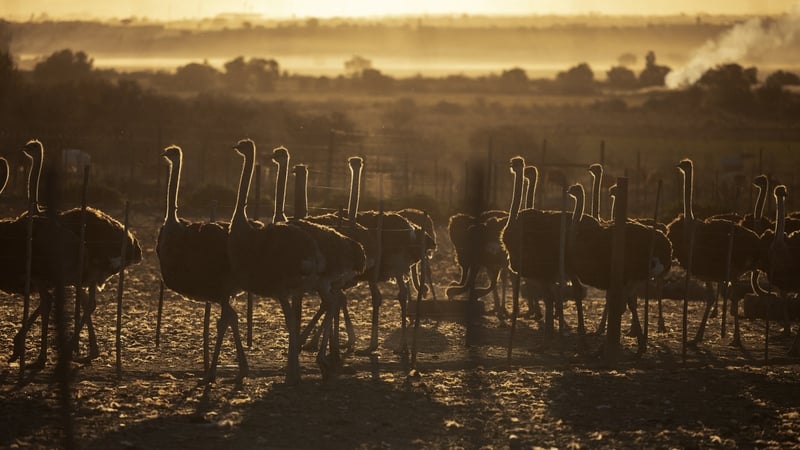
Britain and France were ostrich farming rivals. France’s early efforts in Algeria and Senegal failed, but Britain’s Cape Colony experiments from 1866 succeeded, prompting the attempt to replicate the plan in northern Nigeria. Colonial administrators there noticed that local communities had been managing ostriches for generations. The people captured chicks, hand-reared them and plucked their feathers twice a year long before any British officer arrived to take an interest.
In 1904, F.B. Gall, an assistant resident officer in the Geidam division under Bornu Province, reported local keepers with small flocks of birds, penned and fed with grass and the jara vine. It looked, to colonial eyes, like the raw material for an industry. It just needed, they assumed, some proper European management.

A farm that never quite existed
What followed was almost a comedy of administrative dysfunction, if the human and animal cost weren’t so real. The British tried to set up a formal ostrich farm at Konni, near the French Sudan border, in 1905, an area derailed by a famine that made the whole project impossible that year.
They tried again at Argungu, under an officer named Captain Harbord, the Deputy Resident of Sokoto Province. Harbord had acquired some familiarity with ostrich management, but his bosses insisted his farming duties come a distant second to his actual job as a political administrator. The Resident of Sokoto Province warned, in writing, that this was doomed. Harbord would be pulled away from his real work, the birds would suffer for his absence and he’d be blamed for it regardless.
He was right. By 1908, when the Governor of Uganda wrote asking how Nigeria’s ostrich farming was going, the honest answer was that nobody was quite sure. The Secretary at Zungeru could only relay that a Kano-based trading firm, the London and Kano Trading Company, had attempted ostrich farming in northern Nigeria and failed. The birds had died or dispersed, the plans had been shelved and the officers involved had been transferred, invalided home, or redeployed to other duties. The ostrich farm existed only in the files.
From Huntley Film Archives, rare footage of a 1920s’ farm rearing ostriches for the fashion industry
The birds that had to be trekked, floated and railed
The 1912 Thornton expedition was the boldest attempt to salvage something from all this. South African breeders believed their best feather-producing birds descended from Sudanese stock, and that the industry’s declining fortunes might be reversed with fresh blood from the birds’ ancestral range. Thornton and his team sailed to West Africa, took a riverboat six days up the River Niger, boarded a train to Kano and then set off on foot with 94 porters toward the French Sudan (present-day Niger), only to be refused permission to take any birds out of French territory at all.
Undeterred, they turned back into Nigeria and, with the enthusiastic help of the Emir of Katsina – described by Thornton as “a most progressive man” who kept meticulous written records of every transaction – began assembling a flock. In a treeless country with no timber for fencing, they improvised six-foot barriers out of guinea-corn stalks bound with grass rope and a dug trench, hoping it would hold birds capable of a lethal kick and a 70 km/h sprint. Two colleagues trekked 500 miles east towards Lake Chad and Maiduguri hunting wild ostriches and found only their tracks in the sand.
Getting the birds home was its own ordeal. Nigerian Railway freight wagons had never carried an ostrich and had to be specially modified. Thornton himself collapsed with sunstroke and had to be hospitalised mid-expedition. At Lagos, the birds waited eight days for a ship, two of them anchored offshore in a heavy swell that Thornton feared would kill them through sheer stress. Four birds died en route to the coast alone.

Right timing, wrong century
The final irony is the cruellest kind: right timing, wrong century. The birds that survived the journey took two extra years to reach breeding age in their new home. By then, it was 1917 and the market they’d been shipped across a continent to save had already been wiped out. Bird-protection campaigns in Britain and America had turned public opinion against feathered fashion.
The First World War had strangled international luxury trade, while the open-top motor car made enormous, feathered hats a practical impossibility. An industry built on decades of speculative ambition folded within a few short years, and a great deal of imperial effort, expense, and animal suffering had been spent chasing a fashion trend that was already dying as the ships were loaded.
Northern Nigeria’s ostrich farms have left almost no trace. There was no institution, no breeding programme, no surviving expertise. All that remained was a scattering of colonial letters in an archive in Kaduna, and the memory of an emir, a railway official and a handful of local ostrich keepers whose knowledge was never quite valued enough to keep.
Follow RTÉ Brainstorm on WhatsApp and Instagram for more stories and updates
The views expressed here are those of the author and do not represent or reflect the views of RTÉ