
Analysis: This landmark Brexit-related treaty will have immediate benefits for the 15,000 workers who cross La Línea every day
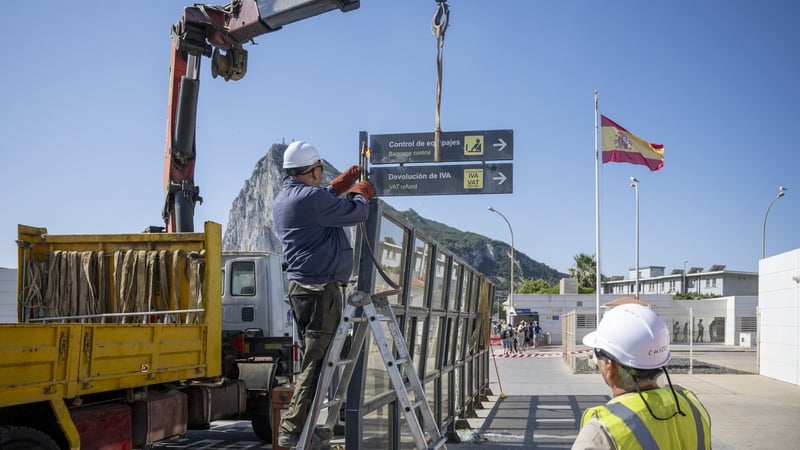
Described as “the fall of the last frontier fence in western Europe”, the border fence between Spain and Gibraltar has fallen this month, marking the conclusion of more than four years of negotiations between the UK, Spain, Gibraltar, and the EU after Britain’s departure from the bloc. Since 15 July, all physical barriers at the land border with Spain have been removed. Border controls have been relocated to Gibraltar’s port and airport, which now operate as external border crossing points of the Schengen area, even though Gibraltar itself remains outside Schengen.
This treaty constitutes a landmark in the history of Gibraltar, for at least two reasons. First, the opening of the land border represents a significant advantage and a tangible improvement in the daily lives of the approximately 15,000 workers who crossed the frontier every day. Second, as regards the controls at the port and airport, the Spanish presence on Gibraltar’s territory had been considered a non-negotiable red line throughout the Brexit negotiations, one that has evidently now been crossed.
We need your consent to load this rte-player contentWe use rte-player to manage extra content that can set cookies on your device and collect data about your activity. Please review their details and accept them to load the content.Manage Preferences
From RTÉ Radio 1 Morning Ireland in 2018, Spain ‘will vote no’ to Brexit deal unless Gibraltar text changed in 2018
How did Gibraltar get here?
In the 2016 Brexit referendum, Gibraltar recorded the strongest support for remaining in the EU, with 95.9% of voters choosing to stay. Despite this objection, Gibraltar left the EU when Brexit eventually occurred in 2020.
Gibraltar retains the legal status of a British Overseas Territory, ceded to the United Kingdom by the Treaty of Utrecht in 1713. However, its borders have always been contested, partly because the Treaty itself does not provide an unambiguous definition of them. The question of sovereignty is officially and legally settled. The citizens of Gibraltar voted in 1967 and 2002 in favour of maintaining British sovereignty. Despite the strong willingness of the Gibraltarians in keeping the Rock within the UK’s sphere, the old Spanish claim weighed against the implementation of Brexit in this disputed area.
Generally speaking, the withdrawal from the EU posed a threat to the stability and prosperity of the region. Gibraltar borders a region of Spain that heavily relies on Gibraltar’s economy, Andalusia is one of the Spanish regions with the historically highest unemployment rates and lowest GDP per capita. One of the main issues raised by the implementation of Brexit was the impact on Spanish workers. Approximately 15,000 cross-border workers cross La Línea every day, and of these 10,000 are Spanish.
In the Brexit referendum, Gibraltar recorded the strongest support for remaining in the EU, with 95.9% of voters choosing to stay.
The proposed solution was the partial entry of Gibraltar into the Schengen area, but it was contested whether the checks should be carried out by Gibraltar or Spain. Additionally, Spain’s other demands also impacted the implementation of the Protocol. Specifically, Gibraltar was asked to comply with international standards of transparency in taxation and the selling of products containing tobacco.
Although the Protocol to the Withdrawal Agreement addressed these points, the issues remained unresolved for more than five years. Last year, the parties met in Brussels and reached a new agreement. The parties underlined that the goal of the Agreement is to ensure prosperity to the whole region, and committed to promoting shared prosperity and close and constructive relations between Gibraltar and the Spanish authorities.
What’s in the agreement?
All physical barriers, checks and controls on persons and goods circulating between Spain and Gibraltar are to be removed, while preserving the Schengen area, the EU Single Market and the Customs Union. In particular, the parties agreed to carry out double checks on persons at the Gibraltar port and airport. On the EU side, the Schengen checks will be carried out by Spain. This is a significant achievement, one Spain has always claimed, but which seemed to be unacceptable to Gibraltar at first.
We need your consent to load this rte-player contentWe use rte-player to manage extra content that can set cookies on your device and collect data about your activity. Please review their details and accept them to load the content.Manage Preferences
From RTÉ Radio 1’s Today with David McCullagh, the legacy of Brexit ten years later
On the UK side, the Gibraltarian authorities will keep working as they were. They also agreed on close cooperation between the police and law enforcement authorities for visas and permits. As far as frontier workers are concerned, all checks will be removed for those crossing between Gibraltar and La Linea daily.
In the area of goods, the parties hope for a future customs union and the removal of controls on the movement of goods. This goal may be supported by the International Agreement on Taxation and Protection of Financial Interests reached between Spain and Gibraltar in 2021, which clarified tax residency rules to prevent fraud and established a duty of cooperation and transparency in tax matters. The parties specified that the new agreement would touch upon other important areas of the EU-UK relations, such as commitments on State Aid, environment, trade and sustainable development, anti-money laundering and transport, and social security coordination.
The mention of anti-money laundering is particularly interesting as this issue has created tensions in the past. Gibraltar has been asking Spain to be removed from the ‘fiscal havens’ blacklist, and Spain has committed to do so in the near future. Moreover, the parties agreed on the creation of a financial mechanism to promote cohesion and support training and employment in the region. The representatives of the EU, UK, Spain and Gibraltar underlined that the agreement was reached in a shared commitment to European security. They are confident a finalised full legal text will be negotiated as the way is ‘now clear’.
Border controls and customs checks have been eliminated to create an open border and Spain now has responsibility for Schengen controls at Gibraltar’s airport and port.
This agreement marks a significant milestone in the Brexit negotiations for Gibraltar. For the past six years, implementation of the Protocol has been slow. The governance structure established by the Protocol on Gibraltar proved insufficient to support the negotiations. The Specialised Committee on Gibraltar met three times between 2020 and 2021, with no substantial progress and negotiations accelerated only in 2024.
In terms of representation, the invitation to participate in the Specialised Committee meetings has always been extended to Spain, whose officers took part in the EU delegation. Therefore, this new treaty is to be welcomed as a step forward in terms of progress, especially considering it adopted solutions that had previously been categorically ruled out – e.g., Gibraltar had previously argued that Schengen checks should not be carried out by Spain but by Frontex.
What next?
It appears that the economic interests of Gibraltar, Andalucia and cross-border workers have finally prevailed over the trade conflict. The prosperity of the region is mentioned several times as the primary goal of the agreement. Border controls and customs checks have been eliminated to create an open border and Spain now has responsibility for Schengen controls at Gibraltar’s airport and port. The border fence that has physically separated Spain from Gibraltar since 1908, has finally tumbled.
Follow RTÉ Brainstorm on WhatsApp and Instagram for more stories and updates
The views expressed here are those of the author and do not represent or reflect the views of RTÉ