
Former Atlantia CEO jailed for 12 years for role in Italian bridge collapse
Updated / Thursday, 16 Jul 2026 19:56

Getty
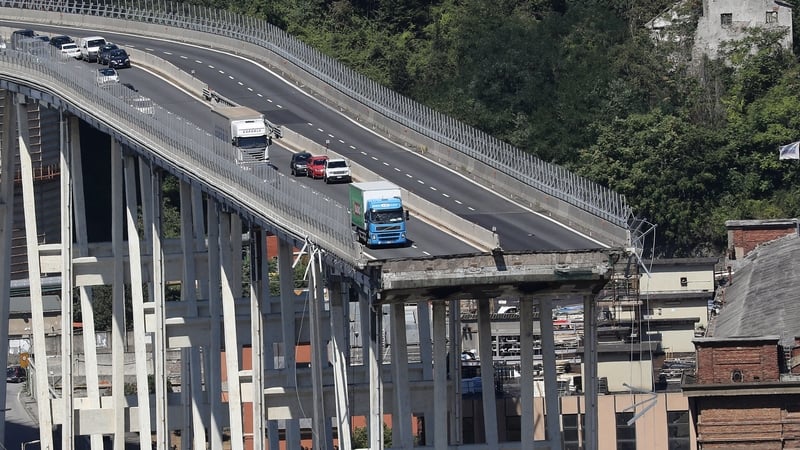
The former head of Italian motorway operator Autostrade per l’Italia has been sentenced to 12 years in prison for his role in a disaster that killed 43 people when a bridge collapsed near the city of Genoa in 2018.
Giovanni Castellucci was among 32 people convicted over the collapse of the Morandi bridge which sent vehicles plunging onto warehouses and a riverbed beneath the flyover during a summer storm.
Michele Donferri Mitelli, another former senior Autostrade manager, got an 11-year prison sentence.
A further 25 defendants were either acquitted or cleared because of the statute of limitations.
Egle Possetti, a spokesperson for the victims, called the Genoa court’s verdicts, which can be appealed, “a first stage … that opens up a ray of light”.
“We are satisfied with the sentences. The important thing was to identify the precise responsibilities for individual senior roles in the companies involved,” added Ms Possetti, who lost her sister, brother-in-law and her sister’s two children in the tragedy.
We need your consent to load this rte-player contentWe use rte-player to manage extra content that can set cookies on your device and collect data about your activity. Please review their details and accept them to load the content.Manage Preferences
There was silence as presiding judge Paolo Lepri read out the verdictsfor around 45 minutes in a courtroom packed with 400 relatives of the victims, lawyers, journalists and members of the public.
The case had become both a search for accountability for the disaster and a symbol of the slow pace of justice in complex Italian criminal proceedings.

Castellucci, who also served as CEO of Atlantia, the controlling shareholder in Autostrade at the time, was convicted of complicity in multiple counts of manslaughter through negligence.
Prosecutors had demanded a sentence of more than 18 years for him.
Castellucci is already in prison, serving a six-year sentence over another fatal incident in 2013 on a viaduct in southern Italy, and was not in court to hear the verdict.
His legal team said they would appeal and that he had been made a scapegoat.
“This is a defeat for the truth of what happened,” his lawyer Giovanni Paolo Accinni said.
“It is part of a trend that has already led to Castellucci being sent to prison. The criminalisation of the chief executive cannot be the solution. We will continue to fight for his innocence.”
Under the Italian legal system, the first instance ruling can be appealed at least twice.

Vehicles plunge from broken bridge
The collapse of the Morandi bridge on the eve of a national holiday shocked Italy and triggered years of investigations into the management and maintenance of its ageing infrastructure.
A 50-metre high section of the bridge collapsed with as many as 35 vehicles driving across it.
The disaster caused a dispute between Atlantia, controlled by the Benetton family, and the then government that ended with the sale of Atlantia’s controlling stake in Autostrade.
Prosecutors argue that years of inadequate maintenance, ignored warning signs and delayed safety work contributed to the collapse, alleging that vital work was postponed while profits continued to be generated and distributed.
Defence lawyers reject that theory. They argue that the disaster was caused by an original design defect in the bridge’s stay cable number nine, the one that failed, and that no maintenance programme could have prevented the tragedy.