
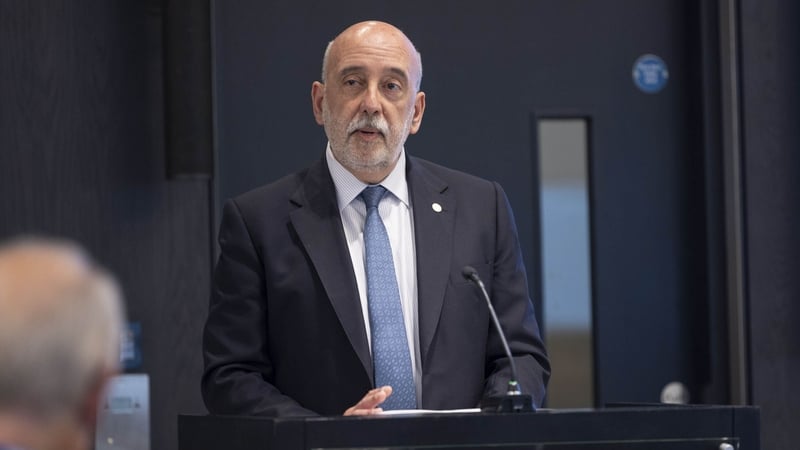
Central Bank Governor Gabriel Makhlouf has warned Minister for Finance Simon Harris if Budget spending overruns persist there could be a €25.7 billion deficit in the public finances by 2030 when unreliable tax payments from multinationals are excluded.
About half of the corporation tax paid in Ireland relates to activity which takes place outside the country and is considered a highly unstable source of revenue.
In a letter to the Minister ahead of Budget 2027, Mr Makhlouf said that the underlying deficit is forecast to be €20.4 billion by 2030, but if overspending beyond Budget ceilings continue it would reach €25.7 billion.
“This would deplete fiscal buffers, limiting capacity to respond to future negative shocks, while adding to domestic inflationary pressures,” Mr Makhlouf said.
He said the vulnerability in the public finances was “exacerbated by the exceptionally narrow nature” of corporation tax with 10 companies responsible for 56% of payments last year.
Corporation tax accounts for 23% of general government revenue, up from 12% previously.
Mr Makhlouf warned against using “potentially vulnerable revenues to fund permanent increases in spending.”
He called for the Government to broaden the tax base, which usually involves increasing the amount of activities which are subject to taxation and cutting back on exemptions.
Read the Governor’s letter here
Mr Makhlouf also sounded a note of caution about Ireland’s €210 billion national debt, following a warning last week from the National Treasury Management Agency that the interest bill will double from €3 billion annually to €6 billion.
“We know how vulnerable a small open economy can be to rapid changes in market sentiment,” the Central Bank Governor said.
“Reducing public debt as a share of national income should remain a key focus of national economic policy,” he said.
Mr Makhlouf said, however, there were reasons for optimism and “sound policy decisions” could help steer the economy through a turbulent international environment.