
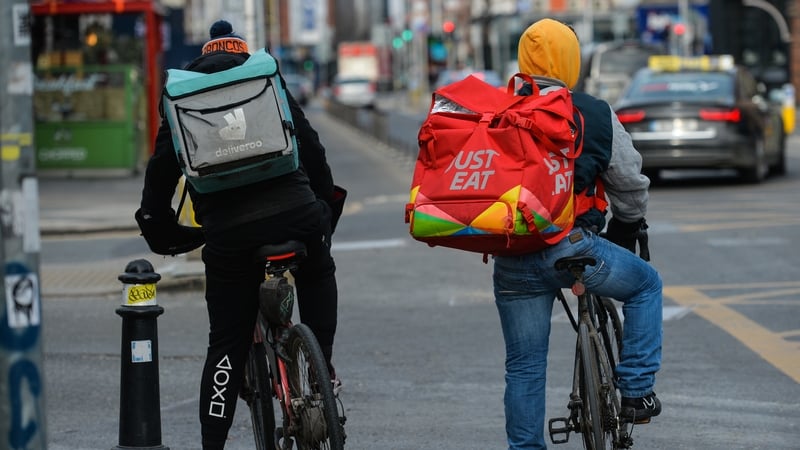
A new EU directive to be implemented by this December will change how delivery workers are classified and will likely increase prices of takeaways for customers.
The workers in the takeaway meal economy were typically classed as self-employed but new legislation will require them to be classified as employees.
“The way the people are working is changing and the legislation needs to change to catch up with it,” Dr Eddie Keane, assistant professor in employment law at University of Limerick, told RTÉ’s This Week.
There are two business models a restaurant can use to deliver meals to its customers.
Takeaway food deliveries either arrive to a customer’s door via a platform app such as Deliveroo, Just Eat or Uber Eats, or from a delivery service owned and run directly by the restaurant business.
Supreme Court judgment
Due to recent legal changes – redefining how delivery workers are classified – costs for restaurants who do deliveries within their own business are likely to increase.
Before a 2024 Supreme Court decision, many food delivery workers in Ireland were incorrectly classified as self-employed.
This clarification by the Supreme Court represents a big change for the food delivery industry as well as other industries that use a lot of gig-economy workers, Dr Keane said.
“Everything comes at a price and what has been happening up to this point is when the delivery drivers were being classed as independent, all of the costs of deliveries were effectively being visited upon the driver.
“The savings that could be made were being made by paying the drivers less and having less obligations in relation to them like not paying social insurance or not paying holiday pay.
“Once the drivers are considered to be employees, there is going to be an additional cost to be paid. The cost of social insurance, the cost of holiday pay.
“There is a social benefit to that, but there is also an economic cost.”

After the Supreme Court judgment (The Revenue Commissioners v. Karshan (Midlands) Ltd. t/a Domino’s Pizza), Revenue encouraged any business that engaged workers in the gig economy to review the nature of their employment.
Revenue gave businesses a disclosure opportunity to reclassify people from contractors to employees.
According to Revenue’s preliminary statistics, 286 employers reclassify more than 6,600 employees with total tax adjustments of more than €26.7 million.
Changes coming for delivery platform workers
For the workers who use a digital platform such as Deliveroo, Just Eats or Uber Eats, changes are also coming.
By 2 December this year, Ireland must transpose the EU’s Platform Workers Directive into law.
This does not apply to all gig economy workers but does give some protections to workers who use food delivery apps.
The digital platforms themselves can challenge the presumption of employment.
Dr Laura Bambrick, head of Social Policy and Employment Affairs at the Irish Congress of Trade Unions, welcomes the directive and says gig economy workers need more protections.
“Because these workers are treated as self-employed contractors, you’re only paid per delivery.
“So you’re going without the protection of minimum wage for each hour you work.
“You don’t have the protections of sick pay, of auto-enrolment pension contractors. contributions, social welfare benefits when you can’t work.
“Added to this, the pressure to keep the app happy, because if you have unhappy customers, that impacts on how the algorithm is assigning you to work, which has implications for how much you can earn.”
The two delivery models in the food delivery industry have allowed for relatively cheap delivery costs for meals in recent years.
However, now that employers will pay more tax for these workers, it is likely some of these costs will be passed on to the customer.
Dr Bambrick said the cost is already being paid.
“Under the current system, the tab is being picked up by the army of young, mostly migrant workers who are out on their bicycles working at all times,” she said.
“On top of that, we are all paying in the cost of this because we are missing hundreds of millions of employers PRSI not going into the social insurance fund.
“That’s the fund that pays our contributory social welfare benefits, including our contributory pension.”
In a statement to RTÉ’s This Week, the Department of Enterprise said it was committed to making the EU Platform Workers Directive law by the early December deadline.
“This is a significant and wide-ranging Directive, covering employment status, algorithmic management, transparency, data protection, health and safety, reporting, consultation and redress,” it said.
“The Department is coordinating work across relevant Departments and agencies to deliver it on time.”
It added that Ireland has robust employment rights legislation protecting workers and this includes those that work in the gig economy.

Restaurants like using the delivery platforms
According to figures from Just Eat, Irish people spend an estimated €2.2 billion on food delivery and takeaway orders each year.
On average, Irish households order three takeaways per month.
Adam Clancy, general manager of the two Doh Pizzas and two Zambreros restaurants in Limerick, said that they had looked into hiring their own delivery staff but it is easier to use the platforms because they give you more flexibility.
“Possibly we wouldn’t be able to do as many deliveries,” he said.
“Obviously there’s going to be some weeks where you’re doing loads of deliveries, other weeks it drops off a little bit.
“It varies massively from week to week. Some of our stores it ranges from average of 10-20% of our business. Other stores then it could be up around 40% of our business.”
Gary Huymh, head chef and owner of Sambros restaurant on Thomas Street in Limerick, said delivery is a huge part of their business.
“We work with all the big apps,” he said.
“I like using the delivery apps just because if you have a slow day, you don’t necessarily need to hire an order star to bring them in and stuff like that.
“It’s nice to have use of the delivery drivers that the apps provide.”
On a hot sunny day in July, demand for takeaway meals was not very high.
Delivery drivers speaking to This Week said that good weather is bad for them.
“[When it is] raining is when the delivery is the very best.”