
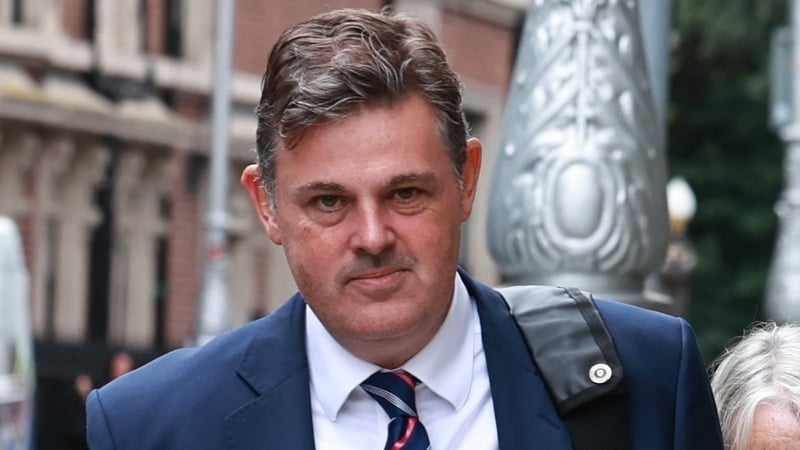
RTÉ Director General Kevin Bakhurst has “categorically refuted” media reports that the broadcaster is seeking additional public funding above what had already been agreed.
RTÉ executives told TDs in a briefing document ahead of their appearance before the Dáil Public Accounts Committee (PAC) tomorrow that it will need an additional €13.49 million more in State funding this year.
Its executives projected that €54.79m is needed this year, compared to €41.3m last year.
However, Mr Bakhurst said in a statement today that RTÉ is not looking for any additional public funding “beyond the commitment already provided by the Government”.
He said the projections are clear that the additional funding for 2026 is less than the anticipated €15m committed by the Government.
He said RTÉ will deliver its strategy with the funding commitment already given “which we remain grateful for”.
Mr Bakhurst said the Government committed to providing public funding to RTÉ of €725m over three years, from 2025 – 2027.
“This is phased as follows over the three years; €225 million in 2025, €240 million this year and €260 million in 2027,” he said, adding that “importantly” includes TV licence revenues.
He said that last year, during the first year of the public funding commitment, RTÉ received €41.3m in additional public funding from the Government on top of TV licence revenues of €183.5m.
“In line with the 2025 figure of €225 million, total public funding received by RTÉ in 2025 was €224.8 million,” said RTÉ’s Director General.
He said the figures for this year will not be finalised until the end of the year when total TV licence revenue figures for 2026 are known.
He said this figure will then allow the Government to determine the additional public funding needed to reach the €240m commitment for this year.
He stressed that RTÉ has not received any additional funding from the Government so far this year.

In a briefing document sent to TDs, RTÉ executives highlighted a “downward trend” in TV licences, with a 5% decline in the number of licences sold to the end of May this year compared to last year.
The national broadcaster explained that last year over 80% of RTÉ’s public funding came from licence fee income.
Under Irish law, only households who have a television or equipment capable of “receiving a broadcast television signal” must pay the TV licence.
It said there has been a 19% decline in TV licence sales since 2022.
The broadcaster said the estimated number of homes without TVs is around 424,0002 or 20.8% of the total household population.
RTÉ said the number of ‘no-TV homes’ has “increased steadily” particularly among young people and in urban areas.
It said many of those homes “rely exclusively on laptops, tablets and smartphones” and “regularly access” public service media through platforms like the RTÉ Player, social media clips and podcasts.
In July 2024, then media minister Catherine Martin announced multi-annual funding for RTÉ. This comes to total funding of €725m over three years up to 2027.
In his opening statement to the PAC tomorrow, Mr Bakhurst will tell TDs that RTÉ has reversed the trend of “reporting deficits and strengthened our financial position”.
He will say this is due to “tighter cost controls and supported by our new commercial strategy, which has driven digital revenue and is paying dividend”.
He will say that this is underpinned by the multi-annual funding commitment made in 2024.
“This certainty has enabled proper planning and contracting and we would appeal very strongly that a similar commitment is made in 2027 when this next comes up for review,” he will say.
Mr Bakhurst will say a recent review by Coimisiún na Meán showed a “recognised funding challenge for public service media in Ireland”.
“The commitment to the first multi-annual funding agreement was a critical step in addressing that funding volatility,” Mr Bakhurst will say.
RTÉ review of employee classification ‘almost complete’
Mr Bakhurst will also tell the PAC that a substantial review of employee classification is “almost completed”.
He will tell TDs tomorrow that “historical employment and contracting arrangements within RTÉ evolved over many decades” and “in some cases, lacked the consistency and clarity that would be expected today”.
Mr Bakhurst will tell TDs that addressing legacy arrangements is “complex” but that the leadership team remains committed to “resolving outstanding issues transparently”.
RTÉ’s policy of ‘Employee First’ has extended to on-air presenters, with the transition of more than 30 presenters to employment.
Mr Bakhurst will also say that progress has also been made in concluding PRSI classification matters, “with 90% of cases finalised” and that “New processes in operation should ensure that kind of ambiguity never arises again”.
The committee will also hear that the Comptroller & Auditor General has formally commenced the audit of RTÉ’s financial statements with effect from 1 July 2026.
This is ahead of the Broadcasting (Amendment) Bill 2026 being enacted, which brings RTÉ under the control of the C&AG.
“Strengthened governance structures, enhanced financial controls, expanded audit and risk oversight, improved reporting arrangements and greater transparency are all intended to ensure that RTÉ is fully prepared for this important change in accountability,” Mr Bakhurst will say.
Taoiseach criticises constant undermining of TV licence fee
Taoiseach Micheál Martin has criticised the constant undermining of the TV licence fee, adding it “only makes things worse”.
Speaking in the Dáil, he said the house has been divided over funding for public service broadcasting.
“I believe the licence fee does make a contribution, so this constant undermining of it, in my view, only makes things worse, because people are not prepared to support a universal levy,” a measure which he said was recommended by an Oireachtas committee.
“There’s no consensus on that in the House. So we do have problems here. We need to make up our minds what do we want.”
Watch: Taoiseach says ‘constant undermining’ of licence fee only makes things worse
Mr Martin was responding to Fine Gael TD Joe Neville who said RTÉ claim a drop in TV licence fees is down to households not having televisions.
However, Mr Neville said: “We all know that’s only part of the story. A major cause of the recent drop in sales is possibly due to the fact that there’s been financial scandals and unnecessary overspends.”
The deputy said these issues include €35,000 spent on limousines last year and RTÉ sending 41 staff members to cover Ireland’s World Cup playoff match in Czechia at a cost of €57,000.
Mr Neville said PAC will look for clarity from RTÉ executives tomorrow.
“We need clarity on what the future funding model is,” he added.
Mr Martin agreed that issues within RTÉ have to be “interrogated”.
Questions remain unanswered for PAC members
TDs on the Dáil’s Public Accounts Committee say documents provided to the committee, and a subsequent statement this afternoon by RTÉ, have raised several questions ahead of the broadcaster’s appearance at the Oireachtas tomorrow.
Fianna Fáil’s Seamus McGrath says he believes the state will be paying more towards RTÉ this year than last owing to a fall in licence revenue, despite an assertion by Kevin Bakhurst that the broadcaster would not be in receipt of a “bailout”.
The Cork South Central TD said he also notes how the broadcaster is to appeal for a continued commitment in funding from 2027, when the current funding arrangement ends.
“It seems long-term direct state funding is built into RTÉ’s sustainability plan,” he claimed.
Fine Gael’s James Geoghegan said he wants to press RTÉ executives on what reforms have been implemented at the broadcaster, especially around target numbers for its voluntary exit redundancy scheme.
Committee chair John Brady said: “Strengthened governance structures, enhanced financial controls, expanded audit and risk oversight, improved reporting arrangements and greater transparency are required to ensure that RTÉ is fully prepared for this important change in accountability, as it comes under the remit of the Comptroller and Auditor General.”