
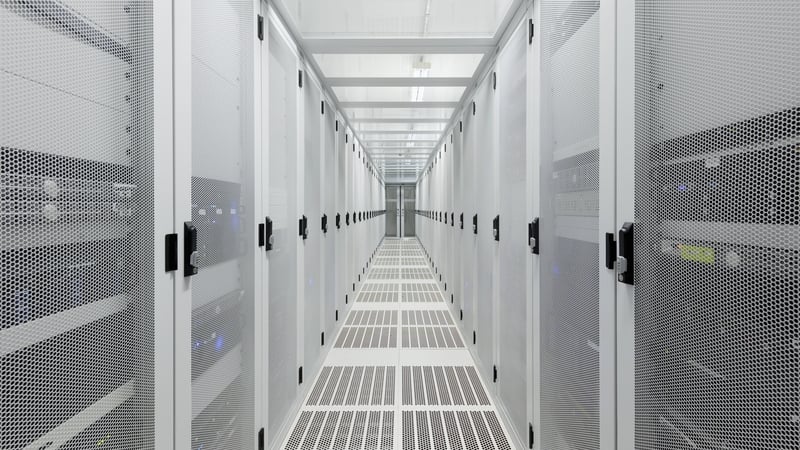
The percentage share of total metered electricity consumption used by data centres rose to 23% in 2025 up from 22% in 2024 and just 5% in 2015.
According to new figures from the Central Statistics Office, metered electricity consumption by data centres increased by 10% in a single year, rising from 6,973 Gigawatt hours (GWh) in 2024 to 7,663 GWh in 2025.
Consumption by all other users, including residential and other business customers, went up by 2% over the same period.
Quarterly tracking from 2015 to 2025 reveals that data centre electricity consumption grew from 291 GWh in the first quarter of 2015 to 1,991 GWh in the fourth quarter of 2025.
Total metered electricity consumption rose by 34% between 2015 and 2025.
We need your consent to load this flourish contentWe use flourish to manage extra content that can set cookies on your device and collect data about your activity. Please review their details and accept them to load the content.Manage Preferences
Large Energy Users, which includes significant data centres, accounted for the largest overall share of total consumption at 33% in 2025.
Their annual usage has risen 9% since 2024.
Total residential consumption of electricity, including both urban and rural dwellings, accounted for 28% of usage, compared with 23% by data centres.
It is estimated that the energy consumption level by data centres will grow to almost a third of the national electricity demand by 2030.

In January, the Government published a Large Energy Action Plan aimed at enabling the further development of energy-intensive facilities, including data centres.
It followed the lifting of an effective moratorium on new data centre connections.
In December, the Commission for the Regulation of Utilities announced that data centres could be built where they meet at least 80% of their annual energy demand through new renewable electricity sources.
In May, a report into data centres from Friends of the Earth suggested that their electricity consumption may be resulting in higher energy costs for households.
It found the average household may have paid an estimated €360 in additional electricity costs between 2015-2023, due, it said, to the intensity of data centre presence on the grid.

Last month, the Government published a report that it commissioned, at a cost of €100,000, in support of data centres.
It claimed that since 2010, €22 billion had been added to the Irish economy, an additional 17,000 jobs have been created, and €2.8 billion in tax has been collected because of data centres.
We need your consent to load this rte-player contentWe use rte-player to manage extra content that can set cookies on your device and collect data about your activity. Please review their details and accept them to load the content.Manage Preferences
‘Central part of Ireland’s economic and digital future’ – Chambers
Minister for Public Expenditure has insisted that data centres are “a central part of Ireland’s economic and digital future”.
Jack Chambers told the Dáil that, “in 2024 an estimated €104 billion in gross value added was enabled by data centre dependent sectors”.
He was responding to Social Democrats TD Jennifer Whitmore who warned of “higher electricity prices for domestic users” as data centre usage increases.
The deputy said that this risks “completely undermining our energy security”.
“Minister, how many data centres is enough?” she asked.
Minister Chambers insisted that the Government is committed to sustainably integrating large-scale energy demand and continuing with decarbonisation, and criticised “just attacking data centres”.
‘Surprised but not shocked’
Hannah Daly, Professor of Sustainable Energy at University College Cork said she was surprised but not shocked that data centres were an extraordinarily large user of electricity in Ireland.
Speaking on RTÉ’s News at One programme, Prof Daly said “Ireland is really seen as a very strong outlier across Europe and across the whole world in terms of the pressure that they put on our electricity sector”.
“And Ireland is increasingly being seen as a cautionary tale, as we’re seeing AI-driven data centre expansion right across the world. The extraordinary feature is not just the scale – they account for almost 1/4 of our metered electricity demand – but it’s the speed of growth.
“So, consumption has increased more than sixfold in just a decade. For that reason, Ireland has one of the fastest growing electricity demand patterns across Europe. Across Europe, electricity demand is effectively flat, or in many countries, it’s decreasing. And actually, Ireland’s per capita electricity demand, excluding data centres, is falling. But Ireland’s total electricity demand grew by around 34% since 2015, almost entirely as a result of data centres. And what’s striking is that that 10% growth last year is during a time when we were effectively under a moratorium, or almost a moratorium, on new data centre grid connections.”
Prof Daly said “as a result of the lifting of this grid connection moratorium, we’re actually seeing a new wave of new data centres in the planning system that are now coming with their own on-site gas power plants, which is a cause for concern”.
She said “it’s striking that there’s been no national level assessment of the future impact on greenhouse gas emissions, on electricity prices or on fossil fuel dependence as a result of the new growth in data centres.
“But what is not often highlighted is that there’s a six-year glide path period during which time they don’t have to add any new renewables. And what this means is that the demand can grow much faster than new renewables can be added to the system or that new electricity grid capacity can be added. And if you look at the historical numbers, we can see that, in fact, the growth in data centre electricity demand has outpaced the growth in renewables addition.”
Listen: RTE’s News at One reports on the CSO’s total metered electricity consumption data
We need your consent to load this rte-player contentWe use rte-player to manage extra content that can set cookies on your device and collect data about your activity. Please review their details and accept them to load the content.Manage Preferences