
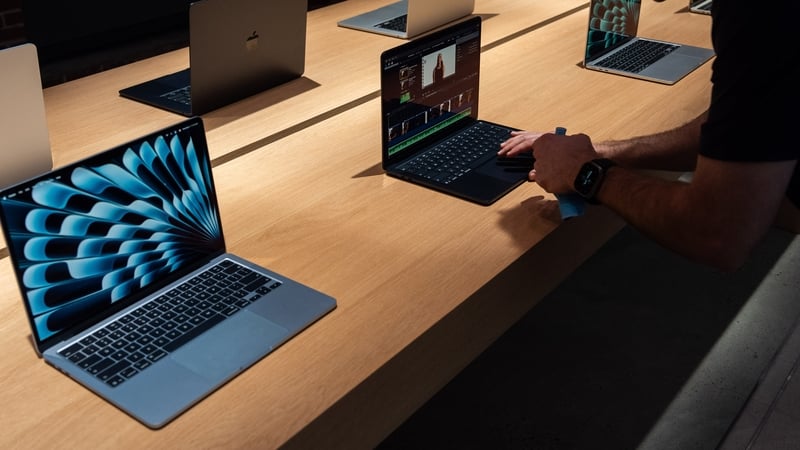
A ‘hundred-year flood’ is the uncharacteristically dramatic phrase Apple CEO Tim Cook used to justify the price rises the company announced on most of its prices last week.
That being said, the price increases were pretty dramatic too.
Many were in the 15-20% range – which is a lot of money when you’re talking about products that cost hundreds or even thousands of euro. Other increases, though, went above the 30% mark – with a few stretching beyond 50%.
The Apple TV is an example of that – it went from €189 to €299.
An iPad Air went up by €160 to €839 – roughly a 23% jump.
Meanwhile the 14 inch MacBook Pro got an extra €300 added to its price tag – or 15%.
And if you happen to be one of the few people who wants the highest end Mac – a Mac Studio M3 Ultra – you’ll now be forking out €6,399 for the privilege. That’s €1,300 more than it would have cost just just over a week ago.
Adding to the drama of Apple’s price hike was just how far across its product range that it stretch. In fact, one of the few product lines that was absent was the iPhone – which is by far Apple’s most popular product, and the main driver of its profit.
But even there, there’s an expectation that we will see the price of that rise when the company unveils its latest model in September.
Big Sur-price

What’s particularly remarkable about it is that even Apple seems to have been caught off-guard by this
In the middle of March the company unveiled an entirely new laptop line – called the MacBook Neo – which was targeted primarily at casual users and students.
And it was quite keenly priced – especially for an Apple product – at €699.
Now, though, that price is starting at €799.
That means that, just weeks after hitting the market, Apple has substantially raised the price. You’d imagine that, if they knew this was coming, they’d have just launched it at that higher price to begin with.
In a broader sense, though, Apple being forced into this kind of move is a bit of a surprise.
Of course they’ve raised prices before – but they tend to do so sparingly, and they tend to time them to coincide with the launch of a new model. They’re rarely so wide-ranging, and don’t tend to be nearly as severe either.
That is in large part due to Apple’s enviable ability to manage its supply chain and keeping a lid on its cost base.
Before he became CEO, as Apple’s chief operations officer, Tim Cook masterminded the company’s modern supply chain and all of the low-cost manufacturing in China – and more recently Vietnam and India – that has been at the core of its business model for decades now.
They have also been very good at negotiating really good deals with suppliers – and squeezing those deals for all their worth.
Part of that is because of the amount of buying power Apple has – particularly when it comes to smartphone components. But part of it is just how clever they are at finding multiple uses for those components.
Across their product range you have examples of multiple products that – under the hood – are essentially the same.
For example, some of the parts that are used to power an iPhone are the same parts that are used to power an iPad. in many cases, an iPad is just an iPhone with a bigger screen.
At the same time, some of the more powerful Macs and MacBooks share components with the higher end iPads.
The new MacBook Neo is a perfect example of this kind of component repurposing.
It’s powered by a processor that first appeared in the iPhone 16, launched in 2024. The smartphone line has since moved on from this chip but it’s by no means obsolete – it’s still plenty powerful enough to be the workhorse behind an entry-level computer.
So, with a fair few of the chips sitting in its inventory, Apple created an entirely new product line to put it to good use.
As a company they’re really good at taking one piece of technology and applying it in different ways and different form factors – which all goes towards improving their economies of scale and buying power.
Chain reaction

Though it is worth saying that while Apple has, for a long time, been really good at managing their supply chains and keeping their costs down – they haven’t tended to pass the benefit of that on to consumers.
Generally speaking Apple products are priced at a premium to other brands’ equivalents – and while you can argue about whether that’s justified or not – it ultimately means Apple typically enjoys a much healthier profit margin than pretty much every other consumer technology company.
Dell, for example, last year had a profit margin of around 5% for its consumer and commercial product division. Samsung’s consumer products tend to sell at a profit margin of around 20%.
Apple’s margin, meanwhile, tends to sit in the 30-40% range. In its most recent quarter, its gross margin was just shy of 50%.
So when Tim Cook claims that they tried their best but that it had become ‘unsustainable’ to protect consumers from rising component price increases, there’s a little asterisks to add there.
The truth is Apple probably could have shielded their customers a little bit more – but it would have meant taking a hit to their profits.
All that being said, though, there is no denying Cook’s central point that the key technologies behind computers and smartphones have gone through some dramatic price rises in the past year.
So much so that it’s gotten a name – RAMageddon.
Battering RAM

A reference to Random Access Memory or RAM – a key component in pretty much every device – RAMageddon refers to the dramatic shift in prices lately.
One that’s making everything – from high-end PCs to memory cards – more expensive.
One industry data source, TrendForce, suggests the price of RAM had almost doubled in the first three months of the year. It’s predicted to have enjoyed another 60% rise in the most recent quarter.
Another company – Counterpoint Research – suggested that certain types of RAM had almost tripled in price between September last year and March of this year.
And the blame for this has been put at the door of AI.
Because there is extraordinary demand for high-end computer components right now – the likes of RAM and computer processors – because they are what power the servers, which power the data centres, which power AI.
It’s estimated that more than $2.5 trillion will be invested in AI this year – and most of that is going towards building out new data centres, or expanding and upgrading existing ones to allow them to handle more data.
And it’s not necessarily the case that the RAM that’s being bought for these data centres is the same as what’s needed for your computer or smartphone – it’s often far more powerful than that.
But it is probably being made by the same company – because there are only a small number of companies able to manufacture at that scale and complexity.
They each have a limited amount of manufacturing capacity – so if they’re making a choice between devoting production lines towards RAM for consumer devices, made by companies like Apple that are trying to squeeze supply chains, or RAM for deep-pocketed tech firms who are throwing hundreds of billions of dollars around in a desperate attempt to get an edge on their rivals – then the choice is relatively obvious.
That leaves the consumer market with a supply shortage – and, of course, when you’ve strong demand and weak supply, that pushes up the price.
It’s an almost identical dynamic to what happened with computer processors a few years ago.
Nvidia would traditionally have specialised in the relatively niche market of graphics processors for high-end PC gaming. But, when it turned out its most powerful chips were ideal for powering AI data centres, it started to focus more of its supply in that direction – because they were willing to pay an awful lot more for a processor than the average consumer was.
And that led to dramatic shortages of consumer products – followed by dramatic price rises.
Its flagship RTX graphics card would have cost you less than $700 when it launched nine years ago. The equivalent processor today would cost you around $2,000.
Tech-tonic shift

This, of course, means that Apple isn’t the only company that’s had to raise prices recently.
In some cases, we’ve seen companies make similar, sweeping price changes to Apple’s.
In other cases, firms have opted to quietly (and regularly) add a bit to their prices every few weeks as they try to keep up with the market.
In April, Samsung raised the prices on some of its flagship phones and tablets, Dell increased the cost of its PCs at the end of last year.
The same has happened with Lenovo, Asus and HP.
(In certain cases companies have opted to downgrade the amount of processor power or RAM that’s offered in specific models – kind of like Shrinkflation but for computers.)
The same trend has been impacting businesses, too, because the cost of servers has increased.
In fact you would struggle to find any consumer tech company that has not had to raise prices in the past six to 12 months. No part of the industry is immune, which has created some really strange market dynamics – particularly in the gaming industry.
Because, when it comes to games consoles, they’ve traditionally tended to follow a predictable life cycle.
A new games console is released – usually at a relatively high price – and then, over time, the price of the console starts to fall.
This is in part thanks to the economies of scale that are enjoyed as more consoles are sold – as well as the manufacturers’ desire to widen its customer base – but it largely hinges on the fact that the console’s components get cheaper and cheaper over time.
And that’s been the way these things have worked for decades now.
When the PS2 launched in Europe in 2000, it sold here for the equivalent of roughly €480. By 2004, a more compact but just-as-powerful version of the same console was selling for around €149.
But the dramatic rise in processor and RAM prices has totally turned that trend on its head.
When the PS5 launched in Ireland in late 2020, the base model cost €400. Today, the cheapest PS5 you can buy costs €600.
That’s a 50% price increase on a product that has now been on the market for more than five and a half years.
It’s a similar story with Microsoft’s Xbox – the Series S launched here in 2020 at €300 but now costs €350. And Microsoft recently announced it would be adding another $100 (€87 at current conversion rates) to that from 1st August.
Meanwhile Nintendo’s Switch 2 only hit the market a year ago. At the time its European RRP was €470 in Europe but the Japanese firm recently announced it would be raising that to €500 due to “changes in market conditions”.
Sale, away

While this is clearly bad news for consumers, it could come at a cost to the tech companies too.
Their price rises are coming against a backdrop of high inflation across the board – all while concerns around job security, the impact of AI and the general direction of the global economy weigh on people’s minds.
This is compounding the financial pressure households are facing after years of high inflation.
As a result most people feel their spending power has waned – and could weaken further in the years to come.
And if you have a situation where people are worried about their financial situation, or in the thick of feeling financial pressures, the first thing they’re going to curtail is spending on luxuries like games consoles.
And even where it’s less of a luxury and more of a necessity – like a phone or a laptop – the people that might have upgraded every two or three years may now look to do so every three or four years instead.
Or they might opt for an entry level device, rather than one of the premium options.
Research firm IDC is currently predicting that the smartphone market could see sales decline by 14% this year – which would be its biggest ever fall. It thinks the PC market would decline by more than 11%.
And while you might think that the tech firms’ higher prices will cushion the blow for them, that may not be the case.
After all, if they’re raising prices in order to make up for the higher costs they’re being charged by component manufacturers then they’re not really going to feel the benefit.
The reality is the main winners from this inflation cycle will be a handful of companies – including a few that you may never have heard of before, like SK Hynix and Micron Technologies.