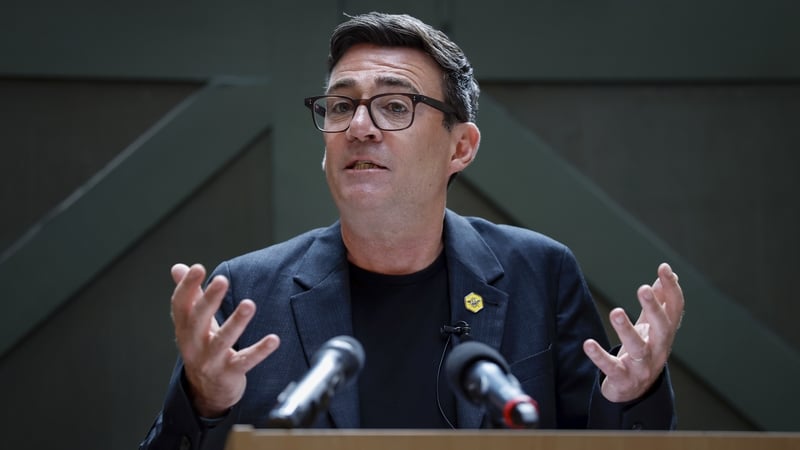
Veteran Labour politician Andy Burnham, who is set to succeed outgoing UK Prime Minister Keir Starmer, has vowed to “bring about the biggest rebalancing of power our country has seen” if he takes power.
Mr Burnham promised to give the UK a “new direction” with the biggest transfer of power out of Whitehall in modern times.
The prospective prime minister promised to end “politics as usual” to rescue a country which is “stuck in a rut”.
In his first major speech since Mr Starmer announced he would be leaving Downing Street, Mr Burnham pledged to pull people together in the “broadest possible coalition” to revive hope across the country.
“The change will be driven through the prime minister’s office in an extended operation based here in Manchester,” Mr Burnham said.
He added: “What hope can we have that it will be different this time? That is the question I would be asking if I was a voter right now.
“It is the one I want to answer as clearly as I can today, and in doing so give the new direction the country is looking for after 10 years of political turbulence since Brexit and 20 years of falling living standards since the 2008 financial crash.”
Read more:
‘King of the north’ sets out big picture political offering
The Makerfield MP, who gave up being mayor of Greater Manchester to return to parliament in a by-election earlier this month, said: “Westminster has not been working for people and it has not been working for a very long time. In fact, it is broken.
“And as a result, the country isn’t where it should be. It is stuck in a rut, and clearly we can’t go on like this.”
During his campaign to become an MP, Mr Burnham remained vague about his economic agenda, particularly on whether he would shift the ruling Labour party to the left.
First as mayor and now prime minister-in-waiting, Mr Burnham’s mantra has long been devolution, or empowering local authorities to make decisions on everything from transport to housing.
Among his more defined economic beliefs is greater “public control” over services like transport, water and energy.
We need your consent to load this rte-player contentWe use rte-player to manage extra content that can set cookies on your device and collect data about your activity. Please review their details and accept them to load the content.Manage Preferences
During his campaign, Mr Burnham positioned himself as a champion for small businesses and proposed cutting business rates for pubs and music venues.
In his speech, Mr Burnham said he would not announce any appointments until the end of the leadership election process.
He added: “I will reach out to other political parties to find as much common ground as we can and build that more collaborative approach I spoke about a moment ago, so a greater sense of unity in Parliament will then allow us to give a clearer sense of direction to Whitehall.”
In the days since Mr Starmer resigned, speculation has been rife among UK media and businesses about who Mr Burnham will appoint as his finance minister, which could determine just how left-wing and pro-nationalism his government will be.
US President Donald Trump chimed into the debate as well, calling Mr Burnham an “extremely liberal” politician who likely “won’t open up” the North Sea to oil and gas drilling.
Additional reporting AFP