
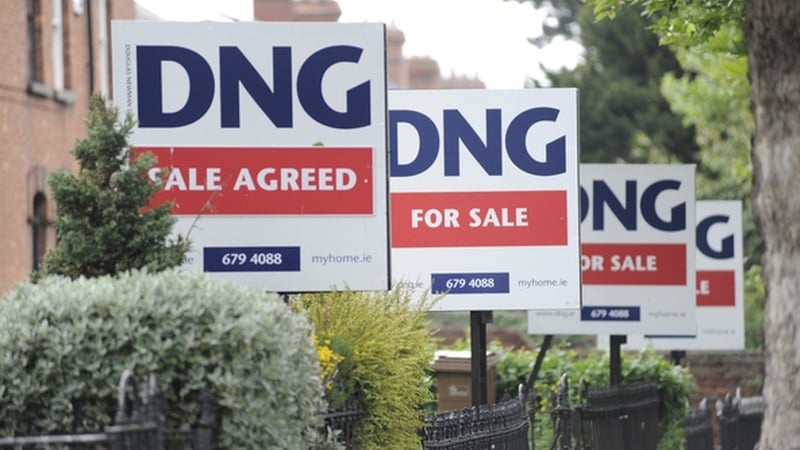
House price inflation has continued to ease nationally so far this year, according to the latest residential market review from DNG.
The property advisor’s National Price Gauge, which measures the change in second-hand house prices in the capital, has recorded an increase of around 3% in Dublin in the first six months of this year.
That was similar to the second-half of last year, so prices are rising about 1.5% a quarter.
On an annual basis, residential property prices increased by 5.6% in the year to June 2026, marking a slowdown from the 7.4% growth recorded in the 12 months to December 2025.
Speaking on RTÉ’s Morning Ireland, DNG’s Head of Research Paul Murgatroyd said while there has been an easing in the rate at which prices are growing in the capital, prices are still increasing there.
“Our analysis shows that the average second-hand house price in the capital stands at €630,000, that’s up around €30,000 in the last 12 months,” he said.
“That’s not the price that everybody pays – that’s our mid-range average, which is high, so prices are elevated and that is impacting affordability to a degree in the Dublin market,” he noted.
The annual rate of house price inflation outside the capital was more elevated according to the DNG report which monitors it every six months.
In the year to the end of December last year, it was over 7.5% and that is down to 5% now.
“Those growth rates have fallen in line – it’s not quite a two-speed market, but we’ve seen the national picture change slightly in the first six months of this year,” he said.
“The figure there for the average price nationally, excluding the Dublin market, is around €330,000, so significantly lower than the capital,” Mr Murgatroyd added.
The highest increases were in the Midlands and Midwest regions which both saw growth above the average rate at around 7.5% per annum.
At the other end of the scale, but still just below the average at about 4.5%, was the mid-east and southwest regions.
On the sales side, 20% of vendors were landlords selling investment properties in the second quarter of 2026, down from 27% of sales in the third and fourth quarters of 2025 when the number of landlords leaving the sector rose following the announcement of the new rental sector reforms which were then enacted in March this year.
Mr Murgatroyd described this spike as there was “shock and uncertainty” initially when the rules came into force.
“Then actually as landlords became to see what the rules were and regulations, that levelled out,” he said.
“That’s not to say there won’t be more going forward because as tenancies end, landlords will make decisions, it’s not cast iron that will stay at that level, but it just seems to have been a temporary spike,” he said.
DNG CEO Keith Lowe added; “New homes output is expected to increase over the next 12–24 months, particularly in the capital, as Government housing initiatives continue to gain traction”.
“Apartment development in Dublin is likely to see a significant uplift due to the success of the Croí Cónaithe Cities Scheme, which is helping to bridge viability gaps and unlock stalled projects,” Mr Lowe said.
“Based on the high volume of approvals currently being granted under the scheme, we anticipate a substantial increase in apartment construction commencements by year-end,” said Mr Lowe.
He also said there has been a notable rise in new home sales, encouraging developers to bring forward additional housing schemes.
“We are aware of a number of large-scale developments that are expected to commence construction across regional locations in the near term, further supporting an increase in housing supply,” he added.