
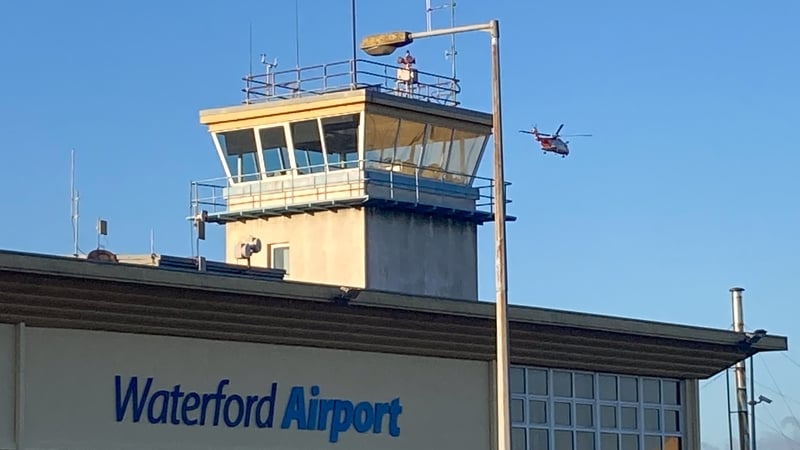
A veteran Coast Guard rescue helicopter crewman who spent five months out of work after hurting his shoulder despite being repeatedly cleared for duty has won €50,000 for disability discrimination.
The award was made to winch operator Adrian O’Hara by the Workplace Relations Commission on foot of a complaint under the Employment Equality Act 1998 against CHC Ireland DAC, the former operator of the Irish Coast Guard search and rescue helicopters.
Mr O’Hara, a career search and rescue airman, flew in the Coast Guard’s Rescue 117 helicopter out of Waterford Airport.
In 2021, he had over a decade under CHC’s employment working as a winchman – a paramedic role which required him to descend from the aircraft to retrieve people from danger.
However, after some medical leave that year, he returned to work as a winch operator, whose duties keep them on the aircraft during a rescue operation, the tribunal was told.
Mr O’Hara said in evidence he continued to work as a winch operator until he suffered a shoulder pain in November 2023.
He was signed off on medical leave and was diagnosed with a degenerative shoulder condition by a specialist doctor – who advised him he would “probably be fit for work by March 2024”, he said.
On 7 March 2024, Mr O’Hara had an occupational health appointment, which found him “medically fit for work” but added certain restrictions.
The assessing doctor advised that Mr O’Hara avoid certain extended shoulder joint positions, as well as repetitive overhead activities and “high-risk manual handling activity”.
His general practitioner advised he was ready to go back to work on 13 March 2024, and Mr O’Hara did so in April after receiving medical clearance for flying duties, the tribunal heard.
However, on 19 April 2024, he was told by email that the company had done a risk assessment on 9 April that year and decided he was “not to return to flying duties”, it was submitted.
He was also told that his sick leave entitlements would run out in mid-May, the WRC heard.
The risk assessment by technical crew manager Derek Everitt concluded the restrictions in the medical report “could not be avoided while operating a winch on a helicopter”, the tribunal heard.
Mr O’Hara would also have difficulty putting on his immersion suit, though a suit with a diagonal zip arrangement would help and had been ordered, the risk assessment noted.
Mr Everitt said in evidence he took issue with the fact the risk assessment was a “paper exercise” and believed a practical assessment ought to have taken place.
He told the hearing that even though he had conducted the risk assessment personally, he believed it was a “predetermined process” and said he “should not have signed it”.
“He was so exercised about trying to have that first risk assessment withdrawn he eventually resigned from the company,” the decision noted.
“The complainant was deeply upset by this, as it [the risk assessment] was a decision made without his involvement, which flies in the face of all the professional advice,” Mr McCabe’s barrister submitted.
He continued to report for work at the Waterford helicopter base as rostered until 9 May that year, the tribunal heard.
On that date, he was told in correspondence he should have been on sick leave and was being put on immediate medical leave, it was submitted.
He attended a three-day medical course in June 2024 and completed a practical assessment in Waterford on 22 July that year.

The tester concluded that Mr O’Hara had gone through “extreme” testing and passed the practical assessment “beyond reproach”, the tribunal was told.
“No further practical assessment will be required to allow [him] back on rostered shifts as a winch operator,” the tester added.
Mr O’Hara’s case was that he took ill and was brought to hospital by ambulance in August 2024 due to the stress of his work situation.
CHC’s lawyers disputed this and argued Mr O’Hara would be on “full proof for the assertion that any hospital stay was the result of [the company’s] actions”.
He filed a formal workplace grievance the same month alleging he was being excluded from work and “forced into unnecessary sick leave” – a grievance which was ultimately upheld, the WRC was told.
The respondent submitted that after a further medical assessment in September 2024, Mr O’Hara was passed fit to return to work immediately.
The CHC human resources officer, Lesley Sim, accepted there were “delays” in Mr O’Hara’s return to work but said the firm had “a duty of care” and had keep staff out until medical issues were resolved.
CHC’s legal team accepted it was an “oversight” not to to involve Mr O’Hara in the first risk assessment and that delays were down to lack of availability of aircraft third-party scheduling with occupational health firm Medmark
Adjudication officer Gaye Cunningham ruled that CHC discriminated against Mr O’Hara due to the “lengthy delay taken to allow him to return to work”, as well as failing to consult with him on reasonable accommodation and doing a risk assessment in his absence.
Ms Cunningham directed the payment of €50,000 in compensation for the disability discrimination.
She also ordered CHC to review its processes for returning staff to work after a medical absence.