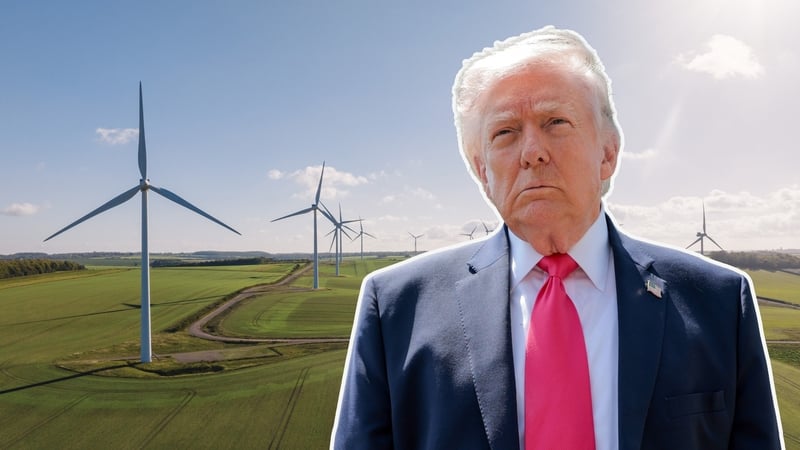
US President Donald Trump’s disdain for wind power – reportedly first seeded by wind turbines visible from his Scottish golf course – is well documented.
Not only are windmills – as he refers to them – “ugly,” “noisy” and “expensive,” but they kill birds, according to the president.
“Want to see a bird graveyard?” he said.
He is right that wind turbines do kill some birds – but far fewer than cars, cats and building glass collisions, according to the American Bird Conservancy.
Nevertheless, the president’s beef with wind, coupled with his contention that climate change is “a hoax”, has resulted in robust action to dismantle America’s wind power industry.
And it is seeing some success.
Gone are the Biden-era tax breaks and investment incentives to clean up America’s energy.
Under a new Trumpian directive of “drill, baby, drill”, energy companies are being paid instead to abandon wind turbine projects midstream and plough the money into fossil fuels.
In one such “pay-not-to-play” deal, the government reimbursed the French power company TotalEnergies for its offshore wind farm leases, to the tune of $1 billion (€866m).
The US Attorney General Pam Bondi said the agreement “prioritises affordability for hardworking American consumers over the prior administration’s ideological, ineffective energy policies”.
The government said it would enhance US national security and reduce bills.

Under the terms of the deal, TotalEnergies agreed to redirect the funds into oil and gas projects.
“Considering that the development of offshore wind projects is not in the country’s interest, we have decided to renounce offshore wind development in the United States, in exchange for the reimbursement of the lease fees,” said Chairman of the Board of Directors and Chief Executive Officer of TotalEnergies Patrick Pouyanné.
The federal government was also successful in halting the Golden State Wind project off central California and Bluepoint Wind off the coast of New Jersey, again paying out in the region of $1 billion to the companies behind them.
But it sparked immediate backlash from Democratic politicians.
Governor of New York Kathy Hochul demanded answers from the White House.
“When I heard this, I said one thing: I’m the governor of New York, if there is a national security threat off the coast of New York, you need to tell me what it is – I want a briefing right now,” she said.
“Well, lo and behold, they had no answer,” she said.
On Tuesday, New York Attorney General Letitia James filed a lawsuit on behalf of seven Democrat-run states including Connecticut, Maine, Massachusetts, New Jersey, New York, Rhode Island and Vermont, in a bid to have the TotalEnergies deal overturned.
“This administration cooked up a sham deal to pay a foreign energy company hundreds of millions of taxpayer dollars to abandon offshore wind and invest in oil and gas instead,” Ms James said in a statement.

“We are fighting back to stop this illegal agreement that threatens to erase over a thousand union jobs and cheat millions of New Yorkers out of clean, affordable energy.”
The California Energy Commission, meanwhile, launched an investigation into the shelving of the Golden State Wind project.
The director of the state’s environmental defence fund energy programme Michael Colvin called it a “wasteful deal” that will cost the American taxpayer.
“As families face soaring bills driven by fossil fuel price spikes and as power demand from data centres, industry and homes keeps rising – we need to bring more reliable clean energy onto the grid with stable, predictable costs,” he said.
Like with other government policy areas, the battlelines have largely been drawn inside the courtroom where there is already a slew of litigation challenging the administration’s stop work – or in this case stop wind – orders.
And federal judges have been busy striking down the administration’s orders on five offshore projects along the East Coast.
“The administration has tried different legal approaches to stop these projects, and so far the courts have rejected each one,” said Hillary Bright of Turning Forward, an offshore wind campaign group.
“Federal judges have allowed all five projects that received stop work orders in December 2025 to continue construction, and three of those five are now delivering power to American homes and businesses,” she said.

But the tug of war over wind is not a simple partisan issue in American politics.
In fact, the biggest explosion in clean energy in America in the past few years has taken place in red states.
Texas, famous for oil barons in ten-gallon hats, is now the country’s undisputed leader in wind power, generating roughly a third of the nation’s wind electricity.
Also at the top of the list are Iowa, Oklahoma and Kansas – all firmly in the Republican heartland.
And despite the high-profile cancellation of offshore wind projects, some largescale onshore projects continue apace.
New Mexico, for example, is about to flick the switch on America’s biggest wind farm to date.
The SunZia wind project, with capacity to supply electricity to some three million people, is due to begin operating in the coming week.
In fact, wind is on track to have its strongest year in America since 2022, according to David Groarke, of Indigo Advisory, a consultancy.
“Over eight gigawatts have been installed,” he told RTÉ News, as developers rush to meet the Biden-era tax credits before they expire.
“There’s an incentive to move quickly, and that’s why we’re having a record year,” he said.
But it will not last.
“The Trump administration and various other factors are hampering the growth of wind,” he said.
“Right now, wind is about 10% of US electricity, and it’s going to stay at that figure roughly through 2030,” he said.
The atmosphere of uncertainty around wind is likely to spook developers, who plan projects years, if not decades out.
With wind beset by firm opposition from Washington and legal battles countrywide, it does not feel like the best time for investors either.
The first quarter report from the industry body American Clean Power showed steady growth in solar and batteries, but a slowdown in wind.
“The pipeline for land-based wind has stagnated, and offshore wind has plummeted by 35%,” the report found.
“Early and-mid-stage land-based wind projects have struggled to secure approvals from federal regulators, and offshore wind continues to weather permitting roadblocks and uncertainty,” it said.
At a time of “load growth” on the electricity grid, largely due to data centre rollout, the cost of shelving wind projects will likely be passed onto the consumer, according to Ms Bright.

Though some projects have been cleared to resume, “the construction pause has cost developers millions of dollars and, along with Trump’s sustained attacks on renewable energies of all kinds, injected uncertainty and additional risk into future projects”.
“Such delays also mean additional costs for ratepayers,” she said.
When it comes to wind, the United States is pursuing a very different approach to other nations.
China has gone all in and now produces more than half of the whole world’s wind electricity capacity.
Brazil and India are similarly surging ahead with wind turbine installation.
And smaller countries like Denmark and Ireland have increased their share of wind electricity generation to 58% and 35% respectively.
“Other developed economies have consistent policy across administrations,” Mr Groarke said, “and that leads to a good marriage of economic incentives and certainty in the market, and the ability for developers to plan long range”.
That is not the case in the US.
Fossil fuels are very much in vogue under this administration. On Thursday the US President announced $700 million (€606m) in new federal funding for the coal industry. Two new coal plants are set to be built.
This is a dramatic shift from the policies of the previous administration.
“What’s happening in the US is it’s primarily an economic argument that’s been made for energy, and there’s inconsistency at the federal policy level,” he said, “which means that the energy build out here is primarily being built on market forces”.
“Which is very American when you think of it,” he added.