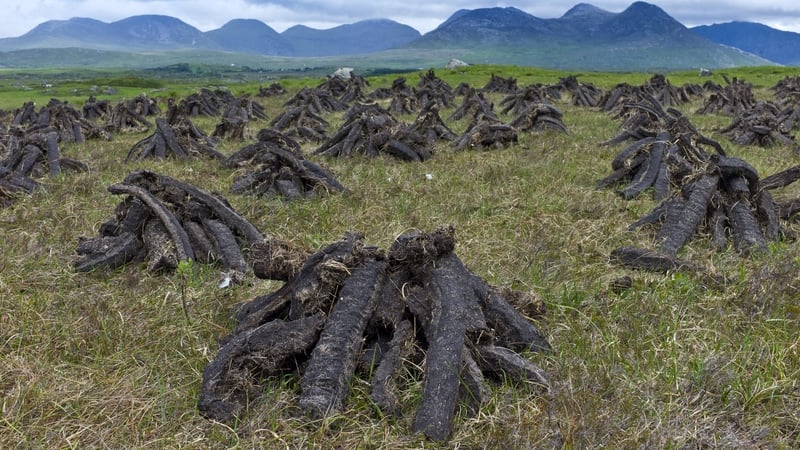
The European Commission has taken Ireland to Europe’s highest court over the alleged lack of enforcement of EU rules when it comes to peat cutting.
Following years of friction between the Government and the Commission on the issue, the EU’s executive body today referred Ireland to the European Court of Justice (ECJ) for failure to comply with EU rules on environmental impact assessments.
In a statement, the Commission said Ireland had failed to comply with the Environmental Impact Assessment Directive.
The statement claimed there was still “significant peat cutting activity” which was not subject to planning permission or environmental impact assessments, especially in relation to sites under 50 hectares.
“Despite evidence of these ongoing illegal activities, enforcement action at the local level is not being taken. The Commission considers that efforts by the Irish authorities have been insufficient and is therefore referring Ireland to the Court of Justice of the European Union,” the statement added.
The issue dates back to the first environmental impact assessment rules which were enacted in 1985.
Ireland was taken to the ECJ in the late 1990s over the incorrect transposition of the directive and was subject to a court ruling in 1999.
Despite Ireland changing its legislation in response to that rule, there was no follow up enforcement action, according to the Commission.
We need your consent to load this rte-player contentWe use rte-player to manage extra content that can set cookies on your device and collect data about your activity. Please review their details and accept them to load the content.Manage Preferences
As a result, Brussels took action for a second time, sending a “letter of formal notice” in July 2019 and a so-called reasoned opinion in July the following year.
Today’s statement said: “At that time, there were significant peat cutting activities ongoing that had not been subject to planning permissions or environmental impact assessments.
“Since July 2020, Ireland has taken significant action to halt peat cutting by the state-owned operator Bord Na Móna.
“Rehabilitation action on the sites owned by Bord Na Móna, where industrial cutting had taken place earlier without an environmental impact assessment, is now underway, largely funded by the EU through its Recovery and Resilience Facility.”
The statement added that since July 2020, the Irish Environmental Protection Agency (EPA) has been undertaking enforcement action against operators on privately owned commercial sites of over 50 hectares, resulting in some commercial peat operators ceasing their activities.
A statement from the Department of Climate, Energy and the Environment said that it noted the announcement by the European Commission.
It said that commercial peat extraction is a regulated activity and that “enforcement against activity at smaller sites, at a local level as refenced by the Commission, is a matter for planning authorities and the Department of Housing, Local Government and Heritage”.
It said that details of enforcement action by the EPA in respect of unauthorised extraction activity at the largest sites are available on the EPA’s website.
The department also specified the different permissions required for peat extraction at different scales:
- Fewer than 30 hectares: Planning permission from the relevant local authority and an Environmental Impact Assessment (EIA) may be required. An Appropriate Assessment (AA) is also required if peat extraction could have a significant effect on a protected area.
- 30 to 50 hectares: Planning permission from the relevant local authority and an EIA is required. An AA is also required if peat extraction could have a significant effect on a protected area.
- Greater than 50 hectares: An Integrated Pollution Control (IPC) licence from the EPA, planning permission from the relevant local authority and an EIA is required. An AA is also required if peat extraction could have a significant effect on a protected area.