
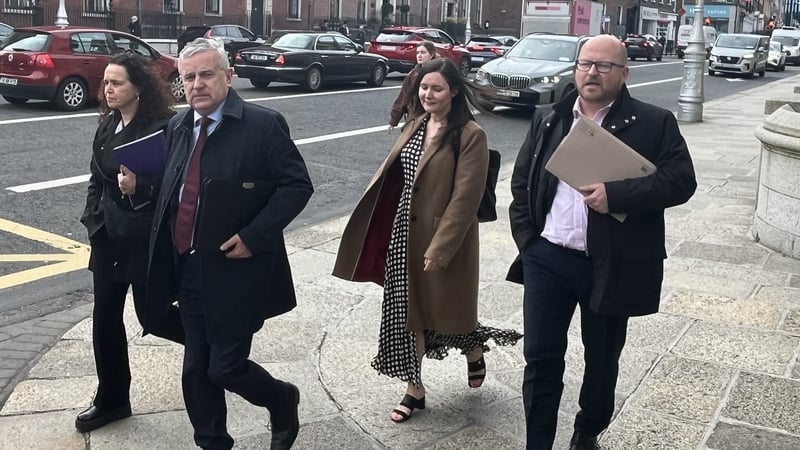
General Secretary of the Irish Congress of Trade Unions Owen Reidy has warned that strike action would probably be “inevitable” if the Government does not listen to the concerns of workers.
Mr Reidy was speaking following a meeting with Government and employer representatives to discuss the impact of the rising cost-of-living on workers.
The Taoiseach chaired the Labour Employer Economic Forum (LEEF) which was also being attended by the Tánaiste, Minister for Public Expenditure, Minister for Enterprise, and Minister for Climate, Energy and the Environment.
They held talks with representatives from ICTU and employer groups including Ibec.
Mr Reidy said there would be further meetings with the Government over the coming weeks and that they would hope to agree on measures to support workers in the next four to six weeks.
He warned of possible industrial unrest in the future.
“Our point has been that if Government doesn’t listen to organised labour at this time, with this crisis, particularly after what happened last week, strike action is probably inevitable as a result of that,” Mr Reidy said.
“Obviously, what we want to do is make sure that we can protect households, workers, families, and their incomes,” he said.
“We want the Government to adopt policies that we’re going to advocate over the next four or six weeks to do that,” Mr Reidy added.
He also said that he thinks the industrial peace of the last decade “has possibly been taken for granted”.
Watch: ‘Important Govt heed the interest of workers’ – ICTU
ICTU sought the meeting to discuss the impact of rising prices on workers, particularly high fuel costs.
The current public sector pay deal is due to expire at the end of June and negotiations on a successor agreement are expected to begin in the coming weeks.
ICTU has previously said that if the Government that can find €500m for the recently announced fuel support package has no credible case to make for restraint at the pay talks table.
Speaking on his way into the talks, Minister for Enterprise Peter Burke warned that said that the fuel support package also benefits workers.
“About 70% of the package is in relation to excise, carbon tax, and in relation to the NORA levy,” Mr Burke said.
“Every single worker, the 2.83 million workers that are currently going out to work use fuel, the majority of them. So that is a package for them. The other 30%, if you look at that, is in relation to getting groceries on our shelves,” he added.
Watch: Fuel support package also benefits workers, says minister
“So the cost of production, the logistics in getting it there, trying to mitigate the inflationary risk on bread and milk and all the other groceries, that we need every single week. And the families really grapple with the price increases.
“So the package is targeted at workers, but we also have to look at the future, and the future is very uncertain right now, because we know the current crisis does not look like stopping anytime soon,” Mr Burke added.
“The strait is still blocked. The price of energy is going to increase. We know a lot of the forward contracts that our energy suppliers have come midway through the year. You could see price increases of 30% upwards if this blockade continues.
“That’s going to have pretty significant consequences for the economy. We also know if the straight continues to be blocked, what the price of oil could go per barrel, which could be pretty significant in the weeks ahead.
“So we are in a very uncertain juncture, all of which is due to geopolitical circumstances, not caused by Irish Government, but the Irish Government has a duty to respond to protect our citizens,” he added.
We need your consent to load this rte-player contentWe use rte-player to manage extra content that can set cookies on your device and collect data about your activity. Please review their details and accept them to load the content.Manage Preferences
‘We want to work with the trade union movement’ – Chambers
Speaking after today’s talks, Minister for Public Expenditure Jack Chambers said a new ‘Labour and Economic Resiliance Forum’ is to be established to listen to the concerns of unions and employers.
“Part of our response was to provide universal measures for workers in the context of the reductions in excise, which have benefitted every worker in the economy, the extension of fuel allowance benefits low-income households, particular, and many workers as well,” Mr Chambers said.
“So we want to work with the trade union movement, to try and continue that industrial peace, and ensure that we’ve stability over the period,” he added.
In recent weeks, ICTU President Phil Ní Sheaghdha, who is also General Secretary of the Irish Nurses and Midwives Organisation (INMO), has highlighted the impact of rising fuel costs on workers.
The INMO has called on the HSE to pay the highest mileage rates for nurses and midwives working in the community for the duration of the current fuel crisis.
The National Executive Council (NEC) of SIPTU met yesterday to discuss the pressures being felt by workers.
The NEC said it would “support members in pay talks in all sectors of the economy, both the private and public sectors, including in the taking of industrial and strike action to ensure their pay and living standards are protected”.