
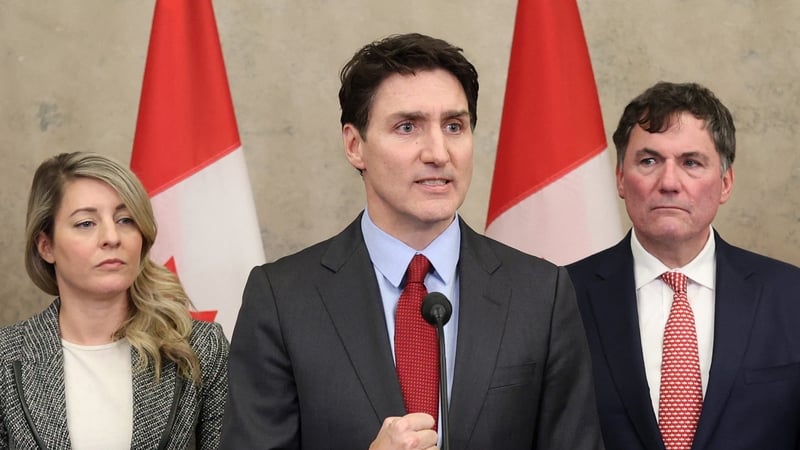
Canada, Mexico and China have all announced plans to retaliate against tariffs imposed on them by US President Donald Trump.
Mr Trump ordered 25% tariffs on Canadian and Mexican imports and 10% on goods from China starting on Tuesday.
China said it will challenge Mr Trump’s tariff at the World Trade Organization and take unspecified “countermeasures” in response to the levy.
Mexican President Claudia Sheinbaum also ordered retaliatory tariffs in response to the US decision.
Canadian Prime Minister Justin Trudeau said his country will retaliate against Mr Trump’s tariffs by imposing 25% tariffs on US goods from drinks to appliances.
As relations between the long-time allies who share the world’s longest land border reach a new low, Mr Trudeau told a news conference he was slapping tariffs on $107 billion of US goods.
Mr Trudeau warned the coming weeks would be difficult for Canadians and that Mr Trump’s tariffs would also hurt Americans.
Addressing Americans, he said: “They will raise costs for you, including food at the grocery store, gas at the pump. They will impede your access to an affordable supply of vital goods.”
The Canadian leader said tariffs would include American beer, wine and bourbon, as well as fruits and fruit juices, including orange juice from Mr Trump’s home state of Florida.
LIVE: Canada’s response to U.S. tariffs | EN DIRECT : Réplique aux tarifs douaniers américains https://t.co/1R7HT03O9G
— Justin Trudeau (@JustinTrudeau) February 2, 2025
Canada would also target goods including clothing, sports equipment and household appliances.
The northern neighbour to the US is considering non-tariff measures, potentially relating to critical minerals, energy procurement and other partnerships, Mr Trudeau said.
The Canadian leader also encouraged Canadians to buy Canadian products and holiday at home rather than in the US.
“We didn’t ask for this but we will not back down,” Mr Trudeau said.
White House officials also said that Canada would no longer be allowed the “de minimis” US duty exemption for small shipments under $800.
The officials said Canada, along with Mexico, has become a conduit for shipments of fentanyl – a deadly opioid – and its precursor chemicals, into the US, via small packages that are not often inspected by customs agents.
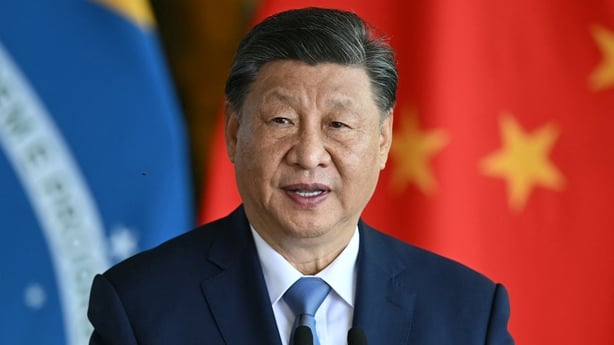
China pushes back, says ‘fentanyl is America’s problem’
China said it will challenge Mr Trump’s tariff at the World Trade Organization and take unspecified “countermeasures” in response to the levy.
The response stopped short of the immediate escalation that had marked China’s trade showdown with Mr Trump in his first term as president and repeated the more measured language Beijing has used in recent weeks.
China’s commerce ministry said in a statement that Mr Trump’s move “seriously violates” international trade rules, urging the US to “engage in frank dialogue and strengthen cooperation”.
Filing a lawsuit with the WTO would be a largely symbolic move that China has also taken against tariffs on Chinese-made electric vehicles by the European Union.
For weeks Chinese Foreign Ministry spokesperson Mao Ning has said Beijing believes there is no winner in a trade war.
China’s sharpest pushback was over fentanyl, an area where the Biden administration had also been urging China to crack down on shipments of the China-made precursor chemicals needed to manufacture the drug.
“Fentanyl is America’s problem,” China’s foreign ministry said. “The Chinese side has carried out extensive anti-narcotics cooperation with the United States and achieved remarkable results.”
‘We will win!’ – Mexico vows retaliation to Trump tariffs
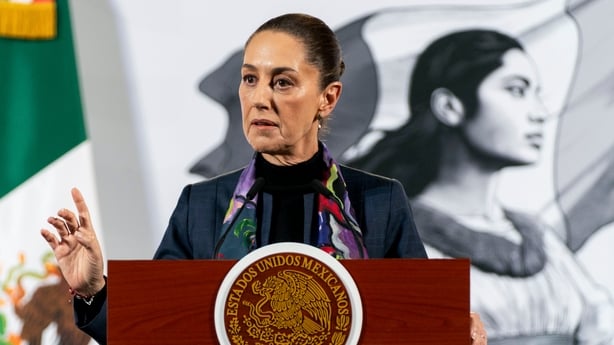
Mexican President Claudia Sheinbaum ordered retaliatory tariffs in response to the US decision to slap 25% tariffs on all goods coming from Mexico.
In a lengthy post on X, Ms Sheinbaum said her government sought dialogue rather than confrontation with its top trade partner to the north, but that Mexico had been forced to respond in kind.
“I’ve instructed my economy minister to implement the plan B we’ve been working on, which includes tariff and non-tariff measures in defense of Mexico’s interests,” Ms Sheinbaum posted, without specifying what US goods her government will target.
The United States is by far Mexico’s most important foreign market, and in 2023 Mexico overtook China as top destination for US exports.
Mexico has been preparing possible retaliatory tariffs on imports from the US, ranging from 5% to 20%, on pork, cheese, fresh produce, manufactured steel and aluminium, according to sources familiar with the matter.
The auto industry would initially be exempt, they said.
Economy Minister Marcelo Ebrard said on X that Mr Trump’s tariffs were a “flagrant violation” of the US-Mexico-Canada Agreement.
“Plan B is underway,” Mr Ebrard said. “We will win!”
US exports to Mexico accounted for more than $322 billion in 2023, Census Bureau data showed, while the US imported more than $475 billion worth of Mexican products.
In her post, Ms Sheinbaum also rejected as “slander” the White House’s allegation that drug cartels have an alliance with the Mexican government, a point Trump’s administration used to justify the tariffs.
Mr Trump said the tariffs against Mexico were due to the country’s failure to stop fentanyl from getting into the United States, as well as what he called uncontrolled migration.
Ms Sheinbaum touted her government’s record since she took office in October – seizing 20 million doses of fentanyl, in addition to detaining over 10,000 people tied to drug trafficking.
The US measures were “one of the heaviest attacks Mexico has received in its independent history,” Mexico’s ruling party congressional leader Ricardo Monreal told broadcaster Milenio.
Analysts said the tariffs imposed by Mexico’s biggest trade partner would deal a heavy blow to Latin America’s second-largest economy.
The United States bought more than 80% of Mexico’s exports last year, according to official figures.