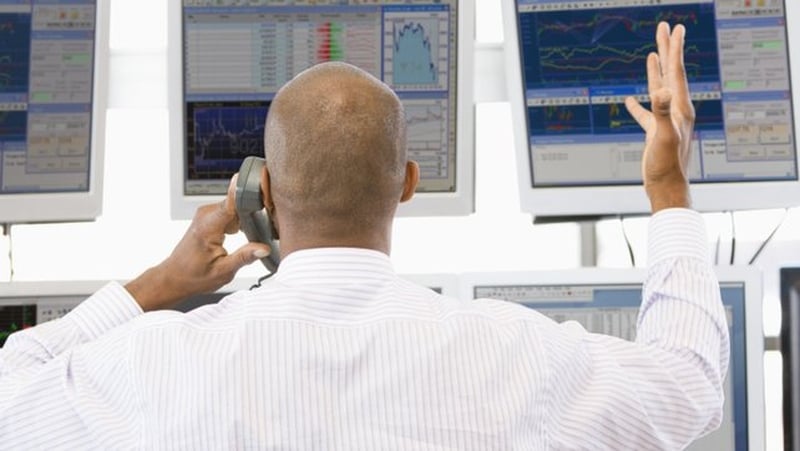
European shares were seeing big losses this morning as they headed for their steepest weekly loss in three years, as investors grappled with prospects of a global recession after US President Donald Trump announced sweeping tariffs on trading partners.
London’s FTSE index was down 2.8% in mid-morning trade, while the Paris CAC lost 3.2% and the Frankfurt DAX sank 3.8%.
Dublin’s ISEQ index was seeing even bigger losses, dropping 4.5%, with the Irish bank stocks seeing big drops.
AIB shares had plunged 10.5%, while Bank of Ireland shares slumped 9.3% and Permanent TSB sank 6.7%.
Trump’s harsher-than-expected “Liberation Day” levies also sent shockwaves through markets yesterday. The Paris CAC 40 closed 3.3% lower yesterday while Frankfurt’s DAX fell 3% and London’s FTSE 100 had more limited losses of 1.6%.
British goods face a 10% tariff, lower than the 20% Trump is imposing on the European Union.
Shares in Dublin closed with losses of over 2% yesterday.
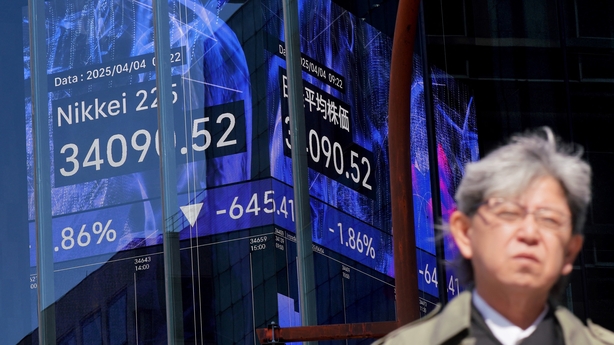
Earlier, Japanese banks tanked as stocks globally extended a punishing selloff in the wake of US President Donald Trump’s sweeping tariffs, helping drive a rally in US Treasuries and supporting gold near a record peak.
“If the current slate of tariffs holds, a second or third quarter recession is very possible, as is a bear market,” said David Bahnsen, chief investment officer at The Bahnsen Group.
“The question is, does President Trump seek some sort of off-ramp for these policies if and when we see a bear market in the stock market. We believe Trump will then pivot to focus on the number of companies that are making significant investments in the US, but it’s unclear that would reverse market sentiment,” he added.
It was a sea of red in Asia, even with markets in China, Hong Kong and Taiwan closed for a holiday, with indexes in Tokyo among the largest losers.
The Nikkei sank 2.7% and was set for a weekly decline nearing 10%, the sharpest drop in more than five years.
The rout was led by banking stocks, as the spectre of Trump’s tariffs and their potential impact on economic growth stoked speculation that the Bank of Japan may need to delay raising interest rates.
S&P 500 companies lost a combined $2.4 trillion in stock market value overnight, their biggest one-day loss since the Covid pandemic hit global markets on March 16, 2020, while other Wall Street indexes similarly suffered sharp falls.
“Central banks are not well-equipped to deal with stagflation as the impacts of slower growth and higher inflation pull policy in opposing directions,” said David Doyle, head of economics at Macquarie Group.
“This means that stronger core inflation is likely to limit the extent of any policy response from the Fed due to the headwinds created for growth,” he added.
Fed Chair Jerome Powell is due to speak later today and investors will be looking out for his latest assessment of the US economy and any clues on the policy outlook following Trump’s fresh tariff salvo.
In the foreign exchange market, the risk-sensitive Australian and New Zealand dollars tumbled more than 1% each.
The dollar was down nearly 0.5% against the yen at 145.41, having tumbled 2.2% in the previous session, its steepest daily fall in more than two years. The euro rose 0.39% to $1.1095 after a 1.9% jump yesterday.
Against a basket of currencies, the dollar languished near a six-month low at 101.60.
Elsewhere, spot gold was perched near a record high at $3,103.97 an ounce and was on track for a fifth weekly gain in a row, as worries about the impact of Trump’s tariffs on the global economy boosted the metal’s safe-haven appeal.
Oil, a proxy for economic activity, extended its steep decline from the previous session.