For all its ills, social media has at least played a positive role in the revival of some out-of-favour practices and past-times; from niche crafts to long-neglected recipes.
But it’s also helping to rehabilitate certain activities – including some that would previously have been seen as the preserve of the most desperate.
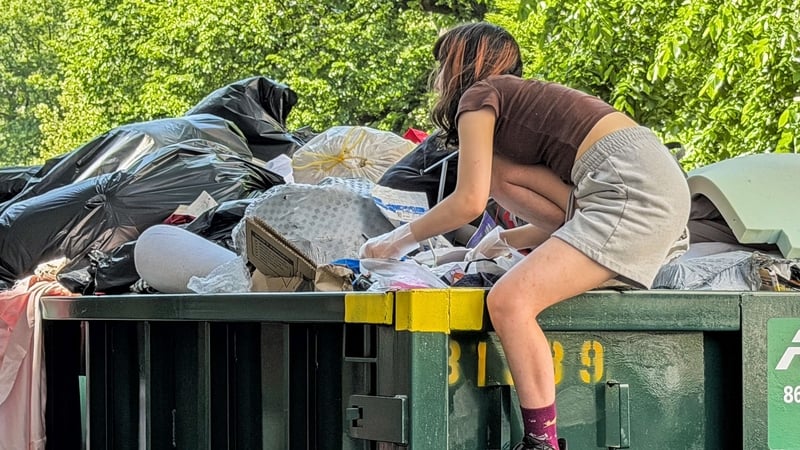
Dumpster diving certainly fits that bill. While the practice of rooting through bins and skips would long have been – fairly or unfairly – with poverty, today it is experiencing something of a boom in popularity.
That is in part due to the cost-of-living crisis, which has made many people take significant steps to reduce their expenses. But that same pressure has also seen people search for ways to earn more money, and many have stumbled upon a community of dumpster diving influencers, who post regularly about their hauls and brag openly about their earnings.
One such influencer – 31-year-old Carter Stevens – claims to be making somewhere in the region of $140,000 a year from dumpster diving. Others talk about slightly more modest – but nonetheless impressive – earnings in the tens of thousands.
Of course this is social media we’re talking about – so followers might not quite be getting the most accurate impression of what’s involved.
Viewers may focus in on the bag of mint condition luxury handbags that a particular influencer found, but not see the 30 times before that find when they got nothing from their trawls through piles of rubbish and mess. Or they might not see the hours and hours of walking or driving around divers did in search of prospects.
But either way, it’s clear those influencers have helped to paint dumpster diving in a very different light than it might have enjoyed before.
Rubbish laws

In many cases they are facilitated by some fairly easy-going or vague laws. In certain states in the US, for example, what’s thrown away is essentially seen as fair game.
Not so in Ireland.
The 1996 Waste Management Act makes it a crime to tamper with anything left in public or private waste receptacles, or at local authority dumps. This essentially outlaws the practice here.
Of course there are some who dumpster dive in Ireland. On your next trip to your local council dump, there’s every chance you’ll see someone waiting around looking for items they can salvage or repurpose.
Some will argue that there are loopholes to the Waste Management Act – others may be relying on a lack of enforcement.
But another more practical issue facing dumpster divers in Ireland is around trespass laws. Because while you might think of dumpster diving as a practice of rooting through whatever bins you come across, the serious participants tend to be focused on higher value targets – like the bins connected to shops and shopping centres.
By their nature, though, they tend to be stored on private property – that means they’re unlikely to be easily accessed, and there’s a good chance they’re being monitored by security guards and systems, too.
Dumponomics

But, where the law allows, many are now seeing dumpster diving as a viable career choice. Or at least lucrative side-hustle.
And the earnings they’re seeing influencers make from diving is not just based on what they earn from going viral, either. The explosion in popularity of resale platforms has revolutionised the economics of selling not-quite-brand-new items.
But the market is also being fuelled by the changed economics of waste that exist for many businesses.
Because while some retailers and manufacturers will do their best to minimise waste, be it through careful planning, stock management or charity partnerships, there are a lot of cases where the easiest and most economically attractive option for a firm is to simply dump perfectly good items.
Returns are a good example of that.
If someone returns an item – even if it’s just because they don’t like it or it doesn’t fit – it may not be a straight-forward or cost-effective process for that to go back onto the shop floor.
Perhaps the packaging has been opened – which would put off a new buyer – or maybe the item has to be checked to ensure it hasn’t been damaged.
If it’s a low margin item, it probably isn’t worth the time and effort to a retailer.
And of course if it is damaged or faulty in any way, it’s likely going to get dumped. That will happen even if the problem is relatively minor – like a stain, or a loose stitch or wire – despite the fact that many people would fix quite easily given the chance, if it was worth their while.
Now some shops might offer a discount on lightly damaged goods, depending on the circumstances – but it’s hard to know if the right faulty item will find the right, willing fixer.
Some shops, particularly bigger chains, also tend to avoid discounting damaged goods – in part because they fear they’ll incentive staff or customers doing some mild sabotage to get some money off.
Fast as you Can

But central to the landscape shift that has made dumpster diving so lucrative is the grip that fast fashion now has on the retail industry.
As the name suggests, fast fashion is all about cycling through products quickly – rather than changing over what’s offered on a seasonal basis.
That means bringing in a line of products and giving it a short amount of time to sell. And there’s no sentimentality in this approach. There is no hanging around waiting for a product to find its audience. If it’s not selling enough to justify its spot on the shop floor, it goes.
At best it might get discounted for a time, but very quickly after that it’s shifted on. Not to another shop, or a big warehouse for safe-keeping until it comes back into fashion. The unsold goods are off-loaded altogether.
The European Union does have rules that dictate how companies handle their surplus and waste stock. In short, retailers are meant to do everything they can to find a use for the goods – with binning them being the last resort.
In some cases that might see them offer some of their products to charities or charity shops; but the scale of waste being produced by the industry means that’s not always going to be practical.
Some retailers will also have partnerships with textile recyclers. Again, though, the scale of waste means this sector tends to be continually operating at capacity (there have also been questions raised about just how environmentally-friendly some textile recyclers are).
The reality is that, often times, the easiest and cheapest option available to a retailer is to dump what they have.
That’s despite the fact that, of course, there is still a cost involved in doing so. In many cases companies might make the calculation that that disposal cost is lower than what they’d spend setting up systems and employing staff to sort through goods, and then find the right destination for them.
And that cost of disposal is factored into the fast fashion business plan. The items are priced in such a way that the company can heavily discount many products, and ultimately dump a lot of what is made, and still turn a healthy profit.
And while the focus tends to be on fast fashion when it comes to this kind of thing, this kind of practice is now common across the entire retail industry.
It can be seen in cosmetics, perfumes, homewares – even groceries to an extent.
Items that are thought to be on-trend are manufactured, put on the shelf, offered for sale, and then shipped back out once demand has died down.
Really there’s a constant cycle of this kind of thing – and sometimes that cycle is blatantly apparent.
If you were in any shop or supermarket in recent weeks you will likely have seen plenty of Hallowe’en decorations and accessories. They might have hit the shelves in September. By the week of Hallowe’en itself they would have been heavily discounted or disposed of, with the same space now taken up by Christmas decorations.
And again, that surplus stock likely isn’t getting stored somewhere in the hope it sells next year. For most retailers, it’s cheaper to dump it now and get fresh stock in in September 2027, compared to taking up lots of warehouse space in the hope that it will sell in a years’ time.
And it’s those kinds of items that dumpster divers are then able to get their hands on – and perhaps sell on to someone else.
Wasted Luxury

Fast fashion is deservedly criticised for its wasteful practices – but at least they tend to discount items that aren’t selling before they decide to dump them. This, of course, is done purely in an attempt to get some return on their costs – but at least it gives items a last chance to be put to use before they end up in the bin.
That might seem like a low bar – but the reality is that some brands don’t even clear it. Particularly higher-end, luxury brands.
These kinds of retailers tend to resist discounting items for fear that a sale rack might damage their high-end image. For the same reason, they’d be far more reluctant to strike a deal that might see large quantities of their items appearing in a charity shop (particularly when you’re talking about the US, where there aren’t the same legal requirements around reducing waste).
Some might have outlet shops that partially fulfil the ‘discounted item’ remit – but they’re relatively uncommon and limited in size and scope.
That means that, when they have a line that doesn’t sell well – or that they’ve decided that their suits need to have a new lining – the old stock is more likely to go into a rubbish bin.
That will obviously represent a high value target for dumpster divers.
If they hit upon a bag full of luxury items, even if they’re ones that didn’t sell all that well at full price, they’ll probably be able to make a decent amount from selling them on.
And that fact hasn’t been lost on the luxury brands – some of which have taken steps to ensure that their image isn’t sullied by association with dumpster diving.
Back in 2021, Coach admitted that it had instructed staff to rip up bags that had been returned – even if they were in perfect condition.
In 2018, Burberry admitted it had burned $36m worth of unwanted stock – rather than trying to sell it down or donate it.
The practice is so common that the EU recently introduced new rules prohibiting companies from destroying unsold stock.
Though how effective that will be remains unclear, as there are loopholes. For example, if the stock is damaged – or if it’s been rejected by charities.
Reduce, reuse, recycle

Fixing these bad practices would be bad news for dumpster divers. Though they can probably rest easy, as a substantial change would be hard to achieve.
Ultimately this comes down to economics – as long as it’s more economical for retailers to dump stock rather than to do something more productive with it, then they will continue to do it.
That means you have to create a system that makes dumping less attractive financially – either by making alternatives cheaper or easier, or by putting heavier costs and penalties on dumping.
But it’s not necessarily straight-forward to create a system that makes dumping the least viable option in all cases.
Take that new EU ban on destroying clothing, for example.
Let’s say lawmakers decided to extend it so that companies can’t destroy or dump the goods. They would still have to keep certain exceptions, like the one for products that are damaged, but who gets to decide what passes the threshold for being damaged enough to be dump-able?
And if you allow products to be dumped only when a charity shop rejects it, who will police the interactions between clothes companies and charities to make sure the offer and rejection are legitimate? And would charity shops even have the capacity to properly assess continual, countless offers of stock from all these different retailers? Is there a risk they end up being the ones having to deal with the cost of dumping unwanted goods?
In saying that, we do have recent evidence that a relatively small financial disincentive can make a difference. At least to consumers.
The customs and handling charges introduced for non-EU purchases has had a significant impact on fast fashion retailers like Shein – and in turn the waste they’re creating – because suddenly there’s an extra cost to buying things you might not really want. And that cost remains even if you return it.
Perhaps it may not take an awful lot on the producer side to similarly tip the scale to make this systematic over-production – and the waste it produces – bad for business.