
Analysis: The sale of looted goods on online resale platforms has highlighted concerns about security and authentication on such sites
Imagine opening Vinted and discovering a designer handbag for sale at a fraction of its usual price. It looks brand new, the photographs seem genuine, and the seller is offering next-day postage. A bargain, surely? Now imagine that an identical handbag was stolen from a luxury boutique during a riot just 24 hours earlier. Would you have any way of knowing? More importantly, would Vinted?
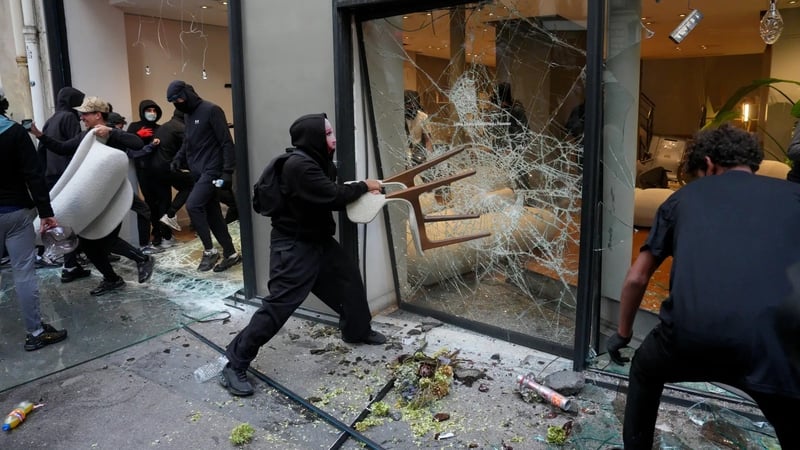
That question has become particularly relevant following unrest across France. Demonstrations over living costs, public services and education funding were accompanied by outbreaks of violence in cities including Paris, Lyon and Marseille. While many protesters demonstrated peacefully, some shops were looted, businesses damaged and police confronted by rioters.
We need your consent to load this rte-player contentWe use rte-player to manage extra content that can set cookies on your device and collect data about your activity. Please review their details and accept them to load the content.Manage Preferences
From RTÉ News’ Behind the Story, Emmanuelle Schon Quinlivan from UCC on the background to the violent protests, riots and looting across several cities in France
Concerns subsequently emerged that stolen merchandise was appearing on online resale platforms. French authorities called on marketplaces, including Vinted, eBay and Leboncoin, to prevent stolen goods from being resold. Vinted confirmed that it had taken action to remove suspicious listings and was cooperating with authorities.
But how can an online marketplace distinguish stolen merchandise from the millions of perfectly legitimate items people sell every day? Consider two Vinted sellers. One lists a brand-new designer jacket, complete with tags, for €100 below its retail price. The other suddenly advertises 15 identical jackets, all unworn and heavily discounted, despite having previously sold little more than second-hand children’s clothing. Neither situation proves wrongdoing, but the second presents an unusual pattern that technology might recognise, which is where anomaly detection becomes useful.
Rather than examining advertisements individually, machine-learning systems can identify activity that differs significantly from established patterns. These systems might examine how frequently someone lists products, whether their selling behaviour has changed dramatically, or whether numerous identical items appear within a short period. Vinted publicly acknowledges using predictive analytics and risk scoring to identify suspicious activity, alongside automated detection and human moderation.
From BBC News, Vinted removes listings of items stolen during French riots
Beyond these capabilities, several other technologies could potentially help marketplaces investigate suspicious merchandise. One possibility involves computer vision, a branch of artificial intelligence that allows software to analyse and interpret images. Imagine a retailer reporting that 50 distinctive designer handbags were stolen during a break-in. Image-recognition technology could potentially search marketplace listings for products with matching visual characteristics, including logos, colours, shapes and distinctive designs. Rather than manually examining thousands of advertisements, investigators could narrow their attention to a smaller collection of potentially relevant listings.
But if a handbag was manufactured in its thousands, recognising its appearance tells us almost nothing about whether a particular example was stolen. The same limitation applies to trainers, cosmetics, electronics and designer clothing. AI might recognise the product perfectly while knowing absolutely nothing about its ownership history. This creates two very different technological challenges: product identification and provenance verification. One establishes what an object appears to be. The other seeks to establish where it came from and whether its seller is entitled to sell it.
From France24, French government has asked major second-hand marketplaces such as Vinted, eBay and Amazon to crack down on suspicious adverts after weekend riots and looting
Perhaps the most promising approach involves connecting information rather than simply examining individual products. For example, suppose several newly created accounts begin advertising identical luxury watches shortly after a jewellery shop is looted. Each account might appear unremarkable individually. Examined together, however, similarities in listing behaviour, photographs or other available account information could reveal a suspicious pattern. Network analysis could potentially identify these connections, helping investigators determine whether seemingly unrelated listings warrant closer examination.
Another possibility involves digital product identification. Some products carry unique serial numbers or electronic identifiers, including radio-frequency identification (RFID) tags. Where retailers maintain sufficiently detailed inventory records, these identifiers could potentially be matched against goods reported stolen. International traceability standards already provide mechanisms for identifying and tracking products through supply chains. Unlike image recognition, item-level identification could help distinguish one particular watch from thousands of identical models.
We need your consent to load this rte-player contentWe use rte-player to manage extra content that can set cookies on your device and collect data about your activity. Please review their details and accept them to load the content.Manage Preferences
From RTÉ Radio 1’s Today with David McCullagh, the rise of online sites such as Vinted is having a big impact on charity shops, but can you still get some good finds in charity shops – and just how much money can be made from Vinted?
Yet practical obstacles remain. Not every product has a unique identifier, not every retailer maintains item-level records, and relevant information may not be visible in an online advertisement. Even where a match is established, investigators still need to determine how the item reached its seller.
There is something rather ironic about the role of technology in all of this. The same online marketplaces that make it possible to sell merchandise to thousands of potential buyers within minutes could also provide investigators with valuable evidence about where those goods have gone.
A stolen handbag might leave a shop without a trace, but selling it online could be what finally gives it one.
Traditionally, stolen merchandise might disappear into informal markets, private transactions or networks of intermediaries. Online selling introduces a different dynamic. Advertisements, photographs, account histories, transaction records and delivery arrangements can all generate information that may assist an investigation. Of course, criminals can attempt to conceal their identities or move transactions elsewhere. Nevertheless, putting stolen merchandise online can create a digital trail that would not necessarily exist in a cash transaction.
The irony is that the very convenience that makes online marketplaces attractive for reselling stolen goods may also become one of the greatest obstacles to getting away with it. A stolen handbag might leave a shop without a trace, but selling it online could be what finally gives it one.
Follow RTÉ Brainstorm on WhatsApp and Instagram for more stories and updates
The views expressed here are those of the author and do not represent or reflect the views of RTÉ


