Analysis: Disputes over the Suez Canal in 1956 and the Strait of Hormuz 70 years later show geopolitical power is often no match for economic power
By Eoin McLaughlin, Heriot-Watt University
It is over seven months since the US attacked Iran and launched Operation Epic Fury, which has led to the blockage of one of the main arteries of international trade. The world is still reeling from the fallout of the closure of the Strait of Hormuz, with countries in the immediate vicinity in crisis. Initial successes quickly turned into a debacle, and, despite the assurances of the US president, the US has been unable to negotiate the reopening of the Strait of Hormuz.
From New York Times, why it is so hard to reopen the Strait of Hormuz
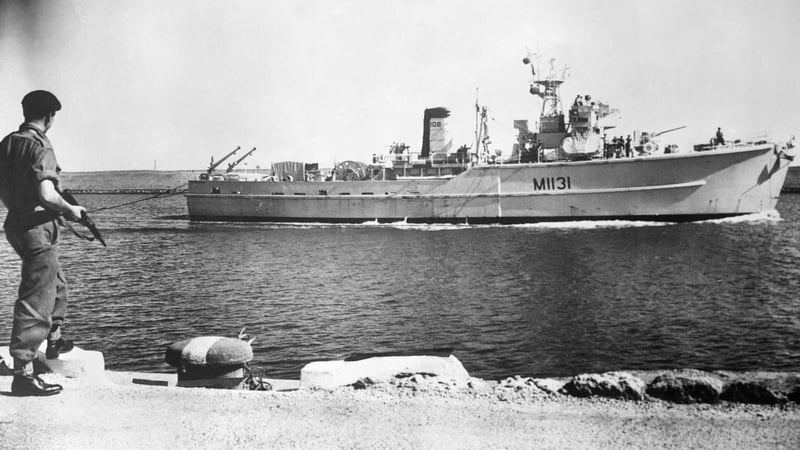
The events in Hormuz echo an earlier crisis in the Middle East: the 1956 Suez crisis. That began with the nationalisation of the Suez Canal in July 1956 by the Egyptian government, leading to British and French governments colluding with Israel in an attempt to regain control of the canal. The resulting invasion in October and November was a spectacular failure that was widely condemned by the international community. The crisis came to symbolise Britain’s loss of superpower status and was a reflection of Britain’s relative decline rather than its cause.
The Suez mattered to Ireland too. The Irish economy was still closely tied to sterling, meaning Britain’s struggle to defend the pound had very real consequences for Ireland. While Ireland today is not tied to the dollar in the same way, the fallout from Hormuz has enormous implications for a country highly dependent on international markets for oil and gas.
But the parallels between Suez and Hormuz go beyond the closure of two vital waterways. 70 years apart, both crises raise the same question: how far can geopolitical power outrun economic power?
The eclipse of a superpower
In 1944, William T. R. Fox coined the term ‘superpower’, associating it with ‘great wealth, great population, and favourable geographic position’. He identified three superpowers: the US, Britain and the Soviet Union. Almost 40 years later, he acknowledged that including Britain had been ‘an elementary mistake’. Britain had already been declining relative to the US since the 19th century.

Arguably, a similar shift is taking place today. Historian Phillips O’Brien argues that great power is determined by economic power, land mass and population with economic power, especially the ability to make ‘stuff’, essential. Measures of economic size are contested, but China’s rise on a purchasing-power-parity basis is striking: from a fraction of the US economy in 1990 to well ahead today. Even allowing for problems with Chinese official data, its rise has been spectacular.

Consequences of decline
In the 19th century Britain benefitted from what economists call ‘exorbitant privilege’: the ability to easily finance debt at favourable interest rates because sterling played a central role in the international monetary system and London was the world’s leading financial centre. As Britain declined, this privilege gradually shifted towards the US. Its loss became particularly pressing during the Suez crisis as the pound sterling came under intense pressure. Harold Macmillan, then Chancellor of the Exchequer, emphasised the pressure on the pound in explaining why the crisis ended so abruptly.
Today, there are signs of strain in the financial system that underpins American power. During the summer, the US Treasury took unusual steps to stabilise financial markets, including selling euro reserves to support the Japanese yen (a move that also reduced pressure on Japan, the largest foreign holder of US Treasuries, to sell its holdings) and doubling its buybacks of long-term US Treasuries as US bond yields surged. In September, US Treasury Secretary Scott Bessent declared that ‘he was the house’, warning investors to bet against him at their peril. The bond market was unconvinced.
During the Suez crisis, Britain’s inability to sustain its policy in Egypt in 1956 reflected not simply diplomatic isolation, but the constraints imposed by relative economic decline, currency weakness, and dependence on American financial support. The US is certainly not Britain in 1956, but Suez demonstrated how economic weakness could ultimately limit what even a major military power could do abroad.
We need your consent to load this rte-player contentWe use rte-player to manage extra content that can set cookies on your device and collect data about your activity. Please review their details and accept them to load the content.Manage Preferences
From RTÉ Radio 1’s History Show, Dr Hussein Omar, lecturer in Modern Global History at University College Dublin, on the 1956 Suez Crisis
Geopolitical echoes
The Suez crisis was also part of wider Cold War geopolitics. An arms deal between Egypt and the Soviet Union has been identified as the ‘main cause of the crisis’, upsetting the regional balance of power and contributing to Israel’s decision to launch a preventative war. After the deal, the US withdrew financing for the Aswan Dam and Egypt nationalised the Suez Canal.
British leaders interpreted the crisis through the lens of the Second World War, repeatedly portraying Egypy’s president Gamal Abdel Nasser as a ‘Mussolini’ figure intent on regional dominance. The US intervention in Iran has similar connotations; the assassination of the Iranian leadership was presented by US Secretary of War Pete Hegseth as necessary to prevent an existential threat from ‘America’s mortal enemy’.
Geoeconomic considerations were also a key feature of Suez. The Suez Canal, which had initially been built to facilitate international trade, became a major conduit for Middle Eastern oil. British policymakers became increasingly concerned about the possibility of the Canal being closed to British interests. Ironically, it was the decision to invade Egypt that led to a shortage of oil and fuel rationing in Britain. Today, the US-Iran war has led to another major energy conduit being blocked as the Strait of Hormuz remains closed.

The current conflict with Iran should also be seen through the lens of ‘Cold War II’ geopolitics. Iran has supplied drones to Russia in its war with Ukraine; in turn, Russia has been supporting the Iranian war effort. The result is that US geopolitical commitments are increasingly stretched, most clearly seen in the depletion of munitions. US munition stocks were already under pressure (in part because of its earlier support for Ukraine) and have been further depleted by the war with Iran, placing constraints on US military options elsewhere, particularly in a potential conflict with China over Taiwan.
The lessons from Suez
Suez showed what happened when Britain’s geopolitical ambitions outran its economic power. Britain remained wealthy and militarily formidable, but its leaders had failed to adjust their ambitions to the constraints they faced.
Seventy years later, the circumstances are different. The United States remains enormously powerful, but its financial and military constraints are becoming harder to ignore. The question is whether Washington will adjust its ambitions before those constraints force it to.
Follow RTÉ Brainstorm on WhatsApp and Instagram for more stories and updates
Prof Eoin McLaughlin is Professor of Economics in Edinburgh Business School at Heriot-Watt University. He is a former Research Ireland awardee. His latest book The Inclusive Wealth of Nations is published by Bloomsbury.
The views expressed here are those of the author and do not represent or reflect the views of RTÉ