
The origins of the Paris Motor Show date back to the late 19th century – long before most of the car brands we know today even existed. And while the biennial event is open to car-makers from around the globe, it’s traditionally served as a chance for Europe’s car industry to flex its motoring muscle on the world’s stage.
This year, though, the Europeans had to make room for a major rival. A lot of room.
Because, of the 64 manufacturers that were exhibiting this week, nearly one third were Chinese-owned.
That has underlined the stark challenge now facing Europe’s car industry, as its major players struggle to keep up with what is often more advanced – as well as cheaper – competition.
That has sparked an industry-wide reckoning, with deep cost-cutting programmes underway. But China staking a claim for Europe’s car market has also created political concern, at a time when the EU-China trading relationship is under intense scrutiny.
Accelerating sales

In a lot of ways, China is still a relatively small player in the European car market.
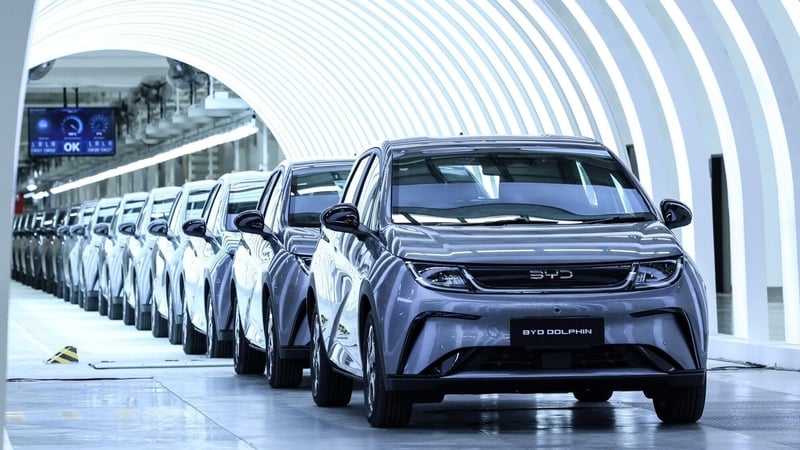
In Ireland, for example, the biggest Chinese brand here is currently BYD. It had just over 4,400 car registrations in the first nine months of the year, according to the Society of the Irish Motor Industry.
The next biggest is MG (which many may think of as English, but has actually been Chinese-owned for more than 20 years). It had a little over 2,800 new cars registered in Ireland in the first nine months of this year.
After that you have Volvo – again, now Chinese-owned. It had a bit over 2,000 registrations between January and September.
And then you have smaller brands like Xpeng, Leapmotor* and Polestar, which have registered a few hundred cars each so far this year.
(*Leapmotor’s European business is actually a joint venture between China’s Leapmotor and Europe’s Stellantis – which owns a range of brands like Fiat, Peugeot and Opel.)
It means that, all in all, a little over 10,000 cars registered in Ireland so far this year were made by Chinese-owned companies. That’s out of around 128,000 registrations total in the nine months – giving Chinese brands 8.3% of the new car market here.
So – a decent share, but not exactly dominant.
Meanwhile data from the ACEA – or the European Automobile Manufacturers Association – can then tell us how these brands are doing across the EU, European Free Trade Area and UK.
According to its figures, Chinese-owned brands sold around 725,000 vehicles across the region in the first eight months of the year; out of a total of 7.5 million sales.
So that’s a 9.6% share. Again, decent but not dominant.
What is notable, though, is how quickly China’s share has been growing.
For example, while Chinese-owned brands only have an 8.3% share in Ireland so far this year, that’s well up on the 5% share they had in the same period of 2025.
In the first nine months of 2024, those brands held less than 4% of the market.
Bear in mind, too, that BYD – the biggest-selling Chinese brand in the country – only launched in Ireland in 2023.
In Europe, meanwhile, while Chinese brands have a near 10% share of the market so far this year – it was just over 6% in 2025.
Cornering EVs

The numbers are even more stark when you isolate out full electric vehicles. It has been the main – but by no means exclusive – focus of Chinese manufacturers’ expansion into Europe.
When you look at the SIMI stats for EVs only, you can see that Chinese producers are very big players.
Like with car sales in general, they’re not dominant – established brands like Kia, Volkswagen and Hyundai currently sit in the top three of EV makers here so far this year.
But, when you add all of the China-owned brands together, you can see that they make up around 17.8% of all EV sales here in 2026 so far. That compares to a 13.6% share of EV sales in the same period of last year – so they’re taking a bigger piece of what is a rapidly growing market.
The European figures are a bit harder to break down – the ACEA don’t give EV sales by car-maker.
But, if we were to use the Irish figures as an indication, it would suggest that Chinese company’s account for around a quarter of all EV sales in Europe – possibly even more.
Hitting the brakes

This is of particular concern to European car-makers because they’ve tended to do well in their home market.
EVs are also where the industry is moving.
They are now the best-selling engine type in Ireland, and they’re in joint second across Europe. (The most popular are hybrids – where Chinese car-makers are also very competitive).
It means that, just at the time when European firms need to invest heavily in new types of vehicle, new platforms and new technologies, they’re finding themselves being undercut by cheaper, more advanced and more nimble competition from China.
And it’s taking away sales they may previously have relied upon.
Those sales – which could have justified all their investment plans, and all of the existing costs they have relating to factories, brands, and marketing – are now in doubt.
And that – along with US tariffs on the other side – is forcing many of these companies to undertake significant restructurings.
Germany’s Volkswagen is perhaps the best example – it recently struck a deal with unions that would see it cut 50,000 jobs across its operation. That’s on top of a 50,000 job cut previously announced.
That’s more than 15% of its total workforce.
The move is part of a plan that will see it cut its costs by 20% in the coming years – because that’s the cost disadvantage it reckons it has with its Chinese rivals.
Some of those savings will come from administration – but key to the restructuring is also a simplification of the group’s business.
After all, Volkswagen Group is not just Volkswagen – it also owns Audi, Skoda, Seat and Porsche. Each of these brands have countless makes and models and variations, but head office now Plans is to slash that dramatically to simplify its structure.
It’s also looking at potentially shutting down or repurposing some of the factories it has – though that’s something that has been kicked down the road, and could cause political headaches in Germany.
But it’s not just Volkswagen – French-Italian group Stellantis is aiming to cut €6 billion in costs by the end of 2028.
That includes trying to make the factories it runs more efficient, while also potentially selling some of the less productive ones off.
It’s also looking at cutting thousands of engineering jobs globally.
Jaguar Land Rover is cutting thousands of jobs in the UK, as part of a £1.7 billion cost-cutting programme.
Meanwhile BMW is also trying to cut costs, though it’s focused on slashing middle-management while also investing in its production as part of its turnaround plan.
All-in-all it’s estimated that European car-makers are shaping up to cut 30-40% from their cost base just to stay competitive.
European Drive

But it’s not just the car-makers themselves that are repositioning themselves in the face of Chinese competition. EU politicians are trying to respond, too.
That’s because there’s a distinct memory in Europe of both the steel and solar panel industries being decimated by Chinese competition in the recent past. Both markets were flooded with cheap product from China, regional producers couldn’t compete, and they were ultimately pushed out of business.
And given how important car-making is to the European economy – and particularly big European economies like Germany, France and Italy – the prospect of them becoming bit players in the market, or even out of business altogether, would have huge ramifications for the region’s economy.
But it also poses a broader challenge – as it would further erode Europe’s manufacturing base while also increasing its reliance on China. This is at a time when the EU is trying desperately to boost European manufacturing in order to make it less reliant on others. In particular China.
Central to Europe’s concern too is the belief that Chinese car companies are not playing fair – and are only able to put up such stiff competition because they received substantial subsidies from the state.
The view is that, many years ago, China decided to build a domestic car industry, so it pumped lots of money into multiple producers. They then ramped up production to the point that they were making more cars than Chinese consumers could buy, so then they turned all of that extra output towards other markets, like Europe.
And given the state’s effective backstop, they don’t have to worry about running the business in a sustainable or profitable way – so they can sell for much cheaper than would otherwise be possible.
For what it’s worth, China and its car-makers have consistently denied that they’ve benefitted from unfair advantages.
They say that they can make cheaper cars because they’ve been more focused on EVs for longer – unlike European producers, who have been slow to move towards EVs and hybrids, because they wanted to protect their share of the combustion engine market.
They also say they benefit from more efficient manufacturing.
BYD, for example, is vertically integrated, so it makes most of what’s in its cars rather than relying on third party suppliers. It was actually a battery company that eventually started to build a car around that key component. Today it even owns its own cargo ship so it doesn’t have to pay third parties to bring its cars from one part of the world to the other.
So, China’s argument is that European car-makers are just too bloated and slow – and Chinese producers shouldn’t be punished for that.
To a certain degree, European car-makers seem to be accepting that argument. They wouldn’t be undertaking such hefty cost-cutting programmes if they felt they were already running as lean an operation as they could.
Interestingly, though, they’ve also been slow to back moves to punish Chinese car-makers for other reasons.
Because most major European car-makers also have joint-ventures in China. They know that, if Europe makes it too hard for Chinese companies to sell here, their lucrative partnerships could be targeted by any retaliation from China.
Safety first

As important as the economics of China’s rise may be, another thing concerning European officials is the security risk it may pose.
Because modern cars – and especially EVs – are absolutely laden in sensors. They have GPS, telemetry monitors, they’re covered in cameras, they have microphones inside. They can also connect to smartphones and potentially tap into all those sensors too.
And, if all that information from the right person got into the wrong hands, it poses a significant security risk.
Chinese companies routinely deny that there’s any security risk coming from their vehicles. Some say the data they gather never leaves Europe, while others deny claims that Chinese security services have backdoor access to their systems.
But there have been numerous tests and experiments to show that some cars sent data back to Chinese data centres.
That includes a recent case in Norway, where researchers drove a Chinese-made SUV deep into an underground tunnel that would block any signal. Despite that, it kept trying to ping Chinese servers.
The concern in Europe is that having lots of Chinese cars on European roads could give the country lots of valuable information.
It could also represent a significant lever that could be pulled in any hostile situation – with the functionality of millions of cars on European roads open to exploitation.
Trading in

To try to tackle this, two years ago the EU imposed some fairly hefty tariffs on Chinese-made cars.
These differed from company to company – and were calculated based on the extent to which the EU felt each firm had benefitted from unfair assistance. But at the top of the list was SAIC Group (MG’s owner), which was hit with a 35.3% tariff. That was on top of the 10% base tariff that applied between the EU and China.
That added to a growing trade dispute between the two sides – with China hitting back with tariffs on some European goods.
But there have also been talks between the two sides in the months since – with those negotiations leading to a prospective deal this week which would see the number of hybrids China ships to Europe being capped at 350,000 a year.
The tariffs remain on pure EVs for now, though. But how much they’ve impacted Chinese car-makers in debatable. After all, the data shows that Chinese car firms have continued to grow rapidly despite the supposed rebalancing of the fairness scale.
Another complicating fact is that, while the companies themselves may be headquartered in China, that doesn’t automatically mean the cars they produce are Chinese-made.
Because many of these car companies have been preparing for exactly this trade situation for years. Some already have manufacturing facilities in Europe, some are planning to build some in the near future.
BYD, for example, is just about to start full-scale production at a plant in Hungary. It’s also reportedly looking at setting up production operations in France.
It’s estimated that around 90,000 “Chinese” cars will be made in Europe this year – with that number rising to one million by 2030 and 1.5 million by 2035.
And those cars will technically be European – and so not subject to tariffs.
It means that Europe is now facing a new challenge of potentially having lots of factories that are really little more than assembly plans. Plants similar to the ones we used to have in Ireland, where parts were imported and put together locally (in order to avoid Irish tariffs).
These kinds of facilities provide very little local economic benefit – especially now that car assembly is so heavily robot and automation-based. That means they wouldn’t do much to help the European car industry, its workers, or the surrounding economy.
As a result Europe is now moving to try and get ahead of that new threat – with proposals moving forward that would require a certain percentage of each car is made from European-sourced parts.