The money is there and both sides say they want to do a deal so how are we facing into a massively disruptive public sector strike on Wednesday?
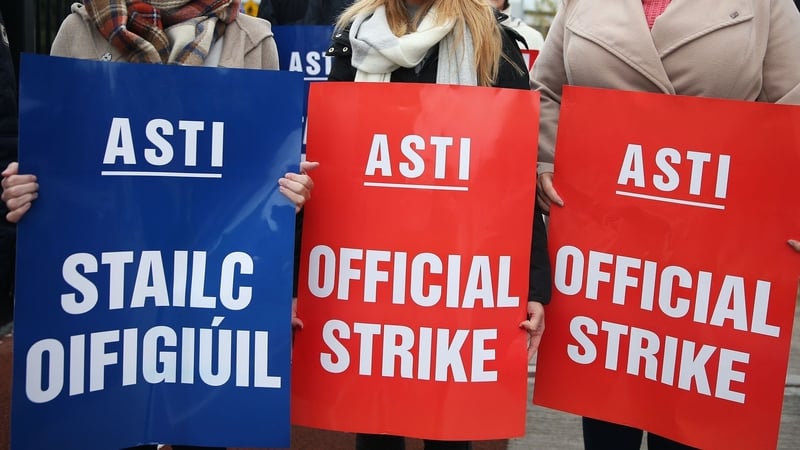
More than 300,000 workers including nurses, doctors, teachers and civil servants will engage in a 24-hour work stoppage and take to the picket lines.
It will lead to the closure of schools, the cancellation of hospital appointments and massive disruption to public services.
Unions are threatening another strike a week later on 21 October. So how did it come to this?
Last pay deal
In the early hours of the morning of 26 January 2024, following overnight talks, bleary-eyed trade union negotiators and Government officials emerged from the Workplace Relations Commission to announce that a new public sector pay deal had been agreed.
It provided for pay increases of 10.25% and over a two-and-a-half-year period.
It included a 1% local bargaining element that allowed individual groups of public servants to address specific issues within their sectors.
The total cost of the pay deal was €3.6 billion.
It was known then, on that cold January morning more than two years ago, that the deal would expire on 30 June 2026.
And yet, that deadline came and went.
Now, here we are in October 2026 facing a massive public sector strike because there have been no substantive talks on a successor agreement.

Unions demand different approach
Normally, negotiations on a public service agreement begin with weeks of talks on reforms, efficiencies and greater productivity.
This is important as the Government has to be seen to be getting something in return from public servants if their pay is being increased. It is, after all, taxpayers’ money.
The pay elements of the deal are typically only discussed at the end of the talks process.
Public sector unions said they wanted things to be done differently this time. They want meaningful commitments on pay to be discussed at the start of negotiations.
They also want a mechanism that would protect wages from inflation over the duration of a multi-annual deal.
The Government has branded these demands as “preconditions” and said it cannot enter talks that have a predetermined outcome.
€1.2 billion offer ‘an insult’
On Tuesday, the Government announced that funding of €1.2 billion has been allocated in the Budget for a public sector pay deal.
It said the money would be used to address all elements of both the last public service agreement, which expired at the end of June, and any successor pay deal in 2027.
“This includes the cost of any associated pension impacts,” according to the Department of Public Expenditure.
In his Budget speech, Minister for Public Expenditure Jack Chambers made reference to the current industrial action and said every effort should be made to avoid further disruption.
“I have made significant provision in today’s Budget package for public service pay,” Mr Chambers said.
“This demonstrates my seriousness, and indeed the seriousness of Government, in our desire to reach a new agreement that responds to the issues that have been raised.
“I would now call on ICTU and other associations to match this intent by re-engaging as a matter of urgency and standing down the ongoing industrial action,” he added.
However, public sector unions said the €1.2bn allocated is not enough to resolve the current dispute.
“The Government has demonstrated fiscal capacity elsewhere in the Budget but has apparently not allocated enough to resolve a pay dispute that is now escalating,” said the Public Services Committee of Irish Congress of Trade Unions.
On Thursday, Sinn Féin finance spokesperson Pearse Doherty said what was announced in the Budget was an “insult to workers” and had “locked in industrial action” because it will result in falling incomes.

Scale of disruption
Since the end of last month, workers across the public sector have been engaging in industrial action in the form of a work-to-rule.
It has disrupted early drop-offs and late pick-ups in many primary schools after INTO members withdrew out-of-hours supervision.
In secondary schools, ASTI members are refusing to take part in meetings outside of school hours and are no longer responding to phone calls and emails.
The other main teachers’ union, the TUI, will commence its work-to-rule on Monday.
If Wednesday’s strike goes ahead, primary and secondary schools across the country will be forced to close.
Public services will also be severely affected, with some of the biggest impacts being felt in healthcare.
The Health Service Executive (HSE) has warned that there will be significant and widespread disruption to many of its services.
The HSE said it is currently planning for the cancellation of all non-urgent healthcare services across hospitals and community settings.
This would include routine hospital procedures, outpatient appointments, community-based services, such as day services, clinics in primary care services and other scheduled care services.
“Emergency departments, ambulance services (curtailed service) and other critical, time-sensitive healthcare services, such as urgent cancer treatment and dialysis, will continue,” the HSE said.
“GPs, GP out-of-hours and pharmacists will remain available in the community,” it added.
Politicians have been warned that Dáil, Seanad and committee business could all be impacted if Oireachtas workers go on strike.
Members of the Opposition have said they will not be passing any pickets that may be placed outside Leinster House.
SIPTU said that the strike will be the most significant in more than a generation.
“Next Wednesday’s action will be larger than the public service strike in Northern Ireland in 2024 or in the Republic in 2009,” said SIPTU Deputy General Secretary, Adrian Kane.
“The mobilisation is more comparable to the hundreds of thousands of workers across the economy that engaged in work stoppages demanding tax justice in the late 1970s and early 1980s, or even the great conscription strike of 1918,” Mr Kane said.

Budget 2026 and fuel protests
Union demands for a different approach to these pay talks can be traced back to two significant events over the last year.
The first was Budget 2026 which did not contain income tax cuts.
Unions were angry, claiming that workers had been left behind by the decision to instead give VAT cuts to the hospitality sector.
The second event was April’s fuel protest movement.
Unions were enraged that unelected, unofficial groups were given a massive support package after blocking up roads and fuel depots.
Union leaders used terms like “the gloves are off” and “the rules of engagement have changed” when they saw that protests got the attention of politicians and generated a substantial result.
The Government would argue that workers also benefit from the fuel support measures due to lower petrol and diesel prices, but nonetheless it left the trade union movement in a very unhappy place.
They don’t have trucks and tractors to create blockades but they do have the power to shut down public services across the country and that is exactly what they are planning to do on Wednesday.
More: Nurses and midwives protest outside hospitals over pay deal
Industrial relations expert Kieran Mulvey, former head of the Workplace Relations Commission, said he was befuddled and surprised that the row has reached this point.
“Since early summer, I would have thought that the parties behind the scenes would have come to some understanding as to when the talk should start and what should be the basis of those talks because the parties know each other very well,” Mr Mulvey told RTÉ’s Six One News on Thursday.
He also pointed to union unhappiness with the response to the fuel protests.
“It had a reaction within the trade union movement in the sense that how could an unrepresentative national group at that stage get better access to Government for concessions that would have been normally within the remit of the social partners, be they on the enterprise or the union side,” Mr Mulvey said.
Is the strike inevitable?
There is a sense that the strike on 14 October is going ahead, no matter what happens over the coming days.
In a strange way, it is an outcome that would suit both sides.
The Government will blame unions for the pickets and disruption and will also be able to say that it didn’t back down.
Union members will get a chance to vent their anger and show their might and power in the wake of fuel protests that left them feeling devalued, weakened and unheard.
The sense of inevitability was expressed by Taoiseach Micheál Martin, who said on Wednesday on Newstalk that his feeling was that “people want industrial action now, irrespective of what happens”.

That sparked an angry reaction from the General Secretary of the Irish Nurses and Midwives’ Organisation Phil Ní Sheaghdha who said the union members who voted by massive margins for industrial action cannot be ignored.
“To say that public servants are just taking strike action for the fun of it is, I think, a little bit glib and I think that if we’re serious about trying to find a resolution, I would avoid that type of commentary because it’s absolutely inflammatory,” Ms Ní Sheaghdha told RTÉ’s Morning Ireland on Thursday.
The playbook on both sides may well be one of: allow the strike to happen, give unions their day in the headlines, clear the air, and then get down to serious talks.
But that strategy only works if there is meaningful engagement on Thursday morning, immediately after the strike.
Notice has already been served of another strike on 21 October and work-to-rules will continue across the public service.
There are big risks with a strategy of “let them have their strike”. Angry words and inflammatory comments from politicians or union leaders can quickly derail plans and damage relations.
And in the meantime, it is the public that will suffer. Be that the child with special needs that loses access to their SNA, or the sick patient that has their hospital appointment cancelled.
This row will get resolved eventually, all industrial disputes do.
But the longer it goes on, the more painful it will be for those who rely on our vital public services.