
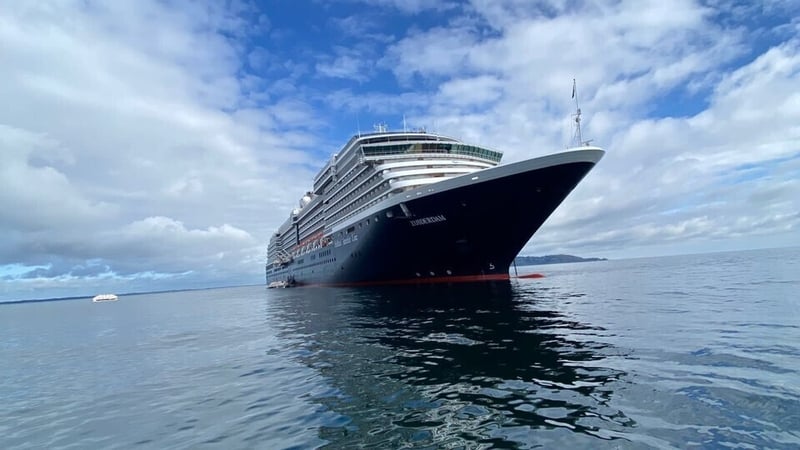
Last week Dublin Port welcomed Atlas Ocean Voyages’ World Voyager, which was wrapping up a ten-night cruise from Reykjavik. The ship’s arrival also happened to mark the end of Dublin’s 2026 cruise ship season.
Meanwhile the Port of Cork will welcome three cruise liners in the coming days – bringing its season to an end.
Cruises have become an increasingly important part of the Port of Cork’s business – with the regular arrival of ships, and their thousands of passengers, estimated to contribute more than €17m to the local economy.
But cruises have become an increasingly significant part of the global tourism industry as a whole.
According to Cruise Lines International Association, there were 37.2 million passengers on ocean-going cruise ships last year.
That’s a more-than 25% increase on the numbers that travelled pre-pandemic, in 2019.
And that’s being made possible in part by the growth of the industry’s fleet in recent years.
This year there were 327 cruise liners on the seas – 17 more than in 2025, and around 57 more than in 2019.
But even that doesn’t give you the full picture of the scale of the industry’s growth in recent years – because of course, cruise ships can be of all different sizes – and there have been some massive additions in recent years.
As a result a better measure may be the number of lower berths – essentially double bed rooms – in the industry’s fleet.
This year there were just over 690,000 lower berths up more than 6% in a single year. It’s also roughly 140,000 more double beds than the pre-covid number, representing a 28% increase.
And the CLIA expects the number of passengers to continue to grow in the coming years.
It’s forecasting more than 38 million ocean-going passengers this year, and more than 42 million by the end of the decade.
That’s despite some pretty bad press in recent months.
People will no doubt remember the pretty horrific details from the MV Hondius earlier this year, where three people died and a number of others were infected by hantavirus.
That obviously sparked discussion around hygiene and disease risk on a cruise ship. The fact that passengers were then stuck on board for the best part of a month – and then sent home to quarantine – is also sure to have created a little bit of unease among would-be cruise-goers.
And that story came hot on the heels of the Netflix ‘poop cruise’ documentary – which was about a 2013 case where the Carnival Triumph lost power after an engine fire, resulting in raw sewage making its way to the passenger decks.
Most passengers there weren’t able to disembark for around five days after that happened.
In fairness, though, those kinds of catastrophes are relatively rare for the industry – especially when put in the context of the scale it operates at each year.
And clearly those disasters have done very little to hinder the holiday-type’s appeal.
Tender Age
There is a certain stereotype about the kinds of people who opt to cruise.
According to the CLIA, globally, the average passenger last year was 46.7 years old. That’s a remarkably resilient number; in 2019 the average was 46.8 years old.
That is an average, though, so it doesn’t tell you everything. For example, a family of four who book on a cruise might have an average age of something like 29.
The data also shows a bit of variation globally. Western European cruisers tend to be older – the average age is closer to 50 – they also tend to book longer trips. Meanwhile, passengers from the Middle East and Central America tend to be younger – into the early 40s or even late 30s.
But really the demographic that has the biggest sway on these averages is the United States passenger, which accounted for 55% of all global cruise-goers last year.
The next biggest market is Germany, with 2.8 million passengers – so a huge gap between first and second. The Ireland and UK market is third place, with 2.5 million passengers.
More broadly speaking, though, the kind of person that books a cruise tends to be similar to the kind of person that likes a package holiday – because, ultimately, that’s what’s on offer here.
A cruise ship is essentially a holiday resort on the sea – albeit one that gives the illusion at least that you’re seeing a bit more of the world.
And nowadays, given the scale of the industry, there are cruises available to suit a variety of interest – from the sun-holiday types, to young families, to those interested in history, sight-seeing or nature.
Profit Seas

And given that scale, it’s no surprise that the industry is generating a huge amount of money each year.
As a whole cruise ship companies are estimated to have had direct revenues of more than $60 billion last year. By some estimates, the actual figure is possibly closer to $70 billion.
Most of that was split between three companies – Royal Caribbean, Carnival and Norwegian. Because, while there are lots of cruise brands, many are subsidiaries of those big three.
Royal Caribbean owns Celebrity Cruises, for example, and has a 50% stake in TUI Cruises. Carnival owns Costa Cruises (of Costa Concordia fame), Cunard and P&O Cruises. Meanwhile Norwegian owns Oceania and Regent.
There are some other cruise companies out there – for example Disney Cruises – but they’re considerably smaller than the three biggest players.
And you can see that in their revenues.
Carnival Corporation had $26.6 billion in revenues last year, Royal Caribbean’s revenues were close to $18 billion, while Norwegian’s was north of $9.8 billion.
But as significant as those figures are, the profits they’re making are even more incredible.
Carnival last year had a net profit of $4.5 billion, Royal Caribbean’s was $4.3 billion, while Norwegian’s was $423m.
To put that into context, Marriot International is the world’s biggest hotel group.
It had more than 1.7 million rooms globally last year, so more than twice the number of beds across the entire cruise industry.
It had revenues of $26.2 billion – roughly in line with Carnival, and more than Royal Caribbean.
However its net profit was $2.6 billion – well below what was enjoyed by the two biggest cruise line operators.
Flying the flag

The travel and hospitality industry is a notoriously tough industry, and one that’s not easy to make a sustained profit in.
So, if cruise ships are essentially floating hotels – how can they make so much more than their land-based equivalents?
There are two sides to that.
One is how they manage their costs, and the other is how they boost their revenue.
On the cost side – there is obviously a huge, ongoing investment required to keep ships in good working order – and full of the things that passengers want.
This year Royal Caribbean began to take passengers on its new ‘Legend of the Sea’ liner, which cost around $1.6 billion to build.
And, of course, these massive floating cities need a lot of staff.
Between the top three companies, you’re looking at more than a quarter of a million workers, spread across hundreds of ships.
But to help take the financial edge off those costs, cruise companies tend to fly what’s called a flag of convenience on their ships. That means they’re registered in a country that isn’t necessarily related to where the business itself is headquartered, or where it does most of its trade.
The Bahamas tends to be a popular flag of convenience for these ships – Bermuda and Panama are sometimes chosen too.
And that has two crucial implications.
One is that it impacts what tax the companies are obliged to pay on their profits. States like the Bahamas, Bermuda and Panama tend not to tax foreign income, which means cruise companies don’t have to pay corporation tax on the money their boats make.
The second “benefit” that the flag of convenience brings is far less onerous rules and regulations – particularly around labour laws, and related factors like minimum wages, and worker entitlements to breaks and days off.
Starting positions on some ships might be paying the equivalent of just $1-2 an hour – the kind of rates of pay that would be downright illegal in Europe, not to mention extremely unappealing. To a worker from a less well-off part of the world, though, it might not seem so bad.
But as well as low wages, those that take up cruise ship jobs can be expected to work extremely hard while on board – in ways that a hotel worker in Ireland or Spain or even New York would not face.
When applying for a job at one of the big three, for example, you might be asked if you are willing to work on a ship for 10 to 34 weeks at a time, working 10-12 hours a day, seven days a week.
Package deal

But cutting your costs only gets you so far – to take full advantage of that, you also need to bring in plenty of revenue. And cruise companies are masters at that.
Of course the ticket sales are a major source of revenue for these companies – it’s not cheap to go on a cruise of any kind.
And within that there’s upselling at play from the outset, as you’ll pay more for a window, more again for a balcony, and more again for a room that’s not a long walk from all the amenities.
But beyond the ticket price, there are so many add-ons involved in a cruise holiday.
And these are a huge part of the cruise liner business model.
One third of Carnival’s revenue last year came from ‘onboard and other’ – for Royal Caribbean it was just over 30%.
One of the first add-ons you’ll face when you book is the gratuity – which you’re encouraged to pay to show your appreciation for the staff being available to you around the clock.
It’s there as a default – you can pay it upfront, or it gets added to your bill when you’re on the ship. Some cruise companies do let you take it off – but it’s not straight-forward to do so.
And tipping staff directly is also expected – so there will be further gratuities owed on top of the up-front gratuity you’re charged.
The gratuity does go to staff – but it is a benefit to the companies nonetheless, because it makes it easier for them to get away with such low starting salaries for many employees.
Another add-on that definitely benefits the companies are the likes of the drinks packages – which passengers are encouraged to buy so they can have “unlimited” drinks while on board.
There’s no one price for these – what’s charged differs depending on whether you buy it in advance or on the ship, while some companies use dynamic pricing to adjust the charge based on timing and demand.
But on the likes of Royal Caribbean, you might be looking at anywhere between €50 and €110 per day for a deluxe drinks package.
(It is also worth noting that, if one adult in the room gets a package, the others have to, too. That’s the companies’ way of stopping a couple, say, getting one drinks package between them).
It means that a couple on a seven day cruise would spend somewhere in the region of €700 to €1,500 for drinks packages.
The most expensive drink on the menu tends to be cocktails – they’re around €13 each – which means each person would need to be drinking 4-5 of them a day (or 8-9 at the higher end of the price range), every day, to get their money’s worth.
If the customer is drinking wine or beer, they’d need to be having far more to “break even”.
For some people, that level of holiday consumption might not be a problem. For others, it may be a struggle.
And drinks are just one of the ways cruise companies will up-sell their passengers.
They might charge customers to access onboard WiFi – and, again, the cost will differ depending on when it’s booked at how it’s used.
Access for multiple devices – say for a family – could cost around €50 euro a day, which translates to hundreds of euro over the course of a trip.
Customers will have to pay extra – or buy a package – if they want something beyond the standard food that’s available as part of their ticket. They may pay a fee for getting something delivered to their room – that’s not covered in the hundreds of dollars they’ve paid for their gratuity.
They’ll pay if they want to access certain on-board activities. Of course the on-board games and casino are going to cost money, but so too are the likes of the treatments in the spa, or fitness classes, or even certain shows and performances.
And passengers will pay if they need to use the laundry service, and they’ll pay a lot if they need to visit the ship’s doctor.
And that’s all owing to the fact that, when on board, passengers represent a captive audience. If they want something, they have to go through the company to get it, and they have to take whatever price they’re offering.
There’s no other choices available – bar perhaps when they go on a shore excursion, which, of course, may also cost extra.